
Safeguarding Social Media: Differentially Private Online Learning for Video Recommendation
Differentially Private Online Learning for Cloud-Based Video Recommendation With Multimedia Big Data in Social Networks
This paper introduces a differentially private video recommendation system using cloud-assisted distributed online learning. By modeling service vendors as cooperative learners and employing adaptive context space partitioning, the system achieves sublinear regret while protecting both user metadata and vendor repositories via Laplace and Exponential mechanisms.
TL;DR
Providing personalized video recommendations in the big data era is a double-edged sword: better personalization requires deeper access to sensitive user context, yet this data is vulnerable to leakage. This paper presents a cloud-based, distributed online learning framework that uses Adaptive Context Partitioning and Geometric Differential Privacy to maintain high recommendation accuracy while mathematically guaranteeing the privacy of both users and service providers.
The Privacy-Utility Dilemma in Social Recommendation
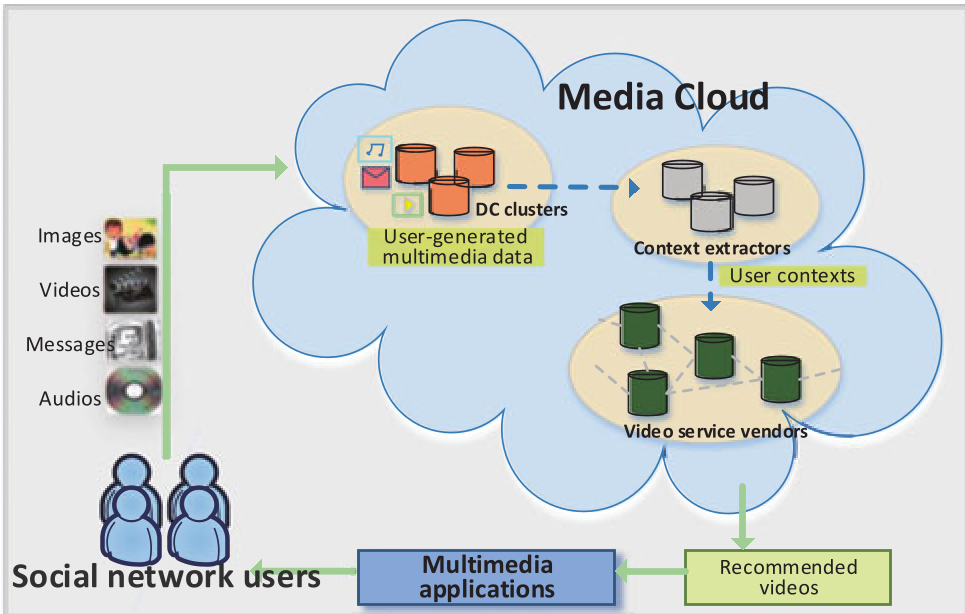
In Online Social Networks (OSNs), the explosion of multimedia data offers a treasure trove of contextual information—age, hobbies, and social status. Modern vendors use these features to drive recommendation engines. However, two critical vulnerabilities emerge:
- User Inference: Malicious actors can infer a user's income or health status simply by observing the sequence of videos recommended to them.
- Vendor Secrecy: In collaborative cloud environments, service vendors risk revealing their valuable video repositories and revenue patterns to competitors when sharing feedback data.
Traditional methods like anonymity or hardware-heavy cryptography either fail against re-identification attacks or incur massive computational overhead.
Methodology: Distributed Learning with Adaptive Geometry
The authors model video recommendation as a Distributed Contextual Bandit problem.
1. Adaptive Space Partitioning
Because multimedia data is high-dimensional and sparse, a uniform grid over the context space (e.g., user features) is inefficient. The system starts with a rough "crowd" partition and dynamically refines the context space into smaller d-dimensional hypercubes as more users arrive. This ensures that the system learns the most matchable videos for specific niches without wasting resources on "empty" feature spaces.
2. Dual-Privacy Mechanisms
- Exponential Mechanism (for Users): Instead of always picking the "best" video (which acts as a signature of the user's features), the system selects videos based on a probability distribution. This prevents any single feature from significantly altering the output.
- Laplace Mechanism & Tree-based Aggregation (for Vendors): To share rewards between cooperative nodes without leaking the performance of individual videos, the system adds Laplace noise. It uses a binary tree structure to aggregate rewards, ensuring that the total noise added over time remains logarithmic rather than linear.
3. The Geometric Insight (GP-DAP)
The "killer feature" of this paper is Geometric Differential Privacy. The authors recognize that "the larger the dataset, the less a given amount of blurring affects utility." In dense regions of the context space, the system can afford a higher privacy level (more noise), while in sparse regions, it adapts the noise level to prevent utility collapse. This density-aware approach creates a much tighter utility-privacy bound.
Performance & Results
The researchers validated their approach using 200,000 user vectors from Sina Microblog and items from Youku.
- Accuracy vs. Privacy: Even at high privacy levels (), the accuracy remains above 80%, while the non-private baseline (DAP) reaches ~91%.
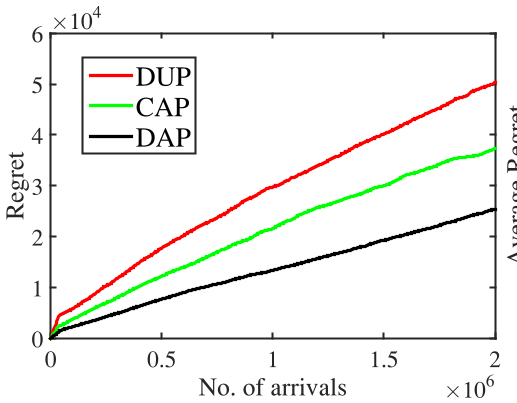
- Regret Convergence: The regret (the gap between the algorithm and an optimal "all-knowing" recommender) is sublinear, meaning the system successfully "learns" the best strategy over time.
- Geometric Advantage: The GP-DAP model outperformed the standard private DAP model, reducing performance loss (regret) by 32%.
Critical Analysis
The paper successfully bridges the gap between theoretical Differential Privacy (DP) and practical big-data engineering. The use of Lipschitz continuity to describe the similarity of expected rewards for similar contexts provides a robust mathematical foundation for their adaptive partitioning.
However, a limitation lies in the assumption of a fixed network of service vendors. In a real-world edge/cloud environment, nodes might join or leave dynamically, which would challenge the current tree-based reward aggregation. Future work could explore how this decentralization scales when vendor trust levels vary.
Conclusion
This work demonstrates that privacy doesn't have to be the "tax" that kills big data utility. By using Geometric Differential Privacy, we can build recommendation systems that are both highly personalized and mathematically secure, providing a blueprint for the next generation of trustworthy social media platforms.