
Differentiating Your Friends: A New Paradigm for Scaling Social Networks
Differentiating Your Friends for Scaling Online Social Networks
The paper introduces WEPAR, an online partitioning and replication algorithm for scaling Online Social Networks (OSNs). By leveraging a Dynamic Weighted Social Graph (DWSG) that differentiates friends based on interaction frequency, WEPAR achieves SOTA performance in reducing storage costs and write latency.
TL;DR
Online Social Networks (OSNs) are no longer just static graphs; they are high-frequency interaction engines. WEPAR (Weighted Partitioning and Replication) shifts the focus from "who you are friends with" to "who you actually talk to." By differentiating friends using a Pareto-inspired weighting system, WEPAR slashes storage overhead and speeds up write operations without sacrificing read performance in cluster deployments.
Background: The Pareto Trap of Social Data
Most distributed databases (like Cassandra or Dynamo) use consistent hashing to distribute user data. While simple, this is "socially blind"—data for close friends ends up on different cluster nodes, causing a "scatter-gather" penalty for every newsfeed load.
Existing social-aware solutions like SPAR tried to fix this by co-locating all one-hop neighbors. However, the authors of this paper discovered a critical insight: OSNs follow a Pareto distribution. For over 90% of users, the vast majority of interactions involve only ~22% of their friends. Treating every friend as "equal" leads to massive, unnecessary data replication.
Methodology: The Dynamic Weighted Social Graph (DWSG)
The core innovation is the Dynamic Weighted Social Graph. Unlike a standard adjacency matrix, it assigns weights based on:
- Activity Weight: Interaction counts (comments, posts) decayed over time to emphasize recent behavior.
- Social Relation Factor: A baseline weight for the existence of a link.
WEPAR: The Online Greedy Algorithm
WEPAR manages data placement through a greedy local optimization that triggers on edge creation or weight changes. It calculates a Partition Bidirectional Weight (PBW) to decide where a master copy belongs.
Specifically, it addresses the Read-Write Trade-off:
- Master Copies: Placed where write interactions are most frequent to keep updates local.
- Slave Copies: Generated selectively. If a cluster node frequently reads a user's data (exceeding a threshold ), a slave copy is created there.
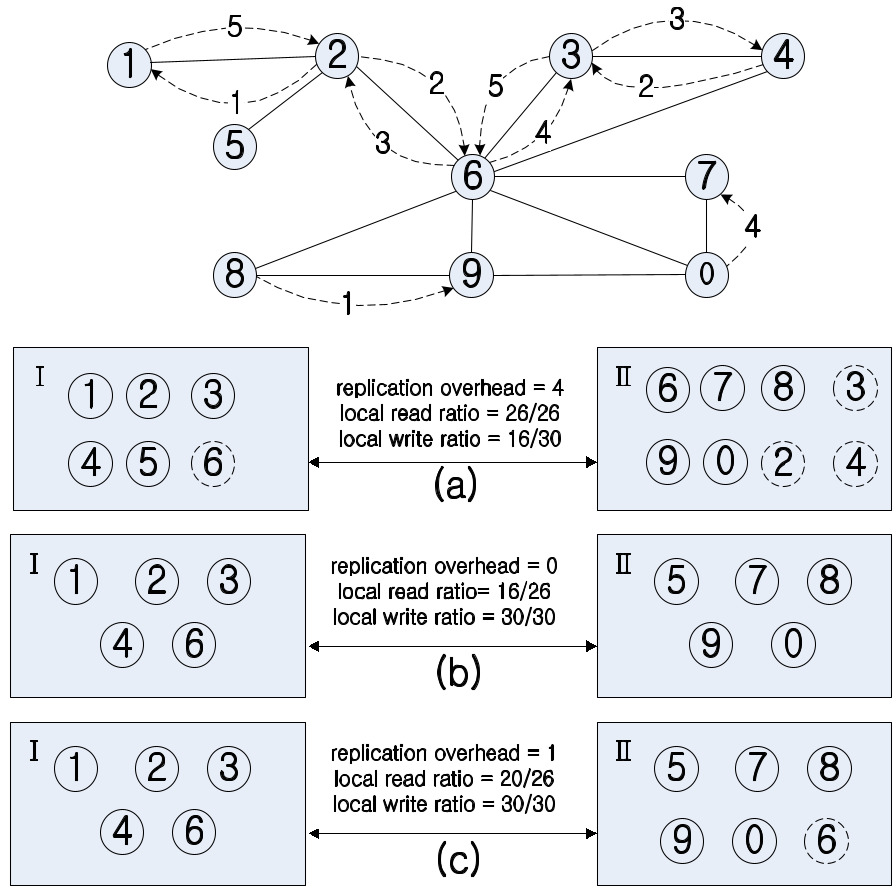 Figure 1: WEPAR vs. Traditional Partitioning. (b) shows interaction-based partitioning, while (c) shows the final hybrid of master/slave placement.
Experimental Validation
Using datasets from RenRen, Facebook, and Sina Weibo, the authors compared WEPAR against METIS and SPAR.
1. Storage Efficiency
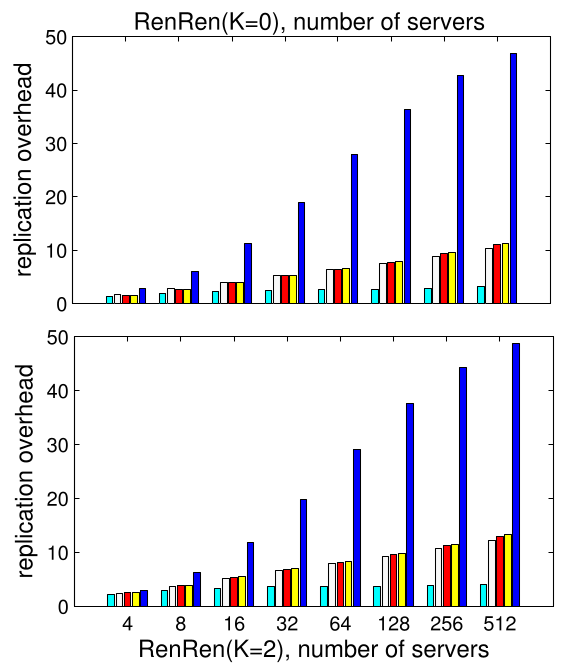
WEPAR (T=2) consistently showed the lowest replication overhead. Unlike SPAR, which replicates data for every neighbor, WEPAR only replicates when it is "worthwhile."
2. Write Performance
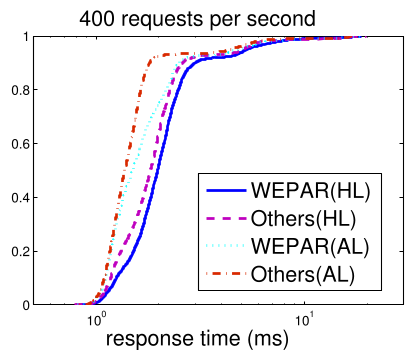
Because WEPAR clusters master copies of frequently interacting users, it achieves a local write ratio of ~79%. In contrast, SPAR (optimized for reads) performed significantly worse in write latency.
3. System Stability
A common fear with dynamic partitioning is "churn"—users moving between nodes constantly. WEPAR proves stable: only 4.52% of edge creations trigger data movement, thanks to the underlying strong community structure of social groups.
Critical Insight & Conclusion
WEPAR proves that "more replication" isn't always better. By introducing a threshold-based selective replication strategy (), the system identifies the "utility" of a data copy.
Takeaway for Engineers: If your system handles skewed interactive data, stop replicating for every relationship. Implement a weight-based gravity model to keep active "hot" paths local, and let the "cold" links suffer a minor remote-access penalty to save 50%+ on storage.
Limitations
While WEPAR excels at interaction-heavy workloads, its performance relies on accurately capturing interaction timestamps. In environments with highly latent "observer" behavior (users who browse but never interact), the weighting might need adjustment to incorporate "Read weights" more explicitly.