
Diffusing the Internet in the Arab World: Why Culture is More Than Just a Barrier
2474_Diffusing the Internet in the Arab world the role of social norms and technological culturation.
The paper explores the diffusion of the Internet in the Arab world, specifically Egypt, by introducing a "Cultural Influence Model." It utilizes Partial Least Squares (PLS) to analyze how Social Norms (SN) and Technological Culturation (TC) drive Internet acceptance at both individual and organizational levels.
TL;DR
In the early 2000s, as the Internet began to globalize, the Arab world faced a unique paradox: massive infrastructure investment but complex cultural resistance. This seminal study by Loch, Straub, and Kamel proves that Internet adoption isn't just about "building it"; it's about Social Norms (SN) and Technological Culturation (TC). By analyzing savvy Arab knowledge workers, the researchers demonstrate that exposure to technology through international travel and expert training significantly predicts usage, even when traditional cultural values remain skeptical.
Problem & Motivation: The Failure of "Force-Fitting"
Why do some regions "leapfrog" into the digital age while others stall? The authors argue that many IT transfer models assume technology is a "neutral agent." In reality, technology carries the values of the culture that created it.
In the Arab context, the conflict often lies between the individualistic nature of the Internet and the patriarchal, collectivist, and family-oriented nature of Arab society. The motivation for this study was to move away from "force-fitting" technology onto a culture and instead understand how cultural exposure (culturation) can bridge the gap.
Methodology: The Two-Model Approach
The researchers developed two distinct models to capture the nuances of Internet acceptance using Partial Least Squares (PLS), a robust statistical technique for smaller sample sizes.
- Model 1 (Individual Level): Linked Social Norms and Technological Culturation to an individual's actual Internet usage.
- Model 2 (Organizational Level): Focused on how Technological Culturation within the workforce drives organization-wide Internet take-up.
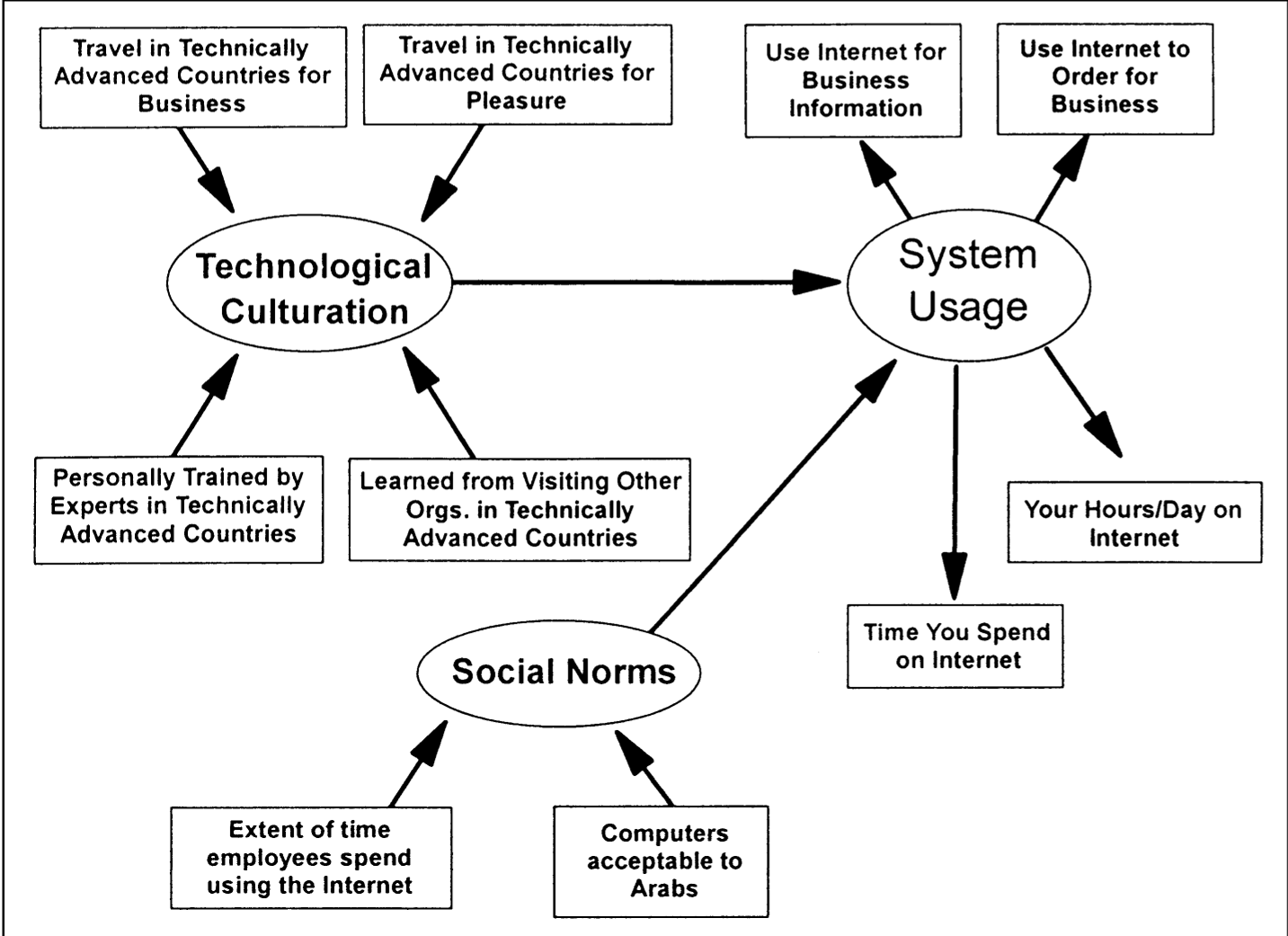 Figure: The Individual Model posits that Social Norms and Culturation are the primary drivers of usage.
Defining "Technological Culturation"
Unlike "acculturation" (which implies losing one's own culture), Technological Culturation refers to the degree of exposure an individual has to advanced tech from other cultures. The authors measured this through:
- Business and pleasure travel to non-Arab industrialized nations.
- Training received from international experts.
- Visits to foreign business environments.
Results: The Digital Paradox
The results provide a fascinating snapshot of a society in transition.
Quantitative Success
The individual model was highly robust, explaining 47% of the variance in usage. Interestingly, "Social Norms" (what peers and society think) were powerful predictors. If the collective group views the Internet as a threat to family ties, usage drops, regardless of technical skill.
Qualitative Hurdles
The qualitative side of the study identified specific "Discouraging Factors":
- Language Barrier: A critical lack of Arabic-language sites inhibited deep adoption beyond the elite.
- Cultural Conflict: 46% of respondents were concerned that the Internet threatened family and community life.
- The "Usage Gap": While 70% were comfortable with email, a staggering 91% disagreed that they used the Internet for business information gathering.
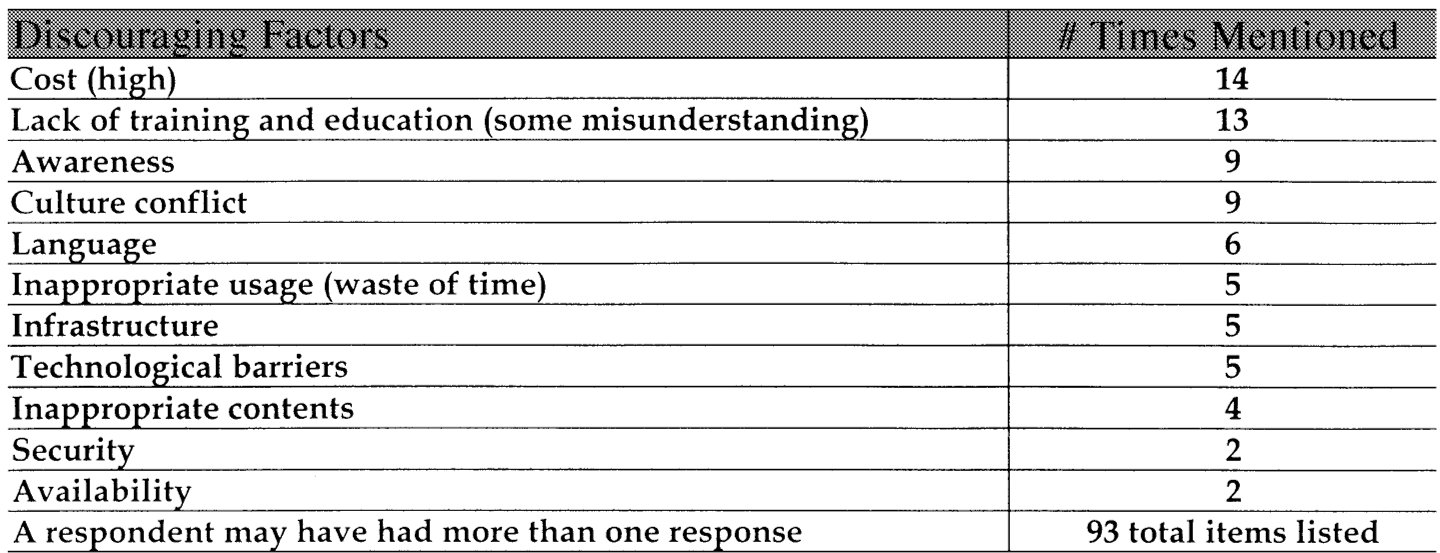 Table: Factors that discourage Internet adoption, with "Cultural Conflict" and "Language" ranking high.
Critical Analysis & Conclusion
The Takeaway
The study's most profound insight is that Technical Training is a form of Cultural Transference. When an Egyptian manager is trained by an expert who brings the "IT culture" with them, the manager doesn't just learn how to click—they learn to trust the tool.
Limitations
The study primarily focused on Egypt (85% of respondents) and "Internet-savvy" users. The authors correctly note that barriers are likely even higher for the general population. Furthermore, "Technological Culturation" is a difficult construct to measure as it is likely recursive: exposure leads to usage, which leads to more exposure.
Future Outlook
For modern engineering and product managers looking at the Middle East, the message is clear: Localization goes beyond translation. It requires a deep alignment with collectivist values and the endorsement of "high-level supporters" (patriarchal/collectivist leaders) to shift social norms. The "Internet" of 2026 might be AI-centric, but the cultural gates—Social Norms and Culturation—remain the same.