
Beyond the Graph: Leveraging Multimedia Hypergraphs for Influence Maximization
Diffusion Algorithms in Multimedia Social Networks: a preliminary model
This paper introduces a preliminary data model for Multimedia Social Networks (MSNs) using a hypergraph structure. It proposes the "τ-Diffusion Algorithm," which integrates multimedia similarity and user-to-object interactions to enhance Influence Maximization (IM) tasks beyond traditional text-only social network analysis.
Executive Summary
TL;DR: This paper argues that the "Social" in Social Networks is increasingly "Multimedia." The authors propose a hypergraph-based data model that treats images and videos as first-class citizens alongside users. By introducing a novel τ-Diffusion Algorithm, they demonstrate how interaction logs and content similarity can be combined to identify influential nodes more efficiently than traditional graph-based methods.
Positioning: This work serves as a foundational bridge between Multimedia Information Retrieval (MIR) and Social Network Analysis (SNA), moving away from simple directed graphs toward complex hyper-relational structures.
Problem & Motivation: The "Blindness" of Traditional OSNs
Most Influence Maximization (IM) research treats social networks as a collection of dots (users) and lines (friendships). However, in the modern landscape (Facebook, Instagram, TikTok), influence is often mediated through objects. You don't just follow a user; you react to their photo, which might be visually similar to a photo from another user you don't even follow.
The authors identify a critical gap: Prior work fails to model the intrinsic characteristics of multimedia content itself. By ignoring the content and only looking at the link, we miss the "hidden" diffusion paths created by visual or auditory similarity.
Methodology - The Hypergraph Core
The authors propose moving from a standard graph to a Hypergraph MSN.
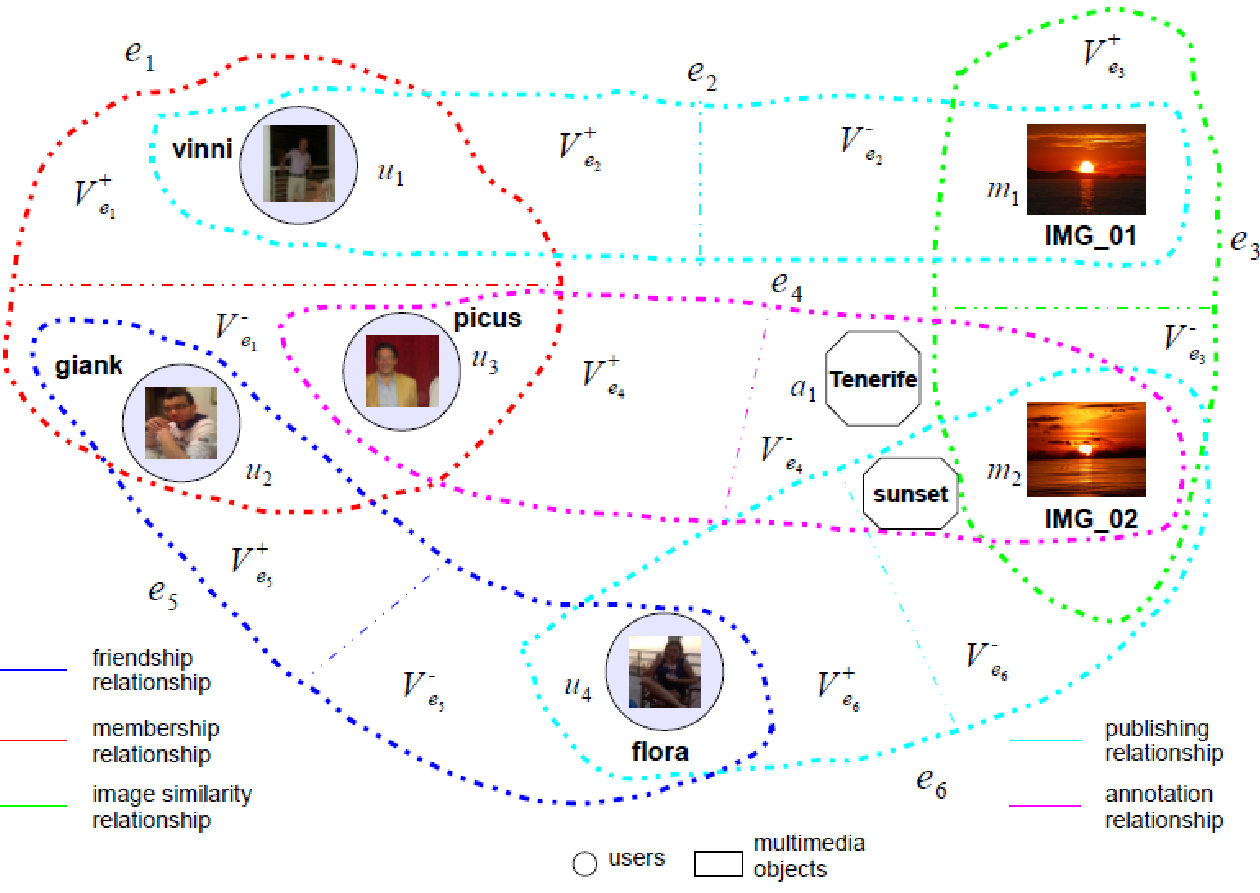
1. The Multi-Type Vertex Set
The network consists of two distinct types of nodes:
- Users (U): Individuals or organizations.
- Multimedia Objects (M): Images, videos, audio, or text.
2. Tri-Categorical Relationships
- User-to-User: Traditional links (Friendship, Following).
- Similarity: Content-based links between two objects (e.g., two photos of a "sunset").
- User-to-Multimedia: Actions such as tagging, liking, or commenting.
3. The Influence Operator
The core innovation is the Reaction Operator . It calculates the probability that user performs action because user performed action on the same or a similar object within a time window . This allows the model to capture "viral" behavior that jumps between similar content.
Experiments & Results
The paper introduces the τ-Diffusion Algorithm, which uses Matrix Factorization-style logic to map users to "Relevant Paths" (UP Matrix) and paths to "Multimedia Objects" (PM Matrix).
Key Tactical Advantage
Instead of running expensive Monte Carlo simulations across the entire user base, the algorithm identifies Relevant Multimedia Objects first. By filtering for objects that exceed a relevance threshold , the system "prunes" the social graph, focusing only on the most potent diffusion channels.
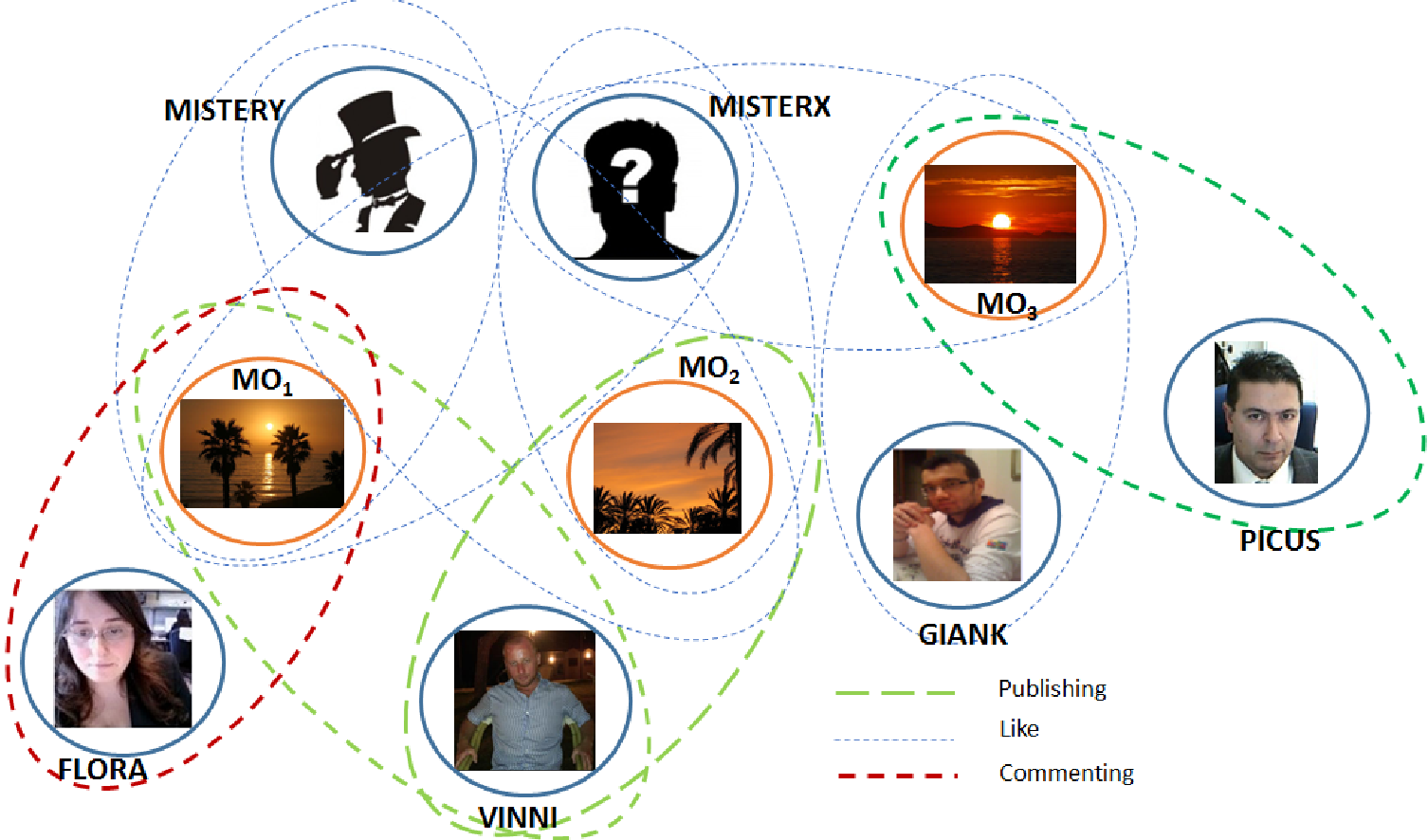
In their walkthrough, the authors show how the User-Multimedia Object Matrix (UM) identifies top influencers (like "Vinni") who exert high impact across multiple media objects, providing a much higher "score" for seed selection in viral marketing campaigns.
Critical Analysis & Conclusion
Takeaway
The integration of content similarity into influence modeling is a game-changer. It suggests that a user can "influence" someone they aren't directly connected to, simply because their content is contextually or visually related to what the other user consumes.
Limitations
As a "preliminary model," the paper lacks a large-scale empirical benchmark against SOTA algorithms like TIM or IMM on datasets with millions of nodes. The selection of the threshold (influence probability) is currently manual, which might require sensitive tuning in real-world applications.
Future Outlook
The authors are scaling this to a Spark-based cloud platform to ingest Twitter and Yelp data. The next frontier will likely involve using Deep Embeddings (like CLIP) to replace the manual similarity functions, allowing the hypergraph to understand semantic influence (e.g., the "vibe" of a post) automatically.