
Diffusion Archaeology: Peering into the Past of Network Infections
Diffusion Archaeology for Diffusion Progression History Reconstruction
This paper introduces a novel framework for "Diffusion Archaeology," the task of reconstructing the full progression history of a network diffusion (e.g., epidemics, memes) from partial snapshots. It proposes DHR-sub, a method based on non-monotone submodular maximization, and faster relaxations (DHR-pcdsvc and DHR-pcvc) that achieve State-of-the-Art performance in identifying initial spreaders and missing temporal states.
TL;DR
How do you reconstruct the journey of a virus—biological or digital—when you only have a few snapshots of the present? This paper introduces Diffusion Archaeology, using submodular optimization and novel vertex cover relaxations to "rewind" the clock on SEIRS-type diffusions. It moves beyond just finding "Patient Zero" to reconstructing every single step of the diffusion history with provable performance guarantees.
The "Blind Spot" in Diffusion Modeling
Most research in network diffusion focuses on forward prediction: given a source, where will the infection go? However, real-world scenarios are often the opposite. We detect a water contaminant or a Twitter meme after it has already spread.
Existing tools like NetSleuth or Rumor Centrality have a major "blind spot":
- Identity-only focus: They try to find the source but ignore the path.
- Model Rigidness: They often only work for the simplest SI (Susceptible-Infected) models.
- No Guarantees: Many rely on heuristics without mathematical bounds on how far they are from the optimal solution.
Methodology: The Math of "Rewinding"
The authors treat the diffusion history as a Maximum Likelihood Estimation (MLE) problem. The breakthrough lies in recognizing the nature of the probability function.
1. DHR-sub (The Submodular Powerhouse)
The paper proves that the log-likelihood of a diffusion snapshot given a previous state is non-monotone submodular. This is a profound insight because it allows the use of greedy algorithms that are guaranteed to stay within a specific bound of the optimal "truth."
- DHR-sub-early: Reconstructs history before the first observation.
- DHR-sub-between: Fills in the gaps between two known snapshots using matroid base constraints.
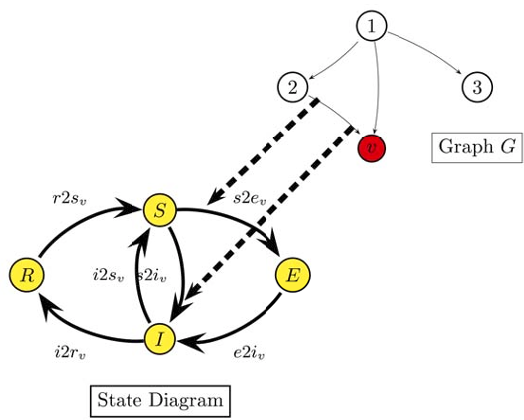 The SEIRS model used as the foundation for the reconstruction framework.
2. DHR-pcdsvc (The Scalable Relaxation)
Submodular maximization can be slow on massive graphs. To counter this, the authors used a first-order Taylor expansion to relax the problem into a new combinatorial challenge: Prize-Collecting Dominating-Set Vertex Cover (PCDSVC). This allows the system to process tens of thousands of nodes in minutes rather than hours.
Experimental Proof: Memes and Water
The researchers tested their "archaeology" tools on several diverse datasets:
- Meme Tracking: Reconstructing the spread of "Fukushima" and "Arab Spring" phrases across blog networks.
- Water Safety: Identifying contamination sources in Pipe-demand networks (Water-sm/Water-big).
Key Results
- Initial Spreader ID: DHR-sub-ens achieved scores of ~0.89 (out of 1.0) in SEIR models, significantly outperforming Rumor and NetSleuth.
- Temporal Dynamics: Remarkably, with only 3 snapshots, the model could accurately reconstruct the speed and acceleration of information flow. It correctly identified that "Unemployment" memes spread uniformly, while "Fukushima" news was "bursty" and centered around media spikes.
 Table II: Comparison showing our methods (DHR) consistently outperforming existing baselines across SI, SIR, and SEIR models.
Critical Insight & Future Outlook
The most impressive takeaway is the robustness to noise. In real-world data, the "time" an infection happens is rarely recorded perfectly. The DHR framework maintained a Kendall Tau-b score of >0.7 even when the temporal data was 50% "noisy."
Limitations: While the relaxations are fast, the "ground truth" submodular approach still struggles with million-node graphs. The next frontier in diffusion archaeology likely lies in integrating these submodular guarantees with the latent-space representation power of Graph Neural Networks.
Conclusion
This work shifts the paradigm from "detecting the source" to "reconstructing the story." Whether it's tracing a computer virus or a public health crisis, Diffusion Archaeology provides the mathematical rig to recover the lost footprints of a network spread.