
Diffusion-Based Collaboration: Accelerating Rationality in Social Networks
Diffusion based collaborative decision making in noncooperative social network games
This paper introduces a Diffusion-Based Regret-Matching procedure for noncooperative repeated games in social networks. By allowing players in friendship cliques with identical interests to fuse their "regrets" via a diffusion protocol, the method achieves faster convergence to the set of Correlated Equilibria (CE) compared to standard individual regret-matching.
TL;DR
How can independent agents in a social network reach a state of mutual coordination faster? This paper proposes a Diffusion-Based Regret-Matching algorithm. By sharing "regrets" (the measure of "what if I had played differently?") among friends with identical interests, the entire network converges to a Correlated Equilibrium significantly faster than traditional individualistic approaches.
Problem & Motivation: The Loneliness of the Individual Learner
In game theory, "Regret-Matching" is a classic decentralized algorithm. Each player looks at their history, calculates how much better they would have done with a different action, and adjusts their future strategy accordingly. While effective, it has a major drawback: it is slow.
In many real-world social networks, we aren't just isolated agents. We belong to cliques—groups of friends, sensors in the same area, or departments in a firm—that share identical interests. The authors argue that it is suboptimal for these agents to ignore each other’s experiences. If we share the same payoff function, your regret is my regret.
Methodology: Fusing Experiences via Diffusion
The core innovation lies in the Diffusion Law adapted from signal processing (LMS algorithms). The process follows a four-step loop:
- Action Selection: Players choose actions based on a randomized policy derived from their current regret.
- Regret Update: After seeing the outcome, players calculate their local regret.
- Regret Fusion (The "Secret Sauce"): Players use a linear combiner to fuse their own regret matrix with those of their social group neighbors.
- Recursion: The fused regret becomes the basis for the next round's policy.
 (Equation 2: The definition of the Correlated Equilibrium polytope the system targets)
The mathematical beauty here is the use of a constant step-size (). While traditional algorithms often use decreasing step-sizes to ensure convergence, a constant step-size allows the system to remain "agile," responding in real-time to changes in the game's environment or rules.
The Global Result: Emerging Equilibrium
The authors provide a rigorous proof using Stochastic Averaging Theory. They show that even though players are only collaborating locally with friends, the "global behavior" (the long-term frequency of action profiles) is guaranteed to enter the set of Correlated Equilibria.
Essentially, by sharing local regrets, the network "diffuses" information across the entire graph, leading to a manifestation of globally rational behavior from locally non-fully-rational agents.
Experiments: Faster, Smoother Convergence
The researchers tested the algorithm against standard individual regret-matching. The results were clear:
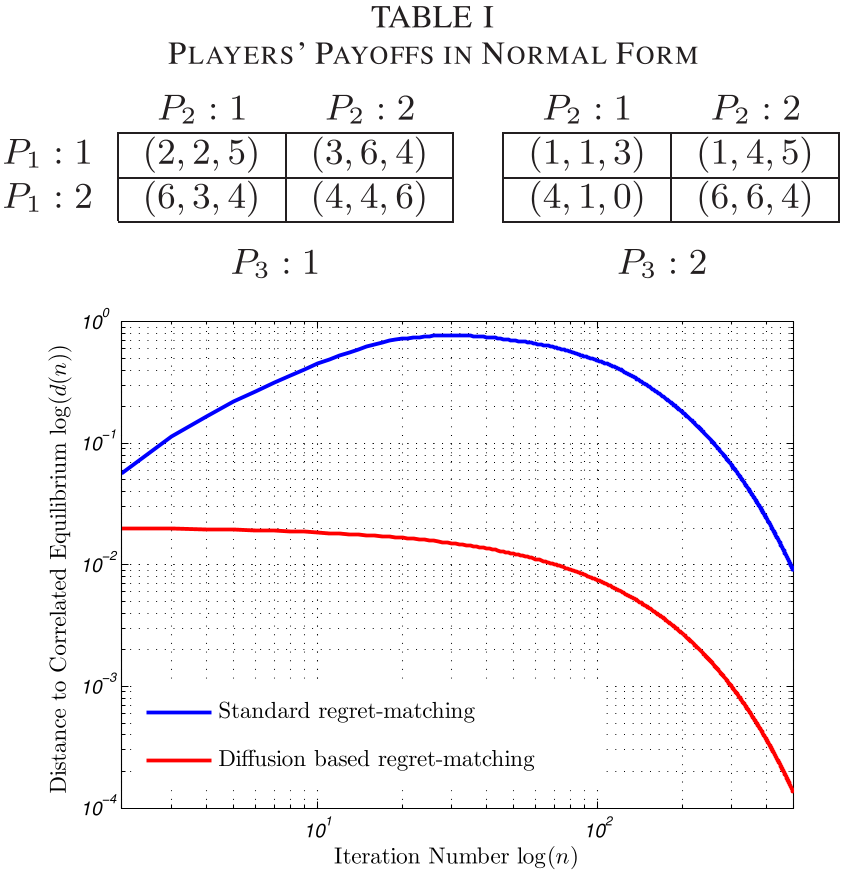
As seen in the plot above, the Distance to Correlated Equilibrium drops much faster for the diffusion-based approach. The collaboration leads to a monotonic decrease in distance right from the start, whereas individual learning (the benchmark) shows much higher variance and slower progress.
Critical Analysis & Conclusion
Takeaway: This work represents a bridge between signal processing (diffusion filters) and game theory. It proves that communication within "cliques" of interest is a powerful catalyst for system-wide coordination.
Limitations:
- Perfect Monitoring: The paper assumes everyone sees everyone else's actions. In massive networks, this is rarely true.
- Identical Interests: It assumes group members have identical payoff functions. In reality, interests are often "correlated" but not "identical."
Future Outlook: This methodology is a precursor to modern "Networked AI." It suggests that in multi-agent systems (like autonomous fleets or smart grids), we shouldn't just share "data"; we should share "regret"—the meta-knowledge of our lost opportunities—to achieve collective intelligence.