
Diffusion Centrality: Why Topology Alone Is Not Enough to Find Influencers
Diffusion centrality: A paradigm to maximize spread in social networks
This paper introduces Diffusion Centrality (DC), a novel vertex importance measure that incorporates semantic properties and specific diffusion models (e.g., cascade, tipping) into social network analysis. Unlike topology-only metrics, DC identifies influential nodes based on how a specific property p spreads, using Generalized Annotated Programs (GAPs) for flexible modeling.
Executive Summary
TL;DR: In social networks, "importance" depends on what is being spread. A top-ranked user on Twitter for politics might be irrelevant for movie recommendations. This paper introduces Diffusion Centrality (DC), a framework that moves beyond graph topology to include the semantics of vertices and the logic of how information flows. By leveraging Generalized Annotated Programs (GAPs), the authors provide a scalable way to find the true "epicenter" of any diffusion process.
Positioning: This work is a pivotal shift from structural graph theory to semantic-aware diffusion modeling, providing the first unified algorithm to compute centrality across disparate models like HIV spread, viral marketing, and collective behavior tipping points.
The Problem: The Topology Trap
For decades, we have relied on metrics like PageRank or Betweenness to find "important" nodes. However, these measures are property-agnostic.
Consider a person with very few connections (low Degree) who is the sole carrier of a rare disease. In the eyes of PageRank, they are invisible. In the eyes of a disease diffusion model, they are the most critical node in the system. The authors argue that current SOTA fails because it ignores:
- The Property: What is spreading?
- The Model: How does it spread? (e.g., Is it a probabilistic cough or a cost-benefit decision?)
- The Semantics: What are the attributes of the nodes and edges (labels, weights)?
Methodology: Logic-Based Diffusion
The core innovation lies in using Generalized Annotated Programs (GAPs). GAPs allow the researchers to write rules like: “If a vertex has property p with confidence X, and it has a sexual relationship with a neighbor with weight Y, the neighbor catches p with confidence 0.9 × X × Y.”
From Logic to Hypergraphs (HyperDC)
To solve these complex logical dependencies, the authors transform the diffusion rules into a Diffusion Hypergraph.
- HyperDC: An exact algorithm that computes the "Least Fixed Point" (the stable state of spread) by traversing hyperedges. It employs "Network Filtering" to prune vertices that cannot possibly participate in the diffusion, significantly speeding up computation without losing accuracy.
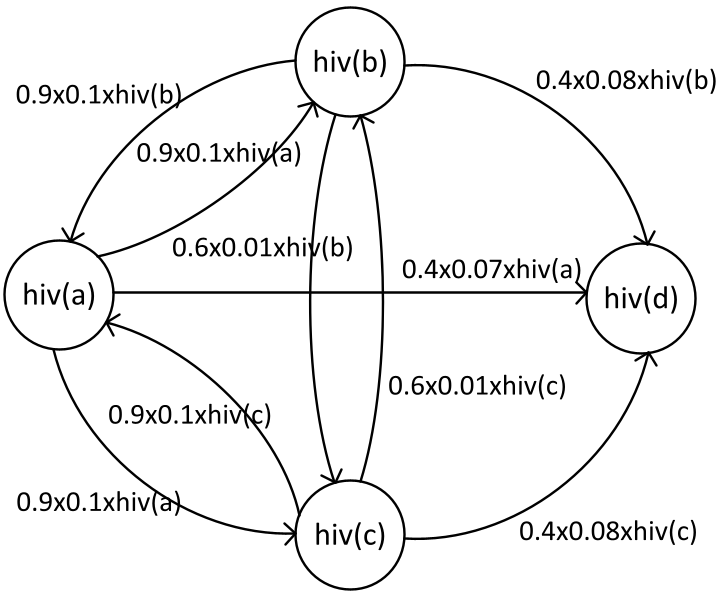 The HyperDC approach maps ground rules to hyperedges to track how confidence values propagate through the network.
Scaling to Millions: CBAF
For massive networks (millions of nodes), exact computation is too slow. The authors propose CBAF (Coarsened Back and Forth):
- Coarsen: Merge "similar" nodes into "super-nodes" based on their diffusion roles.
- Calculate: Run DC on the tiny, coarsened graph.
- Refine: Map the top candidates back to the original graph and re-check their neighborhood.
Experiments: Real-World Evidence
The authors didn't just test on synthetic data; they used MemeTracker data (172M articles) to see if DC could predict which websites initiate viral memes.
Performance & Spread
- Efficiency: HyperDC is 100x faster than previous diffusion-based models and far outstrips Betweenness Centrality on large graphs.
- Quality: In the STEAM gaming dataset and Enron email networks, DC achieved higher spread than classical measures in almost every scenario.
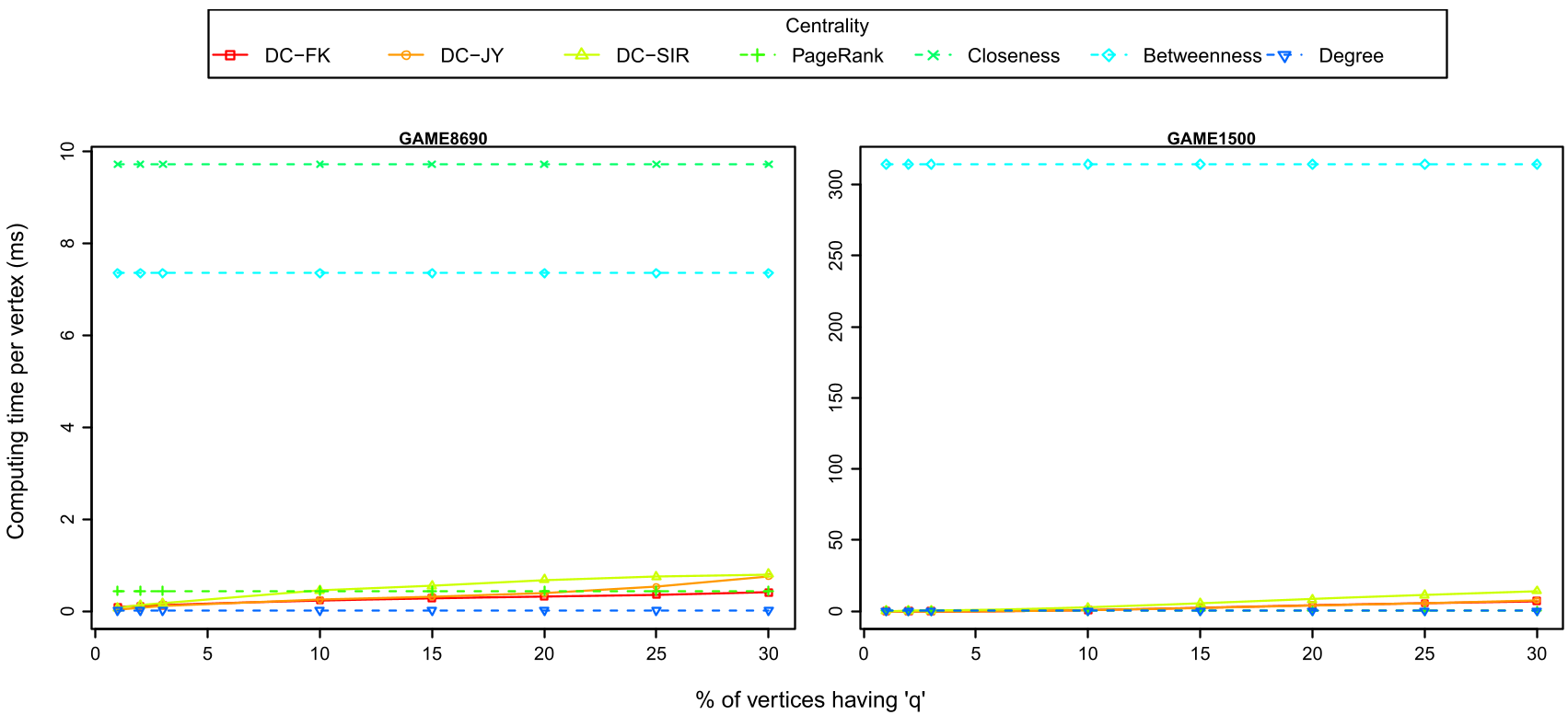 Comparison showing HyperDC maintaining linear-like runtime scaling compared to the exponential or high-polynomial growth of traditional closeness/betweenness metrics.
Critical Insight & Conclusion
Takeaway: The "center" of a network is not a fixed point; it is a ghost that moves depending on the topic of conversation.
Limitations: The accuracy of DC is tightly coupled with the accuracy of the underlying diffusion model. If the logic governing the spread is poorly understood or learned incorrectly from data, DC will prioritize the wrong nodes.
Future Work: This framework opens the door for Hybrid Knowledge Bases where political, demographic, and behavioral factors are fused into a single influencer-finding engine—essential for modern applications from election forecasting to epidemic control.