
Beyond Topology: Why Diffusion Centrality is the New North Star for Social Influence
Diffusion Centrality in Social Networks
The paper introduces Diffusion Centrality (DC), a novel centrality measure for social networks that integrates structural topology with semantic vertex properties and explicit diffusion models. Unlike classical structural-only metrics, DC quantifies a vertex's importance based on its capacity to spread a specific property (e.g., a virus or a political opinion) across the network.
TL;DR
Researchers have long used Degree or Betweenness to find the "center" of a network, but these metrics are blind to what is actually spreading. This paper proposes Diffusion Centrality (DC)—a semantic-aware framework that combines network structure with specific diffusion models. Experiments on YouTube data show that DC is far superior at finding the true influencers that drive information spread, outperforming classical algorithms while remaining computationally feasible for large graphs.
The "HIV Toy Example": Why Structural Centrality Fails
Imagine a small sexual contact network. One person has HIV, but they only have one partner. Traditional metrics like Degree Centrality would rank this person as the least important because they have fewer connections. However, from an epidemiological standpoint, they are the most critical node because they are the source of the spread.
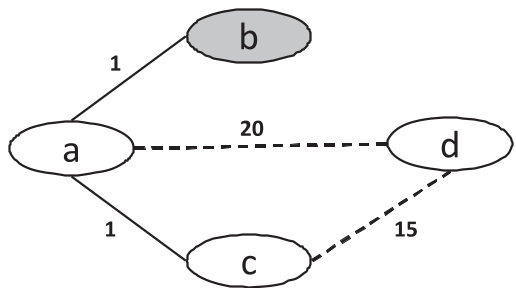
The authors argue that centrality must be tied to a diffusive property. A user might be highly central for "Jazz music" but completely irrelevant for "Investment banking." Existing measures fail here because they treat all edges and nodes as semantically identical.
Methodology: The Logic of Spread
The core of this work is the marriage of graph theory and formal logic.
- Diffusion Rules: The authors use probabilistic rules to define spread. For example: "If X is a friend of Y and Y has HIV, X gets HIV with 90% probability."
- Hypergraph Mapping: To solve this, the network and the rules are transformed into a Weighted Directed Hypergraph.
- The Fixed-Point Approach: The algorithm computes a "Least Fixed Point" (LFP) to determine the expected spread if a specific node is "activated." The Difference between the spread with and without that node being active defines its Diffusion Centrality.
(Note: This represents the mapping from ground diffusion rules to hyperedges for efficient computation.)
Pruning for Performance: The HyperDC Algorithm
Calculating centrality for every node in a 100,000-node graph is usually a nightmare ( or worse). The authors introduced HyperDC, which uses:
- Monotonicity: Since spread only increases, they can stop calculating once a node’s potential falls below a certain threshold.
- HyperLFP: An optimized algorithm that visits hyperedges only when their source nodes' values change, drastically reducing redundant calculations.
Experimental Battleground: YouTube Data
The authors tested DC against the "Big Five": Degree, Closeness, Betweenness, Eigenvector, and Stress centrality.
1. Superior Quality
When picking the top 50 "seed" nodes to spread a property, Diffusion Centrality achieved the highest overall spread across all graph sizes (20K to 100K nodes). Classical measures often picked "busy" nodes that were actually poorly positioned relative to the initial distribution of the property.
2. Efficiency Gains
While simple metrics like Degree are faster, DC proved significantly faster than Betweenness and Closeness on large datasets. While Closeness centrality failed to complete on an 80K node graph within 12 days, DC finished in a reasonable timeframe.
| SN Nodes | Degree (ms) | Diffusion (ms) | Betweenness (ms) |
|---|---|---|---|
| 40K | 0.07 | 17.77 | 231.57 |
| 100K | 0.31 | 53.08 | 781.60 |
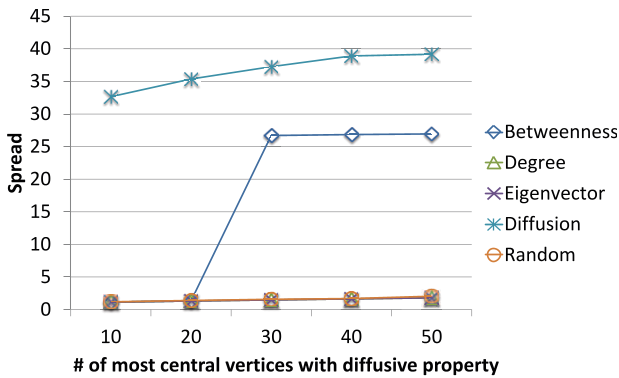 Experimental results showing DC providing the highest spread ratio compared to baselines.
Critical Insight: The Context-Aware Future
The most profound takeaway is that Centrality is not a constant. In the modern era of "Semantic Social Networks" (like Twitter or LinkedIn), a person's value is purely contextual.
Limitatons: The current model assumes we have a "learned" diffusion model. In reality, learning these probabilities () accurately is just as hard as the centrality calculation itself. However, by decoupling the model from the measure, this paper provides a robust mathematical playground for future AI-driven social engineering and epidemic control.
Conclusion
Diffusion Centrality moves us past the era of "counting links" and into the era of "predicting impact." For researchers in viral marketing, public health, or misinformation containment, this semantic framework is an essential tool for identifying the nodes that truly matter.