
Diffusion in Complex Social Networks: More Than Just Connectivity
Diffusion in complex social networks
This paper investigates the mechanisms of behavior spreading in complex social networks using a mean-field approach. It defines a general analytical framework to identify diffusion thresholds across various network topologies and rule-based behaviors, proving that persistence depends on the interplay between connectivity distribution and the contagion rule.
TL;DR
Why do some trends die out while others become permanent fixtures of our culture? This paper by Dunia López-Pintado provides a mathematical rigorous framework to predict the persistence of behaviors in social networks. By moving beyond simple epidemic models, it reveals that the "vulnerability" of a network depends as much on the logic of the individual (how one decides to adopt) as it does on the structure of the group (who talks to whom).
The Core Intuition: Beyond the "Virus" Metaphor
Traditional epidemiology models treat information or behavior like a biological virus: if you meet an infected person, you have a fixed chance of catching the "bug." But human behavior is more complex. We might adopt a behavior because we see a specific number of people doing it (absolute effect) or because a certain percentage of our friend group has joined in (relative effect).
The author's primary insight is that connectivity variance—how many "hubs" or influencers exist in a network—can either help or hinder spreading depending on which of these two logics individuals follow.
Methodology: The Mean-Field Lens
To solve the complex math of thousands of agents interacting, the paper adopts a Mean-Field Theory approach. This simplifies the stochastic mess into a deterministic flow, assuming that in each period, agents are effectively paired with a random sample of the population based on their connectivity.
The model identifies two critical values:
- Diffusion Threshold (): The rate needed for a behavior to survive if it starts from a tiny "seed."
- Critical Threshold (): The rate needed for a behavior to persist once it is already established.
The Model Architecture
The state transition is governed by the diffusion function , which describes the rate at which a susceptible agent with neighbors and active neighbors adopts the new behavior.
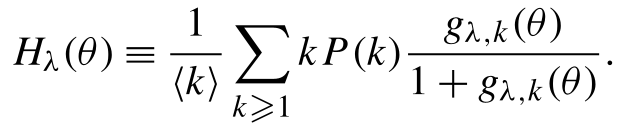 The stationary state equation , where the balance between susceptibility and activity determines the long-term density of the behavior.
Key Finding 1: The Scale-Free Paradox
It is a classic result in network science that "scale-free" networks (like the Internet or large social circles) have no epidemic threshold—meaning even a very weak virus will spread.
However, López-Pintado shows this is only true under absolute rules. If individuals care about the proportion of their friends adopting (the "imitation mechanism"), the advantage of having huge hubs disappears. Why? Because while a hub has many connections, it is much harder to convince 50% of 1,000 friends than 50% of 10. This "neighborhood effect" cancels out the structural power of the influencer.
Key Finding 2: Hysteresis and the "Abrupt Jump"
In "concave" diffusion (where the first few adopters have the biggest impact), the behavior spreads smoothly as the rate increases. But in "non-concave" or convex diffusion (where you need a "critical mass" before you care), we see Hysteresis.
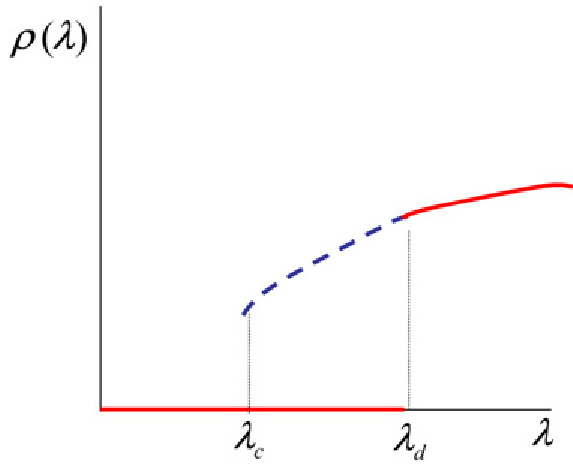 Figure 4: The dashed vs. solid lines show that the "long-run" state depends on whether the behavior started with a small seed or a large group. This explains why some social movements require a massive initial push to become self-sustaining.
Experimental Insight: The Role of Variance
The paper uses Mean Preserving Spreads (MPS) to compare different networks. It finds that:
- Absolute Number Rules: Higher variance (more inequality in connections) lowers the threshold, making spreading easier.
- Fractional Rules (): Connectivity distribution doesn't matter; the threshold is constant.
- Intermediate Neighborhood Effects: Counter-intuitively, broader connectivity distributions can sometimes increase the threshold, making the network more resistant to change.
Conclusion and Takeaways
This work serves as a warning to viral marketers and sociologists: You cannot predict a trend by looking at the network graph alone. You must understand the "adoption function" of the nodes.
- For Innovation: If your product requires "social proof" (relative fraction), target tight-knit small communities, not just "hubs."
- For Policy: To stop a "bad" contagion (like misinformation), knowing if agents use threshold-based logic determines whether you should target the influencers or the small, isolated clusters.
The paper bridges the gap between statistical physics and social choice, providing a foundational tool for anyone studying the "topology of influence."