
The Clustering Paradox: Why Dense Networks Might Kill Innovation Diffusion
Diffusion of innovations in social networks
This paper investigates the diffusion of innovations using the Linear Threshold Model (LTM) on deterministic social networks. It proposes a novel characterization of the final adopter set based on "cohesive sets" and derives an upper bound for the expected number of adopters, fundamentally challenging the prevailing assumption that high clustering always aids the spread of complex contagions.
TL;DR
In the world of social influence, the common wisdom is that "clusters are king" for complex behaviors. This paper by Acemoglu et al. provides a rigorous mathematical counter-argument: Highly clustered social groups act as fortresses that resist external innovation. Unless you have an "insider" (seed node), the innovation will likely stall at the boundary of these dense communities.
Executive Summary
This research positions itself as a critical theoretical correction to the literature on Linear Threshold Models (LTM). While previous SOTA insights suggested that clustering is necessary to provide the "overlapping influence" needed for complex contagions, this work proves that high clustering actually increases the stability of non-adopter sets. By utilizing the concept of cohesive sets, the authors provide a deterministic characterization of why some innovations fail to scale.
Problem & Motivation: The Stability of the Status Quo
Why do some ideas spread like wildfire while others stay trapped in small pockets?
Previous models focused on the "reinforcement" aspect of clustering—if your friends adopt, you are likely to adopt. However, the authors identify a critical structural bottleneck: the same density that encourages adoption within a group also creates a barrier against outside influence. In mathematical terms, if a group is "cohesive" enough, no amount of external pressure can trigger the threshold required for adoption.
Methodology: Cohesive Sets and Partitions
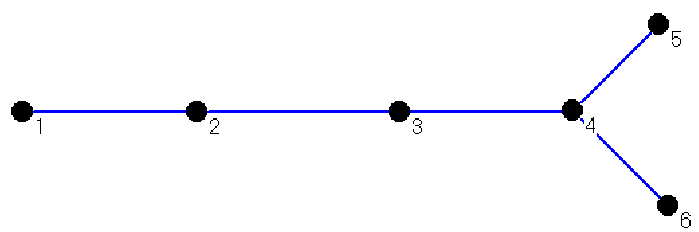
The core of the paper lies in Definition 1, which defines a set as Cohesive if every member has a fraction of neighbors within the set greater than , where is their adoption threshold.
The Structural Insight
The authors prove that the diffusion process stops exactly when it hits the "largest cohesive subset" of the remaining non-adopters. This leads to the Cohesive Partition theory:
- If a network can be partitioned into many small, highly cohesive sets (like a highly clustered network), the expected number of adopters is lower because the "seed" nodes are likely to be trapped within one of these many small partitions.
- Conversely, a network with more "long links" and less clustering has fewer, larger partitions, allowing the innovation to flow more freely.
Path Dependence: The Stochastic Extension
The authors also introduce a Stochastic LTM. Instead of deterministic adoption, users enter a "consideration" phase, and adoption is a Bernoulli trial with probability . This captures path dependence: a few early "rejections" can fundamentally change the global outcome.
Experiments & Results
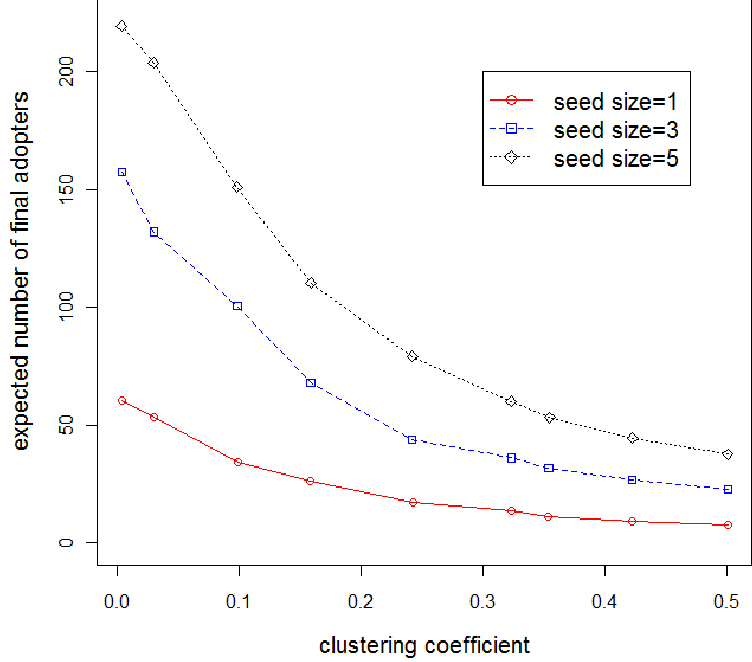
The paper utilizes small-world network simulations to validate its claims. Two major factors were tested: Threshold Value Distribution and Clustering Coefficients.
Key Findings:
- Clustering vs. Adopters: As shown in Fig. 5, as the rewiring probability increases (decreasing clustering), the number of final adopters increases. This holds true across different seed sizes.
- Upper Bound: The analytical upper bound derived in Lemma 3 was shown to be inversely proportional to the number of cohesive sets in a partition. More clusters = More "resistance" points.
Critical Analysis & Conclusion
Takeaway
The genius of this work is in shifting the focus from "how clusters help" to "how clusters hinder." In a highly clustered society, the "cost of entry" into a new community is high. For marketers and policymakers, this means that a broad-seeding strategy (targeting many different clusters) is much more effective than a deep-seeding strategy (targeting many people in one cluster) if the goal is global diffusion.
Limitations
A notable limitation is that the model assumes fixed thresholds and a relatively static network. In real-world scenarios, the "clustering" itself might be dynamic—people form new links because of the innovation, a factor not fully captured here.
Future Work
The proposed Stochastic LTM opens a new frontier for analyzing the "fragility" of social movements. Exploring how "minor shocks" (individual rejections) trigger large-scale cascades of failure is a vital next step for understanding social stability.