
Beyond Basic Citations: Decoding Influence in Academic Social Networks
Study of Diffusion Models in an Academic Social Network
The paper introduces a specialized framework for Academic Social Networks (ASN) to identify the most influential researchers and papers using generalized diffusion models. By applying the Linear Threshold (LT) and Independent Cascade (IC) models to real-world data from DBLP and CiteSeer, the authors demonstrate how academic-specific metrics like cross-citations and cross-co-authorship significantly outperform traditional structural metrics in predicting influence spread.
TL;DR
This research moves beyond simple citation counting to model how scientific influence actually travels. By redefining "social capital" through cross-citations and multi-level co-authorship, the authors leverage the Linear Threshold (LT) and Independent Cascade (IC) models to identify the true "trendsetters" in academia. Their results prove that how you are connected to the network's secondary layers matters more than just your immediate bibliography.
Background: The Problem with Static Metrics
In the academic world, we often rank researchers by their h-index or total citations. However, these are "human capital" metrics that ignore the dynamic flow of influence. An influential researcher isn't just someone with many papers; they are someone whose ideas trigger a domino effect across the community. Previous models (like viral marketing algorithms) missed the unique nuances of academic life: collaboration locations, indirect citations, and shared research areas.
Methodology: The ASN Framework
The authors constructed an Academic Social Network (ASN) by formulating it as a Friendship-Event Network. They focused on two distinct entities: Authors and Articles.
1. The Weights of Influence
Instead of binary edges, the authors assigned weights based on:
- Cross-Reference: If Paper A cites Paper B, and Paper B is cited by Paper C, Paper A receives a fractional weight from Paper C.
- Cross Co-Authorship: If your co-author publishes a new paper in the same field with someone else, your "social capital" increases by a decaying factor ().
2. The Diffusion Engines
The paper tests two heavyweights of network theory:
- Linear Threshold Model (LT): A node becomes "influenced" only when the cumulative weight of its active neighbors exceeds a random internal threshold ().
- Independent Cascade Model (IC): Each active node has a one-shot probability to activate its neighbors independently.
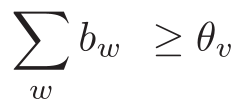 The influence condition in the LT model: activation depends on the weighted sum of neighbor influence.
Experiments and Key Findings
Using the Java Social Network Simulator (JSNS) and data from DBLP and CiteSeer, the authors ran 500 simulations to track how influence "cascades" through 600 nodes.
The Power of Cross-References
One of the most striking results (visualized in the paper's Fig. 4) is that Cross-Reference weight selection allows for much more efficient information spread than standard publication counts. Even with a small initial set of "seed" authors (), the influence reaches a saturation point much faster.
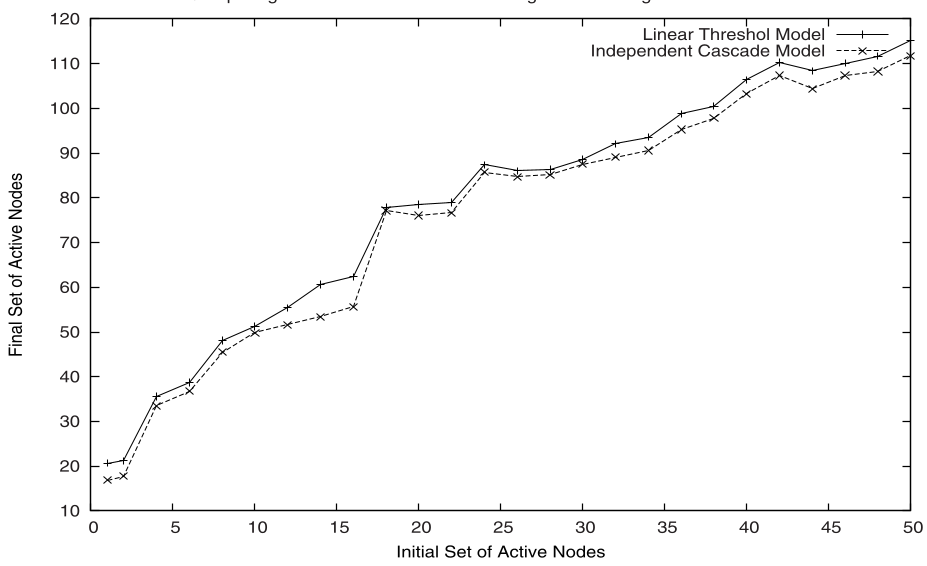 Figure 4 showing the rapid spread of influence using cross-reference criteria.
LT vs. IC: A Subtle Difference
Across almost all criteria, the Linear Threshold Model showed a slight edge in predicting spread. This suggests that academic influence is accumulative—a researcher is more likely to adopt a new methodology or citation if several of their collaborators have already done so, rather than being influenced by a single isolated "cascade" event.
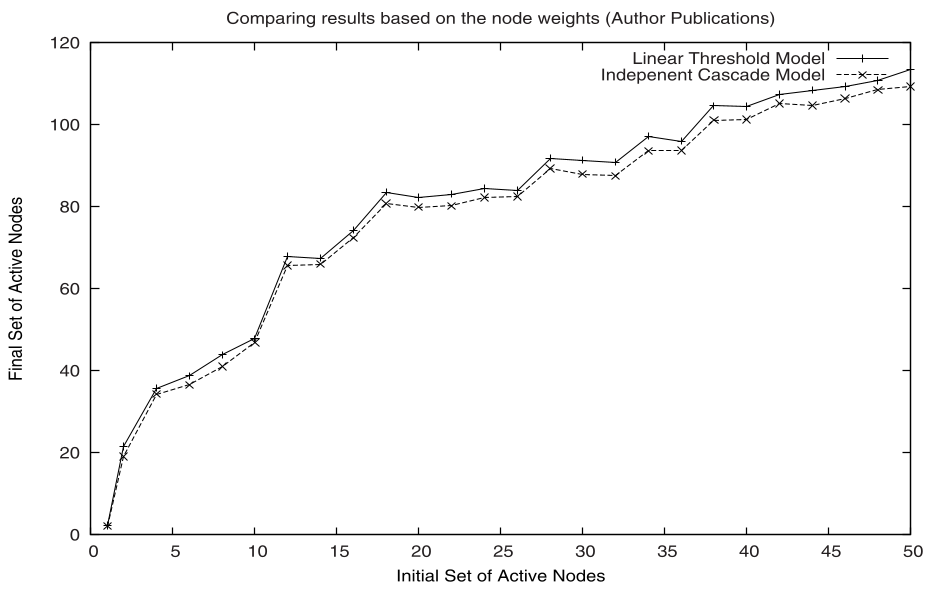 Performance comparison showing the LT model maintaining a lead in node activation.
Critical Insights
- Inductive Bias of the ASN: The paper correctly identifies that academic influence isn't just a "gossip" protocol; it's a structural credit-assignment problem.
- Sensitivity to Thresholds: The experiment in Figure 6 highlights that as the "difficulty" of influence (threshold) increases, only those selected via "Edge Weight" criteria maintain any meaningful spread. This suggests that the strength of the relationship is the only thing that overcomes academic skepticism/inertia.
- Limitations: The study uses a relatively small dataset (600 nodes). In the era of LLMs and millions of daily papers, scaling these -hard problems will require more sophisticated heuristic approximations or graph neural networks (GNNs).
Conclusion
This work provides a robust blueprint for building "Expert Finders" and conflict-of-interest detectors. By treating academia as a dynamic, weighted graph where social capital flows through indirect connections, we can move beyond the vanity metrics of the past and toward a true understanding of scientific impact.