
IMD: Stochastic Exploration on Implicit Manifolds without Geometric Primitives
Diffusion Processes on Implicit Manifolds
This paper introduces Implicit Manifold-valued Diffusions (IMDs), a data-driven framework for constructing and simulating stochastic differential equations (SDEs) on unknown manifolds using only point cloud samples. By approximating the infinitesimal generator and using the carré-du-champ (CDC) operator, the method enables intrinsic Brownian motion and Langevin dynamics that stay confined to the underlying data manifold without requiring explicit charts or projections.
TL;DR
Implicit Manifold-valued Diffusions (IMDs) allow us to simulate "Brownian motion" and guided Langevin dynamics on a manifold using nothing but a raw point cloud. By utilizing the Carré-du-champ (CDC) operator as a bridge between graph Laplacians and ambient space SDEs, IMDs achieve smooth, on-manifold exploration for tasks like image interpolation and Langevin sampling, outperforming standard score-based methods that often "jump" across data folds.
Background: The Manifold Hypothesis
In machine learning, we frequently assume high-dimensional data (like images or neural signals) lives on a lower-dimensional manifold. While we have tools to optimize on known manifolds (hyperspheres, Tori), real-world data manifolds are implicit. We don't have the "road map" (charts) or the "snap-to-grid" function (retractions).
Prior work in score-based diffusion models tries to move toward the data distribution, but it doesn't strictly respect the tangential geometry of the manifold during the process. IMDs change this by looking at the infinitesimal generator of the diffusion itself.
The Core Intuition: Why Carré-du-champ?
The mathematical soul of this paper is the Carré-du-champ (CDC) operator. If the Laplace-Beltrami operator describes how heat (or probability) spreads along the manifold, its CDC describes the "local energy" of that spread.
Critically, when applied to ambient coordinate functions , the CDC matrix acts as an orthogonal projector onto the tangent space of the manifold. This allows the authors to "lift" an intrinsic process on the manifold into an extrinsic process in R^n without ever explicitly calculating a tangent plane.
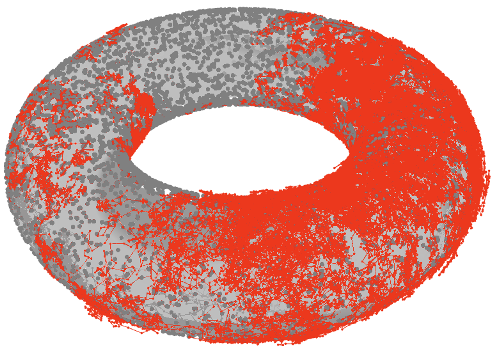 Figure 1: Brownian motion (red path) initialized on a torus point cloud (gray) using IMDs. No prior knowledge of the torus geometry was used.
Methodology: From Graphs to Path-Space Convergence
The authors follow a three-step workflow to implement IMDs:
- Graph Construction: Build a proximity graph from the point cloud .
- Operator Approximation: Compute the Random Walk Graph Laplacian (), which converges to the infinitesimal generator as sample size .
- Euler-Maruyama Simulation: Use a modified discretization to update the position: ensures the noise is purely tangential, preventing the particle from immediately flying off the manifold into high-dimensional vacuum.
The "Snap-to-Manifold" Trick (DRGD)
While the theory holds as step size , numerical errors at finite steps cause "drift." The authors introduce Denoising Riemannian Gradient Descent (DRGD). By using a pre-trained score model , they provide a small "nudge" back to the manifold at each step, ensuring long-term geometric stability.
Experiments: Coherent Image Exploration
The most striking result is found in MNIST latent exploration. When navigating from the digit '1' to the digit '7' under a potential field:
- Standard Langevin + Retraction: The digit becomes a messy blur of 1s and 7s, jumping discontinuously between classes.
- IMD Langevin: The digit physically deforms, first losing its base, then tilting, and finally growing a crossbar—a "locally coherent" transformation that follows the actual learned geometry of handwritten digits.
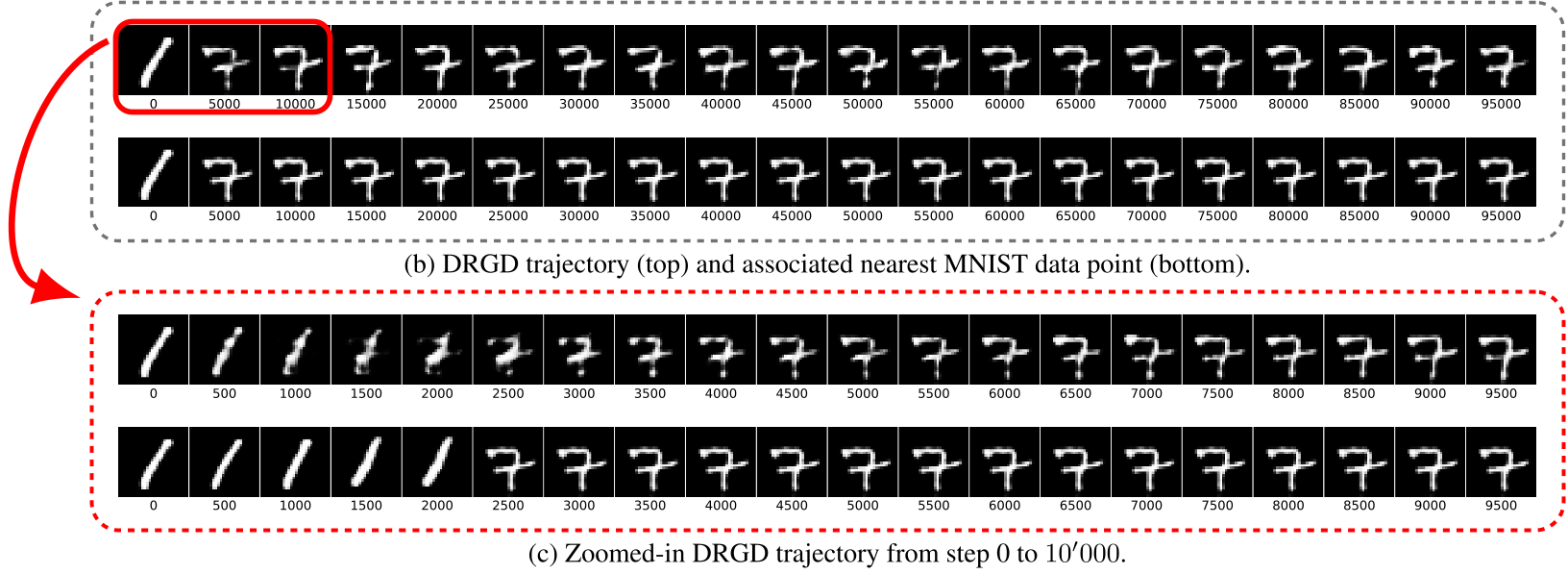 Figure 5: Interpolation comparison. Top row (a) shows IMD following the manifold geometry smoothly. Bottom rows (b, c) show standard retractions failing to maintain class coherence.
Critical Analysis & Future Outlook
The paper identifies an "Implicit Curse of Dimensionality" in Conjecture 1: normal errors accumulate as the intrinsic dimension grows, scaling as . This suggests that for very high-dimensional manifolds (e.g., Video, Protein folding), IMDs will require either increasingly dense point clouds or more sophisticated "neural surrogates" for the Laplacian.
Takeaway: This work transitions manifold learning from static representation (Diffusion Maps) to dynamic exploration. It opens the door for Manifold-Aware Generative Modeling, where models don't just generate samples but can navigate the data space with the same physical intuition we use to navigate R^3.
Final Summary
IMDs offer a mathematically rigorous way to perform stochastic calculus on "unseen" geometries. By marrying graph theory with the Carré-du-champ operator, they provide a blueprint for a more stable and semantically meaningful generation of high-dimensional data.