
Beyond Convergence: How Network Topology Shapes the "Most Likely" Truth in Social Diffusion
Diffusion in Social Networks as SIS Epidemics: Beyond Full Mixing and Complete Graphs
The paper introduces the "Scaled SIS Process," a continuous-time Markov model that characterizes social diffusion (opinions, innovations) on finite, static networks. By proving the process is reversible, the authors derive a closed-form equilibrium distribution that explicitly incorporates the graph's adjacency matrix, achieving a microscopic characterization of asymptotic network states.
TL;DR
Researchers June Zhang and José Moura have bridged the gap between epidemiology and graph theory by introducing the Scaled SIS Process. Moving beyond simple "average-case" simulations, they provide a mathematical proof for the equilibrium distribution of opinions on any given network. Their work reveals that in certain social contexts—specifically when individuals tend to resist the "majority view" of their neighbors—the most probable social configuration is equivalent to solving the Maximum Independent Set problem.
Background: Why "Full Mixing" Fails
Most classical epidemic models assume "Full Mixing"—the idea that you are equally likely to catch a cold (or an idea) from a stranger as from your best friend. In reality, social influence is constrained by a "who-knows-whom" graph. While simulations can show what happens on these graphs, they rarely explain why or what the ultimate stable state looks like at a microscopic level.
The authors' insight was to move from macroscopic moments (like "what percentage of people are infected") to a microscopic characterization: what is the exact probability of this specific configuration of spreaders and adopters?
Methodology: The Power of Reversibility
The core innovation is the Scaled SIS Process. In this model, the rate at which an adopter becomes a spreader is scaled by a parameter raised to the power of their infected neighbors :
This specific choice is mathematically elegant because it makes the resulting Markov Process reversible. In the world of stochastic processes, reversibility is a "cheat code" that allows us to find the equilibrium distribution using the Detailed Balance Equation:
The Two Pillars of Influence
The formula shows that the probability of any network state depends on two simple statistics:
- Node Count (): The total number of spreaders.
- Edge Count (): The number of "infected edges" (connections between two spreaders).
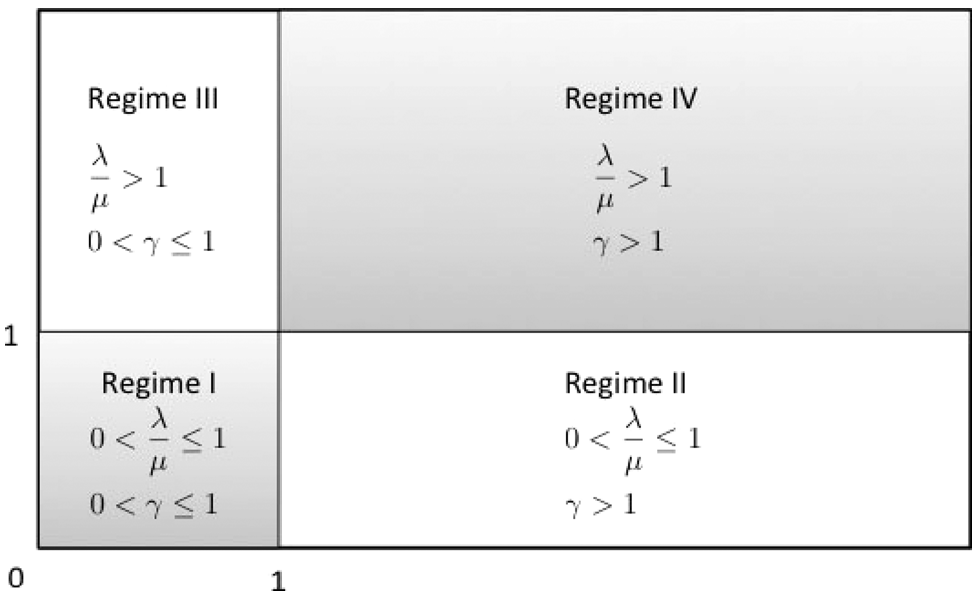 Figure 1: The four regimes of social diffusion defined by the ratio of infection to healing () and the peer influence factor ().
The "Opposition" Effect and Graph Theory
The most striking discovery occurs in Regime III (Exogenous Infection Dominant). Here, individuals have an innate tendency to adopt an idea (), but they are repelled by neighbors who have already adopted it (). This is "diffusion with opposition."
In this regime, the math leads to a fascinating result: to find the most probable state, the system seeks to maximize spreaders while minimizing connections between them. If is small enough, the "most likely" state is exactly the Maximum Independent Set (MIS) of the graph—the largest possible group of people where no two members are connected.
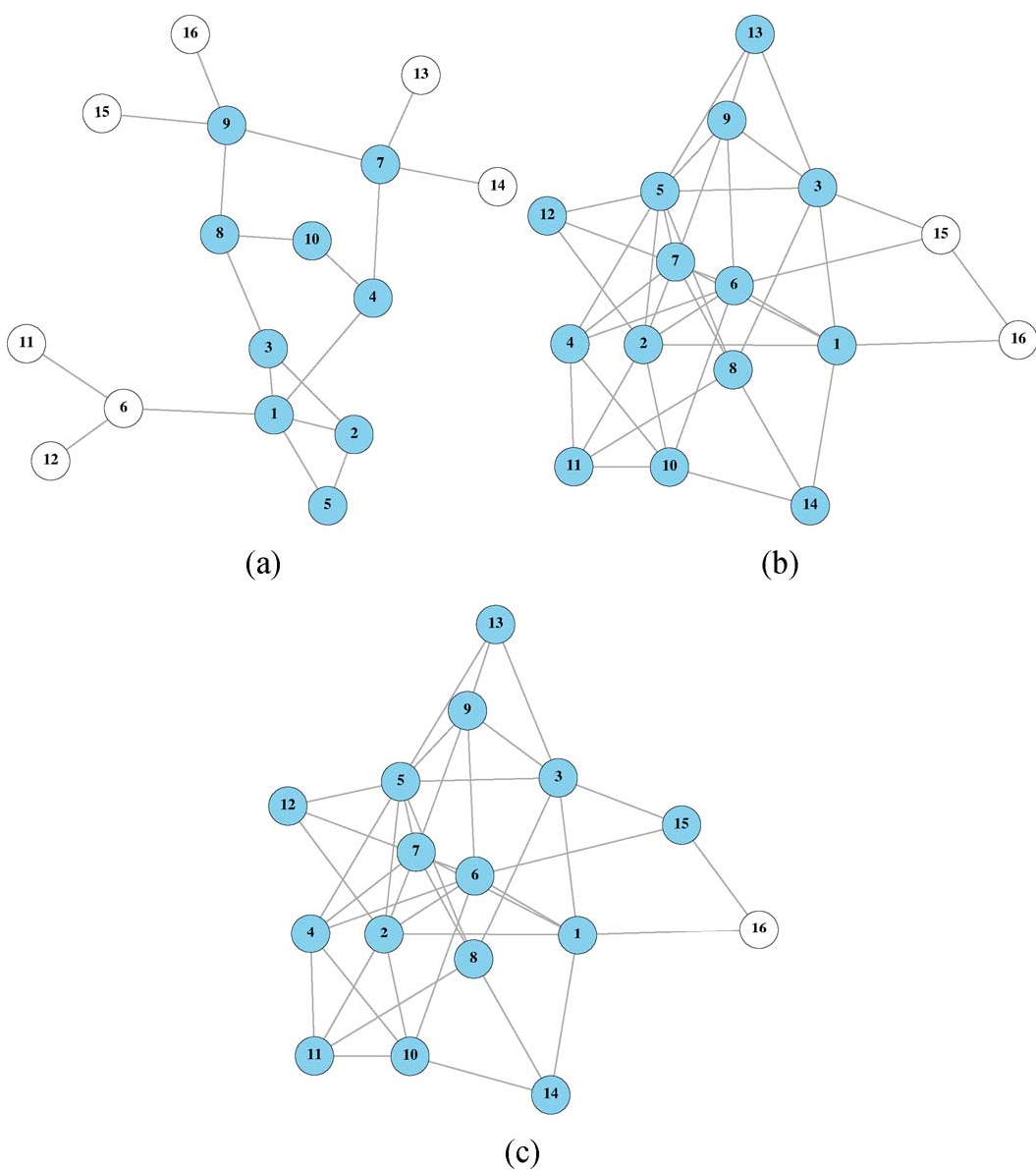 Figure 2: Visualizing the most probable configurations on irregular graphs. Unlike regular graphs which flip between "all" or "nothing," complex topologies exhibit "spurious" stable states.
Experiments: Phase Transitions
The authors analyzed varied topologies, from -regular graphs to Erdős-Rényi and Watts-Strogatz models. They found:
- Structured Graphs: In -regular or complete multipartite graphs, the network exhibits "Threshold Behavior." As parameters cross a critical value , the most probable state flips instantly from "nobody knows" to "everybody knows."
- Unstructured Graphs: In real-world-like graphs, "Spurious" states emerge. There are transition zones where the most likely outcome is neither total adoption nor total rejection, but a specific, mathematically determined subset of the population (as shown in Figure 2).
Critical Insight: The "Special" Agents
The paper's conclusion shifts our focus toward the "specialness" of nodes. In Regime III, the nodes that belong to the Maximum Independent Set are the "load-bearers" of the diffusion process. Even if they have an innate preference to share an idea, their position in the network—surrounded by others they might oppose—dictates the final equilibrium.
Conclusion
This study proves that social diffusion is not just a random walk; it is a structural optimization problem. By linking SIS epidemics to the Maximum Independent Set problem, Zhang and Moura have provided a new toolkit for sociologists and data scientists to predict not just if an idea will spread, but where it will take root in a defiant population.
Author's Perspective: This work is a masterclass in applying "Physical Intuition" (reversibility/energy states) to social dynamics. It reminds us that sometimes, the hardest problems in Computer Science (NP-hard MIS) are exactly what Nature—or Society—is trying to solve in equilibrium.