How Transparent is DiffusionGemma? Peering into the "Black Box" of Text Diffusion
How Transparent is DiffusionGemma?
This paper investigates the interpretability and transparency of DiffusionGemma, a novel text diffusion model. By analyzing "opaque serial depth" and variable transparency, the researchers demonstrate that while diffusion models operate differently from autoregressive ones, they remain highly monitorable and their latent states can be mapped back to interpretable tokens without performance loss.
TL;DR
As LLMs move toward iterative refinement (Diffusion) rather than simple next-token prediction, researchers from Google DeepMind ask: Are we losing the ability to monitor AI reasoning? While DiffusionGemma uses a dense, continuous latent space between steps, this paper proves it is nearly as transparent as its autoregressive cousins. By mapping hidden vectors to "top-k" tokens, the authors show that we can still "read the model's mind" during its denoising process without hurting performance.
The Threat of Opaque Serial Depth
The biggest risk in AI safety is "reasoning in the dark." In a standard Transformer, a long chain of thought (CoT) must pass through a bottleneck of discrete tokens—human-readable text. If a model can perform massive amounts of computation between these tokens (Opaque Serial Depth), it can theoretically hide malicious intent.
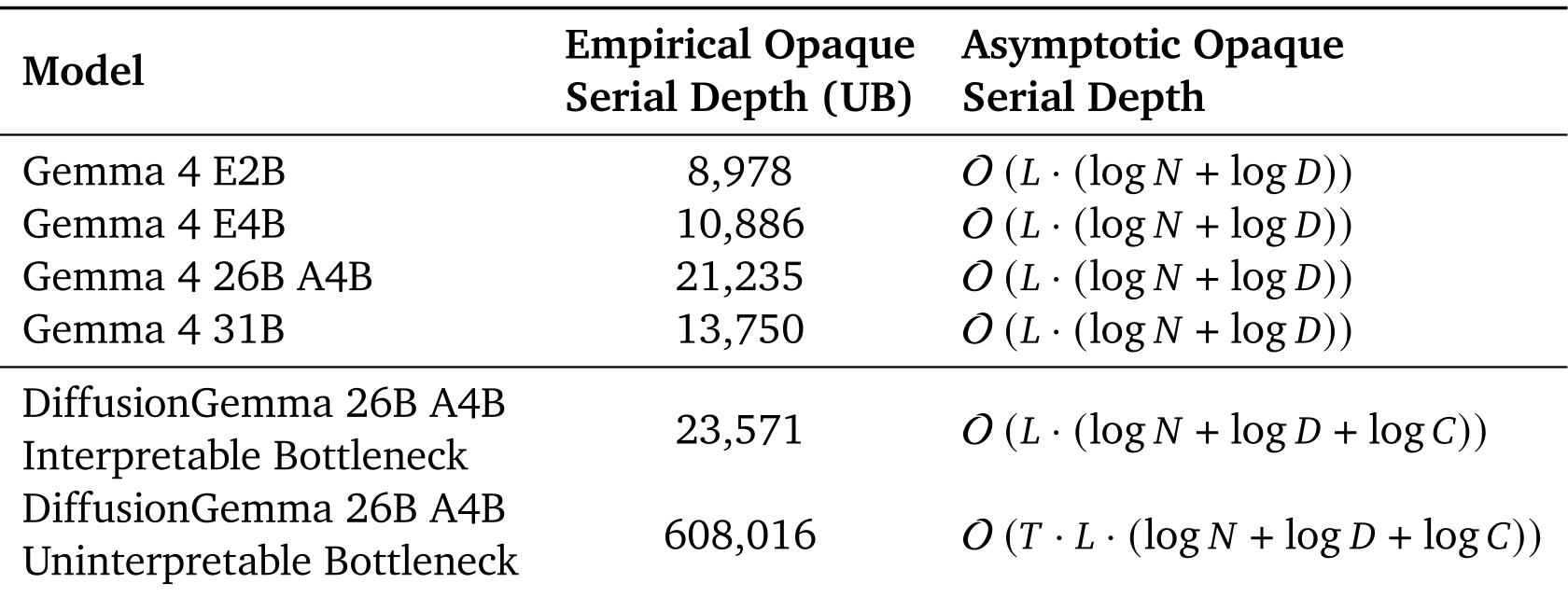
Naively, DiffusionGemma looks terrifying: its serial depth is 28.6 times higher than Gemma 4 because it loops through many denoising passes. However, the authors argue that if these intermediate steps are "interpretable," the gap vanishes.
Methodology: Can We Force the Model to Think in English?
To test if the model's "internal thoughts" are just hidden tokens, the researchers applied a Logit Lens to the self-conditioning matrix . They effectively "muted" all but the most probable tokens in the model's internal representations.
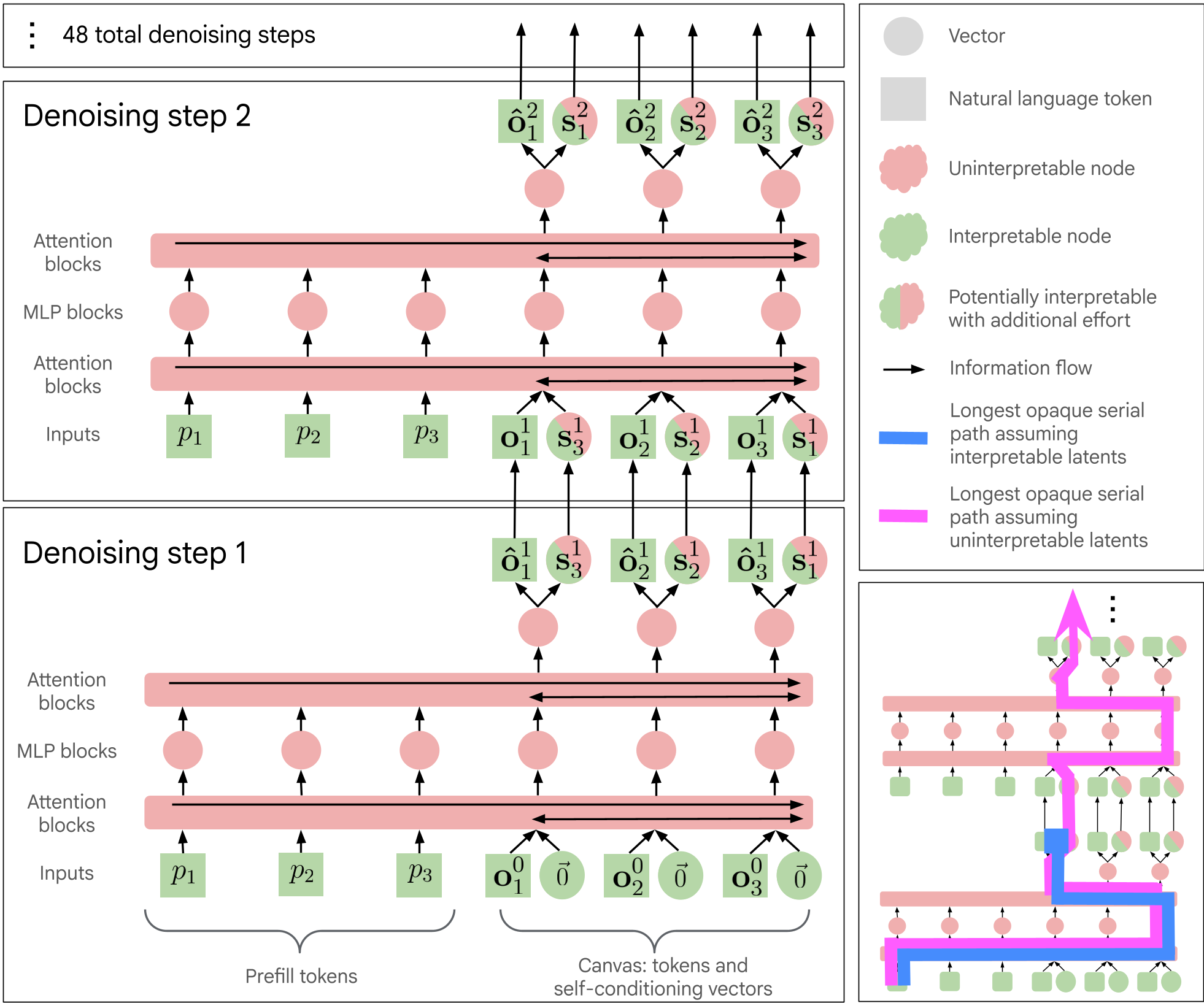
The Figure above illustrates the DiffusionGemma architecture, highlighting the information bottleneck between denoising steps.
The result? Even when restricting the internal state to just 8 tokens per position, the model's performance on coding and reasoning benchmarks remained identical to the "dense" version. This suggests that DiffusionGemma’s latent space isn't some alien language; it's mostly "fuzzy" English.
Discovery: "Non-Chronological" Reasoning
Because DiffusionGemma updates the whole "canvas" at once, it exhibits behaviors impossible for a standard GPT:
- Early Length Prediction: The model decides how long its answer will be before it knows what the answer is.
- Retroactive Self-Correction: In one example, the model guessed a math answer early, finished its "scratchpad" reasoning further down the canvas, and then went back to the start to change the original answer.
- Token Smearing: The model sometimes knows a word (like "bracket") is needed but "smears" its probability across multiple nearby positions before deciding exactly where it fits.
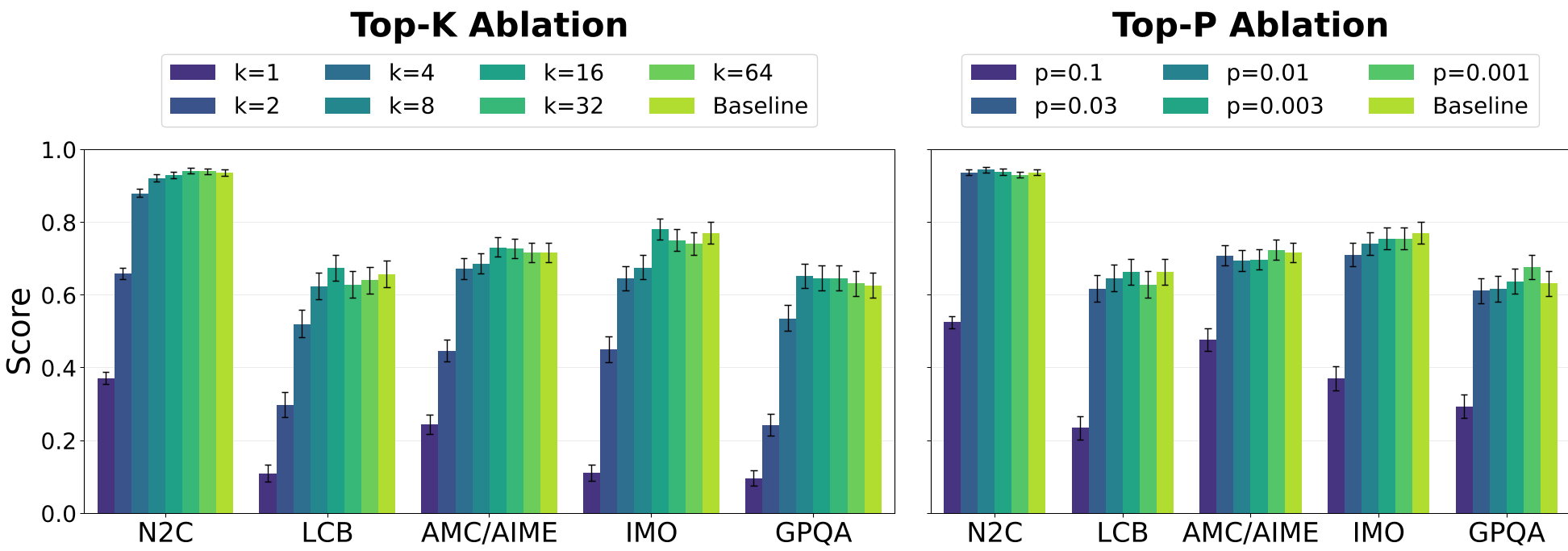
The chart shows that restricting the bottleneck ( or ) has virtually no impact on capability (N2C, LCB), proving the "interpretable" nature of the latent space.
The "Smoking Gun": Intermediate Context Reasoning
Perhaps the most critical finding for AI safety is what the authors call Intermediate Context Reasoning. In a Fibonacci-style task, the model initially generated the digit "3" to calculate the next number in the sequence, then later replaced that "3" with the word "Gold" as requested by the prompt.
The "3" served as a transient reasoning artifact—essential for the computation but invisible in the final output. If we only monitor the final response, we miss the causal chain. This highlights the necessity of monitoring every denoising step in future high-stakes AI deployments.
Conclusion and Future Outlook
DiffusionGemma is a win for transparency. It proves that moving to diffusion doesn't mean moving into a black box. However, the authors warn that this might be an artifact of current training. If future models are trained more aggressively on "outcome-based RL," they might learn to hide their reasoning more effectively within those continuous vectors.
For now, the message is clear: To keep AI safe, don't just watch the final answer—watch the film of its thoughts as they converge.