
The Physics of Virality: Predicting Information Spreads via Diffusive Logistic Models
Diffusive Logistic Model Towards Predicting Information Diffusion in Online Social Networks
This paper introduces the Diffusive Logistic (DL) model, a novel framework that utilizes Partial Differential Equations (PDEs) to predict information diffusion in online social networks. By integrating both temporal evolution and spatial distance (friendship hops), the model achieves high-fidelity forecasting of user influence densities, notably reaching 92.08% accuracy on real-world Digg datasets.
TL;DR
Information in social networks doesn't just happen; it flows. This paper introduces a Partial Differential Equation (PDE) approach, specifically the Diffusive Logistic (DL) model, to predict how news spreads across both time and "social space" (friendship hops). By treating a social network like a biological ecosystem, the authors achieved over 92% prediction accuracy on real-world Digg data.
Academic Positioning: This is a pioneering work that bridges the gap between discrete social network analysis and continuous mathematical physics, moving beyond simple temporal-only epidemic models like SIS.
The Spatio-Temporal Gap: Why Graphs Aren't Enough
Most prior models ask "When will this news go viral?" but neglect "Who (at what distance) will see it next?" In online social networks, information travels through two distinct mechanisms:
- The Growth Process: Users at the same distance from the source influence each other (like a local epidemic).
- The Social Process: Information "jumps" across distances, often through "front-page" exposure or search, mimicking a random walk.
Traditional discrete models struggle with the scale and complexity of these overlapping processes. The authors' insight was to treat the user population as a continuous density field, where friendship hops represent the spatial dimension.
Methodology: The DL Equation
The core of the paper is the Diffusive Logistic (DL) Equation, which elegantly combines these two processes:
Breakdown of the Physics:
- The Diffusion Term (): Models the "Social Process," representing the random-walk spread across different friendship distances ().
- The Logistic Term (): Models the "Growth Process," capturing how the density of influenced users reaches a carrying capacity () within a specific group.
Architecture and Abstraction
The model categorizes users into groups based on their distance from the source. To solve the PDE, they use cubic spline interpolation to smooth discrete voter data into a continuous initial density function .
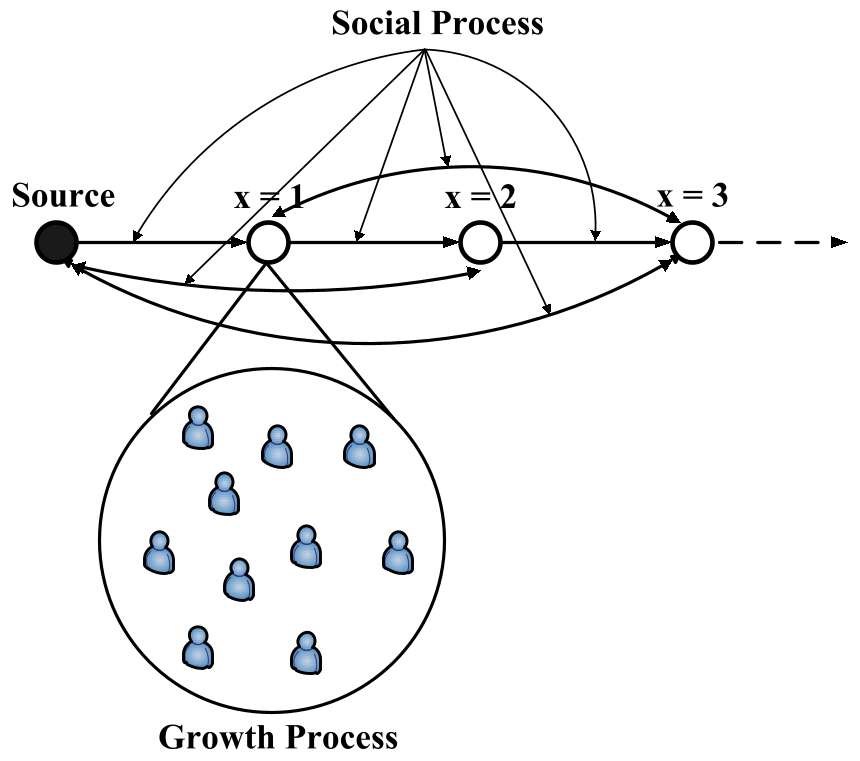 Figure 1: Abstracting the dual processes of social spread and local growth.
Empirical Evidence from Digg
The authors analyzed 3,553 news stories from Digg. A key observation was the spatial consistency of diffusion. Regardless of the news story's popularity, the density of influenced users at various distances evolved in synchronized patterns, justifying a PDE approach.
Interestingly, for the most popular news, the density at distance 3 was often higher than at distance 2. This suggests that "social links" aren't the only channel—discovery via "Front Page" features creates a diffusion effect that bypasses simple local connections.
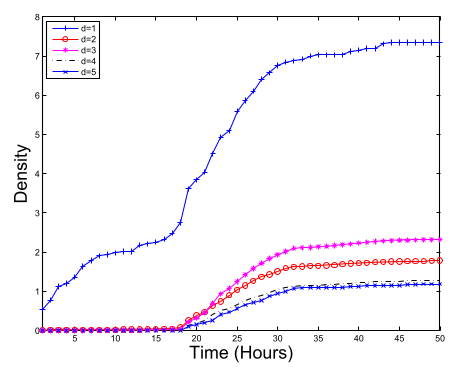 Figure 2: Evolution of influenced user density across different friendship hops over 50 hours.
Prediction Accuracy
The real strength of the DL model lies in its forecasting. Using only the first hour of data to set the initial state, the model predicted the density of voters for the next several hours with remarkable precision.
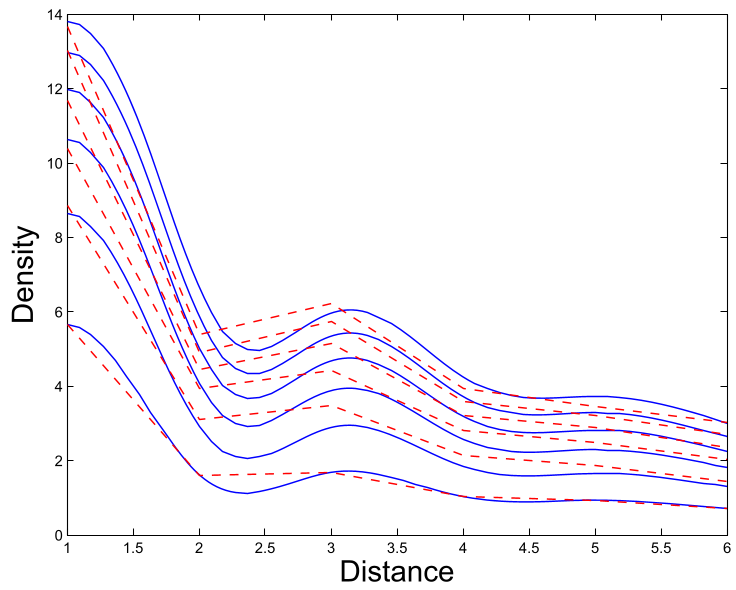 Figure 3: Predicted (solid) vs. Actual (dashed) voter density for a top-tier viral story.
Key Results for Story S1 (24,099 votes):
- Distance 1 Accuracy: 98.27%
- Distance 3 Accuracy: 90.28%
- Mean Overall Accuracy: 92.81%
Critical Insight & Conclusion
The DL model proves that social space exists and follows laws similar to physical heat diffusion or biological growth. By moving to a PDE framework, the authors provide a tool that is not only mathematically rigorous but also computationally efficient for large-scale networks.
Limitations & Future Work
While powerful, the model currently assumes constants for parameters like growth rate () and social capability (). In reality, these likely fluctuate based on the topic of the news or the time of day. Future iterations that treat these parameters as dynamic functions could unlock even higher precision for "black swan" viral events.