
Beyond Time: Mapping the Spatio-Temporal Flow of Information with Diffusive Logistic Models
9023_Diffusive Logistic Model Towards Predicting Information Diffusion in Online Social Networks.
The paper introduces a novel Partial Differential Equation (PDE) approach, specifically the Diffusive Logistic (DL) model, to characterize information diffusion in online social networks. By integrating temporal growth with spatial "social processes" across friendship hops, it achieves a high average prediction accuracy (e.g., 92.08% for popular Digg news) in estimating user influence density.
TL;DR
Researchers have developed a mathematical framework using Partial Differential Equations (PDE) to predict not just when a piece of news will go viral, but where it will land in the social hierarchy. By merging biological growth principles with random walk physics, the proposed Diffusive Logistic (DL) model predicts user influence density with over 92% accuracy, outperforming models that ignore the spatial structure of social networks.
Background: The Missing Dimension
In the study of online social networks (OSNs), we often ask, "How many likes will this get in 5 hours?" This is a temporal question. However, the spatial question—"How deep into the network will this reach?"—is equally vital. Existing models like Independent Cascade or SIR (Susceptible-Infected-Recovered) often struggle with the scale and randomness of modern platforms like Digg or X (formerly Twitter), where information jumps across the network via "Front Pages" or search engines, not just through direct followers.
The Problem & Motivation
The authors identify a critical gap: information doesn't just spread along the "branches" of a friendship tree. It exhibits:
- Direct Growth: Friends influencing friends at the same logical distance from the source.
- Social Diffusion: Information "leaking" or Jumping across different friendship tiers (random walk).
The motivation was to find a single mathematical framework—the Diffusive Logistic equation—that could unify these two behaviors into a predictive tool.
Methodology: The Mechanics of the DL Model
The core of the paper is the translation of human behavior into a PDE. The authors define friendship hops as the distance .
1. The Growth Component (Logistic)
Within a specific "distance group," users influence each other. This is modeled by the Logistic growth equation, which accounts for the "carrying capacity" ()—the maximum possible density of interested users at that distance.
2. The Social Component (Diffusion)
To account for the random movement of information across distances (the "social process"), the authors add a second-order diffusion term: .
Combined DL Equation:
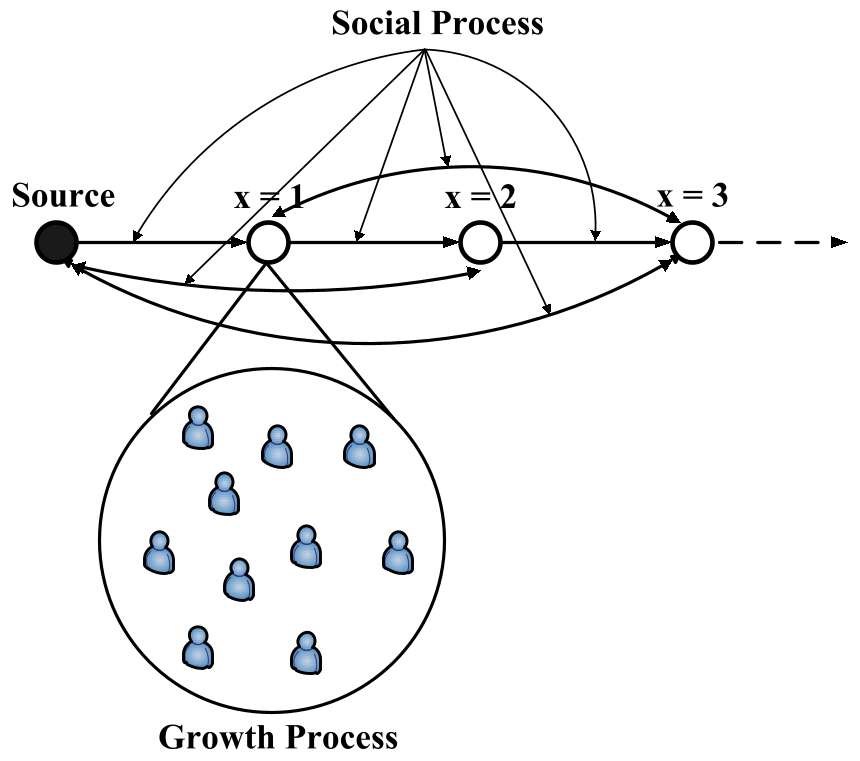 Figure 1: Conceptual visualization of the growth and social diffusion processes.
Experiments & Results
The model was tested using a massive Digg dataset containing over 3 million votes. One of the most fascinating findings was that influence density is not always inversely proportional to distance. In some cases (Story s1), the density of users 3 hops away was higher than those 2 hops away, proving that "spatial" diffusion isn't a simple linear decay.
Predictive Power
By feeding the model data from just the first hour of a news story's life, the researchers could predict the density of influenced users for the next 50 hours with stunning precision.
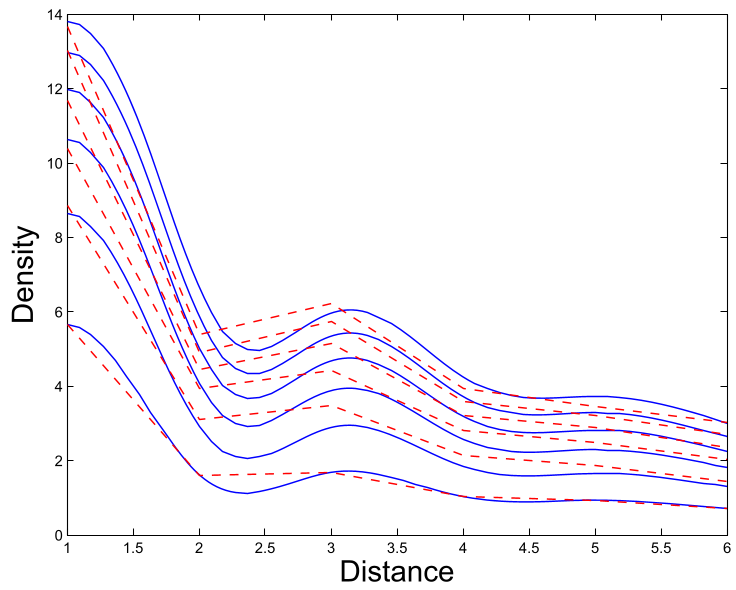 Figure 2: The solid lines (DL model) almost perfectly track the dashed lines (actual Digg data) across various distances.
| Distance (Hops) | Average Accuracy |
|---|---|
| 1 | 98.27% |
| 3 | 90.28% |
| 6 | 94.56% |
| The model maintains high fidelity even as the distance from the source increases. |
Critical Insight & Conclusion
The Diffusive Logistic Model marks a shift from empirical observation to theoretical rigor in social media analysis.
Key Takeaways:
- The Random Walk is Real: Social links are the primary highways, but the "random walk" (diffusion) is what allows stories to jump the gap between isolated communities.
- Universal Patterns: Despite the chaos of human behavior, the evolution of news popularity follows the same mathematical laws as the spread of a virus or the growth of a biological population.
Limitations: The model currently assumes a static network topology during the diffusion process and requires a well-defined "source" user. Future iterations could explore "multi-source" diffusion, typical of trending global hashtags.