
DifRec: Rethinking Recommendations Through the Lens of Social Diffusion
DifRec: A Social-Diffusion-Aware Recommender System
DifRec is a social-diffusion-aware recommender system designed for online social platforms. It avoids redundant recommendations by modeling how items propagate through a social network (sharing/re-posting), achieving up to 191% improvement in user engagement on real-world datasets like Tumblr.
TL;DR
Most recommender systems waste valuable screen real estate by showing you posts your friends were going to share with you anyway. DifRec (Social-Diffusion-Aware Recommender) solves this by predicting the path of "re-posts" across a social graph. By withholding redundant items, it frees up slots for new, relevant content, boosting total user engagement by up to 190%.
Problem & Motivation: The "Wasted Slot" Paradox
In platforms like Twitter, X, or Tumblr, users have two primary ways of discovering content:
- The Recommender System: Explicitly suggested items.
- The Social Feed: Items re-posted or shared by people they follow.
Traditional systems (Content-based or Social-filtering) only look at relevance. If a post is highly relevant to both User A and their follower User B, the system recommends it to both. However, if User A re-posts it, User B sees it twice. Since recommendation slots (K) are limited, this is a massive inefficiency. The authors argue that we should treat these slots as a scarce resource and maximize the unique relevant content a user encounters.
Methodology: The Neighborhoodness Graph
The core innovation of DifRec lies in how it models "conflict" between social sharing and direct recommendation.
1. The Diffusion Model
First, the system calculates a Reliable Node Set () for every user. Using a probabilistic graph where edges represent the likelihood of a re-post (), the system uses Monte Carlo sampling to find which followers are likely to receive a message from User .
2. The Recommendation Problem as MWIS
The authors define a Neighborhoodness Graph (). In this graph, an edge means that if User gets a post, User will likely see it via diffusion. The goal is to maximize: subject to the constraint that if an edge exists between and , they cannot both be recommended the same post ().
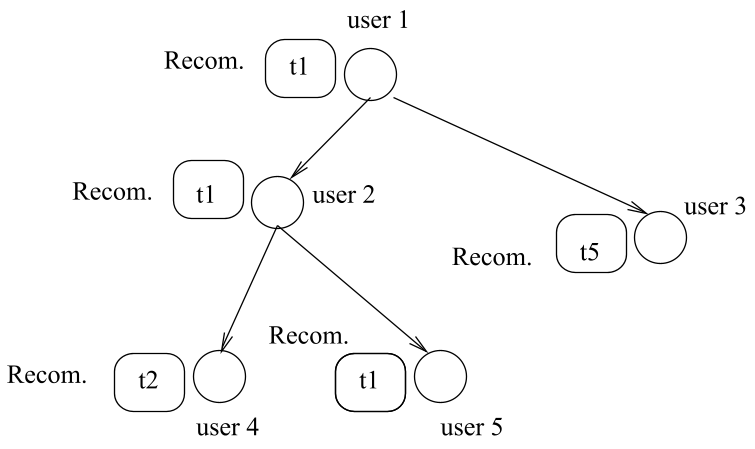 Figure 1: Comparison between (a) Traditional Recommendation vs (b) Diffusion-aware Recommendation.
3. Heuristic Algorithms
Since solving the Maximum-Weight Independent Set (MWIS) problem is NP-hard, DifRec uses a greedy approach. It sorts users by their "Engagement Potential" (the sum of relevance for them and all their reachable followers) divided by their degree in the neighborhoodness graph, ensuring we pick high-impact "seed" users for recommendations.
Experiments: Real-World Impact on Tumblr
The authors tested DifRec using a massive dataset of 1.5 million Tumblr users.
SOTA Comparison
DifRec was compared against the Real Tumblr recommender, a standard Content-based system, and a Social-aware system.
| K (Slots) | Content | Social | Real | DifRec |
|---|---|---|---|---|
| 5 | 2368 | 4117 | 3395 | 11414 |
| 25 | 2156 | 3498 | 3398 | 10185 |
DifRec maintained a consistent lead, providing roughly 2.8x to 3x higher engagement scores than the production baseline.
 Figure 2: Percentage of users achieving high engagement thresholds across different models.
Critical Insight & Conclusion
DifRec proves that a recommender system shouldn't just be "smart" about what a user likes; it must be "aware" of the platform's external dynamics.
Takeaways:
- Diversity via Diffusion: By avoiding social redundancy, DifRec naturally increases the diversity of content a user sees.
- Efficiency: It maximizes the value of every pixel on a mobile screen by ensuring no two slots are wasted on the same content path.
- Limitations: The model assumes a static social graph and constant re-post probabilities, which may shift in real-time. Future work involving dynamic Graph Neural Networks could make these "Reliable Sets" even more accurate.
Ultimately, DifRec moves us from Individual Relevance to Network-Wide Utility.