
Beyond the Social Graph: Why Your Friends Aren't the Only Reason News Goes Viral
Digging in the Digg Social News Website
This paper presents a large-scale empirical analysis of Digg.com, a major social news aggregator, utilizing a dataset of 1.5 million users and 10 million stories. The researchers reveal that content dissemination is driven by a complex interplay between explicit friendship networks and implicit browsing via site interfaces, ultimately finding that temporal synchronization of user activity is a more critical factor for "viral" success than simple network topology.
TL;DR
Is the "Social" in Social Media doing all the heavy lifting? By analyzing 1.5 million users and 10 million stories on Digg.com, researchers have debunked the myth that friendship is the sole engine of virality. Instead, they found that temporal synchronization—the alignment of user activity in short time windows—and platform interfaces are the real gatekeepers of popular content.
The "Social Link" Fallacy
In the early days of OSN research, the prevailing wisdom was simple: information spreads like a virus through social links. If you have many followers, your content spreads further. However, this paper identifies a massive gap in that logic. By looking at Digg.com (a precursor to modern Reddit), the authors discovered that nearly half of the users are "disconnected" (having no friends), yet these users are responsible for a massive amount of content discovery and promotion.
Methodology: A Multi-Dimensional View
To get the full picture, the authors moved beyond traditional Breadth-First Search (BFS) crawling, which often misses isolated users. They looked at the network from four perspectives: The Site, The Story, The User, and the Social Graph.
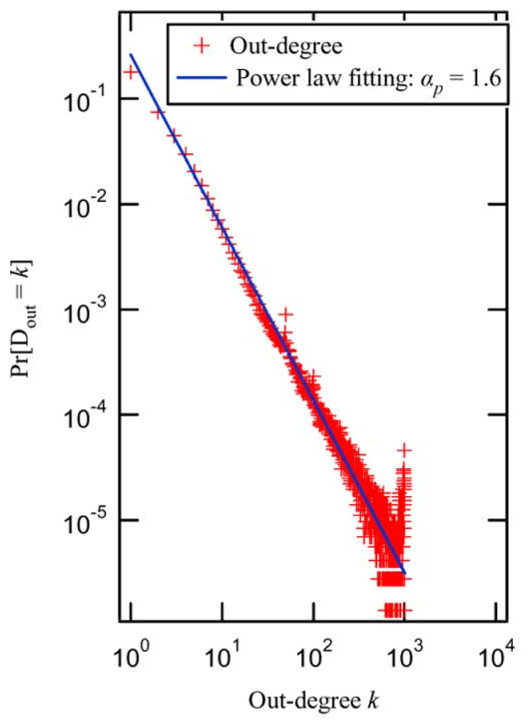
Key Insights: The Anatomy of a Digg
1. The 2% Efficiency Trap
Surprisingly, only 2% of established friendship pairs ever actually interact with the same content. This suggests that the "Social Graph" is largely dormant. Even "Power Users" with thousands of fans only manage to activate about 0.7% of their followers to vote for a specific story.
2. High Interest Overlap (Homophily)
While friends share high interest similarity (36% have identical topic preferences), this similarity doesn't translate into efficient spreading. Why? Because of the Synchronization Problem.
3. The 24-Hour Death Row
Since 88% of Digg content is news, the "novelty" factor is a ticking time bomb. Stories must reach a critical mass of votes within the first 24 hours to hit the "Popular" front page. If your friends aren't online at the exact moment you post, the story dies, regardless of how many followers you have.
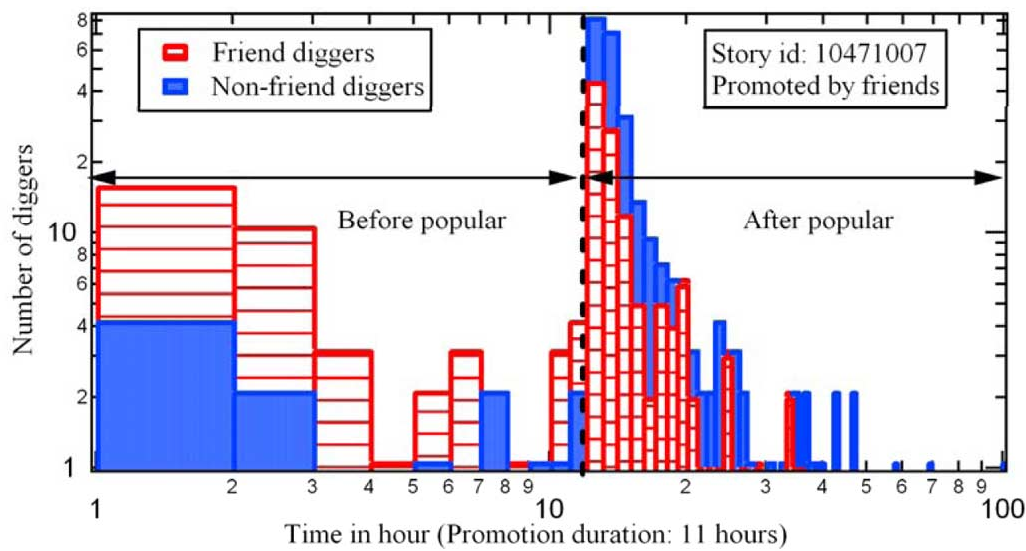
The Science of Success: Synchronized Digging
The paper introduces a crucial concept: Activity Synchronization. In a world of transient news, the effectiveness of a social link is suppressed because friends' activities are rarely aligned in time. Consequently:
- Non-friends (Site Browsers): Play a massive role in content promotion by discovering stories through the "Upcoming" interface.
- Short Hops: Content rarely travels far along a chain of friends. On average, information dissemination stops at 3.9 hops, even though the network would technically allow for more.
Critical Insight & Conclusion
This work serves as a reality check for "Viral Marketing." It proves that having a massive network is useless if that network isn't active simultaneously. The "interface influence"—the power of a website's "New" or "Popular" sections—often outweighs the "social influence" of followers.
Takeaway for Devs & Marketers: Don't just build for followers; build for windows of opportunity. Content discovery algorithms must balance social signals with temporal relevance to keep information flowing.
Limitations: The study is specific to news-aggregators. In "relationship-based" networks like Facebook or LinkedIn, where content is more personal and less transient than news, the social graph might still reign supreme.