
Digital Agriculture for Smallholders: Bridging the High-Tech Divide
Digital Agriculture for Small-Scale Producers: Challenges and Opportunities
This paper explores the design and implementation of digital agriculture technologies tailored for small-scale producers (SSPs) in low- and middle-income countries (LMICs). It evaluates innovations like IoT, AI, and remote sensing within the "FarmBeats" framework to bridge the global food gap and enhance smallholder livelihoods.
TL;DR
To feed a population of 10 billion by 2050, global food production must increase by 70%. While "Smart Farming" (AI, IoT, Robotics) is booming, it is largely inaccessible to the 570 million small-scale producers (SSPs) who provide 80% of the food in Asia and sub-Saharan Africa. This paper outlines a roadmap for "Digital Agriculture" that shifts focus from expensive, high-end systems to affordable, ruggedized, and ultra-low-power innovations designed specifically for the unique constraints of LMICs.
Problem & Motivation: The Scale Mismatch
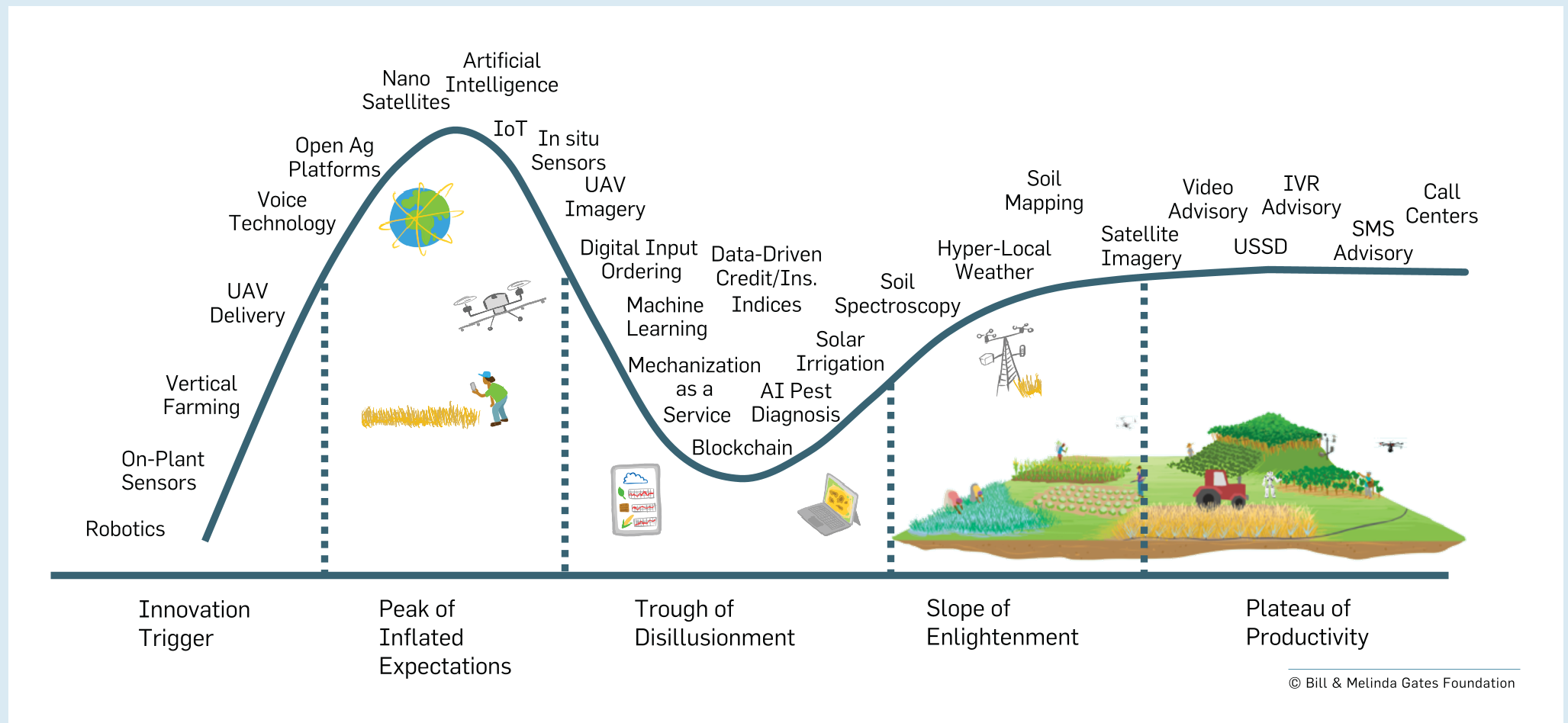
The "Smart Farming" revolution has an inclusivity problem. Current SOTA technologies—drones costing thousands of dollars, GPU-heavy cloud analytics, and high-maintenance sensors—are built for vast monoculture farms in high-income countries.
For a farmer in sub-Saharan Africa living on less than $2 a day, these technologies fail due to:
- Connectivity Gaps: Massive "usage gaps" exist even where 4G signals are present, often due to the high cost of data and hardware.
- Data Sparsity: Satellite imagery optimized for 100-acre fields lacks the resolution to distinguish three different crops planted on a 0.5-hectare plot.
- Usability Barriers: High rates of linguistic and digital illiteracy render standard Graphical User Interfaces (GUIs) ineffective.
Methodology: Engineering for the "Bottom Billion"
The authors argue that solving these issues isn't just about "dumbing down" existing tech, but about radical architectural shifts in hardware, networking, and AI.
1. Affordable Sensing (Surrogate & Low-Cost)
Instead of $300 soil sensors, the paper explores surrogate sensing. For instance, using the signal strength of Wi-Fi chipsets on smartphones to measure soil moisture or utilizing low-cost MEMS and audio sensors.
2. Connectivity via TV White Spaces
To solve the "last mile" connectivity problem, the authors highlight the use of TV White Spaces (TVWS)—the unused spectrum between broadcast channels. TVWS propagates over long distances and through dense foliage, making it a perfect backbone for rural IoT.
3. AI for Sparse and Multi-Crop Data
Standard Computer Vision models struggle with the "visual noise" of multi-cropping. The methodology emphasizes:
- Self-supervised learning: To train models on the limited labeled data available in LMICs.
- Augmented Intelligence: Combining human knowledge with ML to overcome data gaps.
Experiments & Results: The Power of Bundling
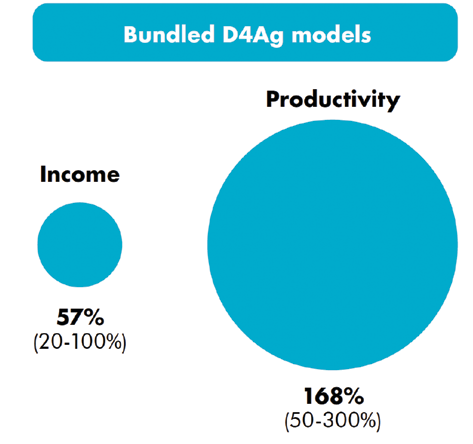
The research demonstrates that digital intervention is most effective when services are "bundled." Providing a farmer with only weather data has limited impact compared to a platform that combines weather advisories with market linkages and index-based insurance.
Quantifiable Gains:
- Yield & Income: Bundled digital services have shown potential to increase yields by 70% and income by 40% in specific African value chains.
- Risk Mitigation: Satellite-derived "credit scores" allow landless farmers to access credit for seeds and fertilizer, which was previously impossible.
Critical Analysis & Conclusion
Takeaway
The future of global food security lies in the "democratization of data." By lowering the barrier to entry through low-cost hardware and localized AI, we can transform subsistence farming into a commercial engine for economic growth.
Limitations & Future Work
The primary hurdle remains Trust and Data Sovereignty. As we collect more data from SSPs, securing that data and ensuring farmers—not just tech conglomerates—benefit from the insights is critical. Future research must focus on "Privacy-Preserving Data Commons" and "Confidential Computing" adapted for geospatial agricultural data.
In conclusion, digital agriculture for smallholders isn't just a humanitarian goal; it is a technical frontier that requires the computer science community to rethink everything from the physical layer of networks to the UI of the smartphone.