
Digital Artifacts: Turning Email Metadata into Personal Narratives
Digital artifacts for remembering and storytelling: posthistory and social network fragments
The paper introduces two visualization systems, PostHistory and Social Network Fragments, designed to transform email archives into "digital artifacts." These systems visualize social networks and temporal interaction rhythms, achieving a shift from utilitarian data management to personal storytelling and self-reflection.
TL;DR
Most of us view our email as a cluttered inbox to be cleared. This paper proposes a radical shift: viewing email as a psychological mirror. By visualizing years of metadata through PostHistory and Social Network Fragments, the researchers demonstrate that traffic patterns (who we talk to and when) are enough to trigger profound personal memories and social storytelling, effectively turning "data" into "digital souvenirs."
Problem & Motivation: The Loss of Tangible History
In the physical world, we use objects—photos, ticket stubs, heirlooms—to anchor our memories. As our interactions move to the digital realm, we lose these tangible markers.
The authors argue that current email systems are purely utilitarian. They fail to reflect our mental models of social exchange, which are centered on relationships and time rather than individual, disconnected messages. The challenge was to create a way to see the "forest for the trees"—to visualize the high-level social landscape hidden within thousands of mundane headers.
Methodology: Two Lenses on the Social Self
The researchers developed two distinct but complementary systems to map the "social landscape" of email:
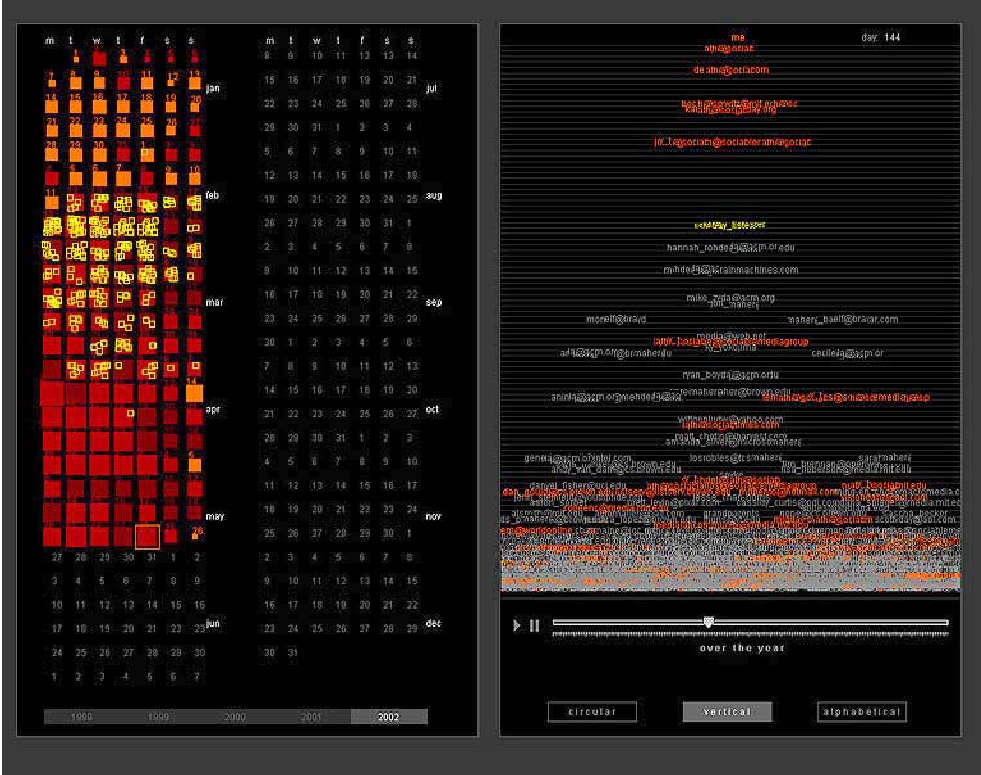
1. PostHistory: The Rhythm of Relationships
PostHistory focuses on the dyad (the 1-on-1 relationship) and time.
- The Calendar View: Each day is a square; its size represents volume, and its intensity represents "directedness" (e.g., mail sent specifically to you vs. mailing lists).
- The Social Landscape: Names of contacts move vertically. Frequent contacts "float" to the top near the user, while those who fade away sink.
2. Social Network Fragments: The Architecture of Community
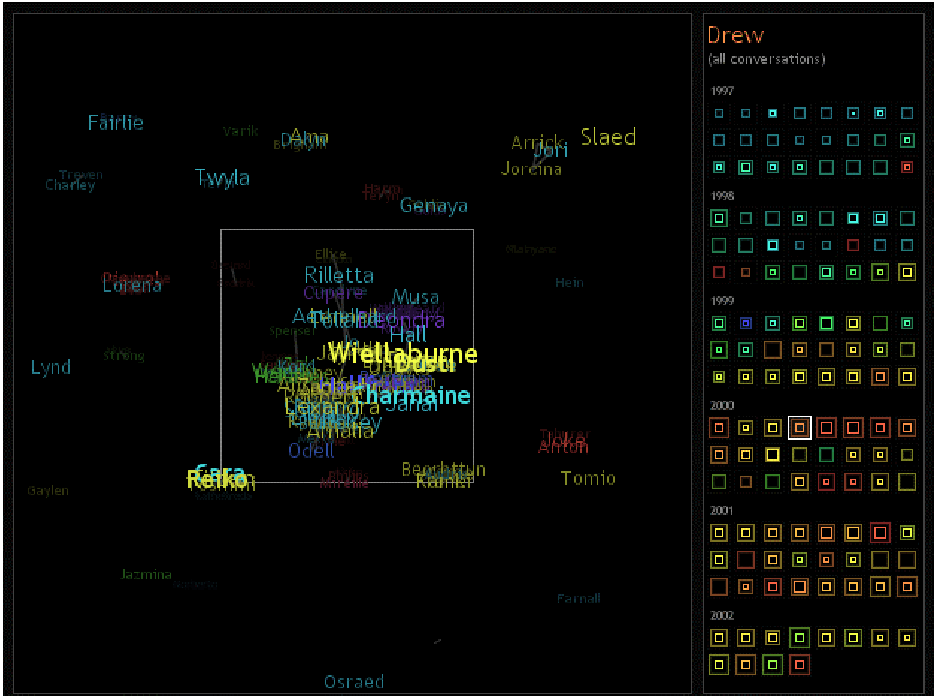
While PostHistory looks at 1-on-1 ties, this system looks at clusters.
- The Spring System: Using email headers, the system calculates tie strengths. It uses a spring-based algorithm to pull people who know each other closer and repel those who don't.
- Contextual Facets: By coloring names based on roles (Work, School, Private), it reveals how users segment their lives.
Experiments & Results: The "Aha!" Moment
The evaluation involved users with up to five years of email history. The results were less about "efficiency" and more about "meaning":
- Pattern Recognition: One user was stunned to see the "rise and fall" of relationship rhythms—the intense bursts of a new romance followed by the absolute silence of a breakup.
- Social Capital & Reconnection: A user shared a screenshot of a dormant "friend cluster" with the people in it. This visual artifact sparked a "memory lane" conversation that led to a real-life reunion after five years of silence.
- Implicit Privacy: Surprisingly, users felt comfortable sharing these graphs. Because the graphs only show patterns and not content, they provided a "semi-public" layer of privacy—meaningful to the owner, but abstract to a stranger.
Critical Analysis & Conclusion
Takeaway
The genius of this work lies in its Isomorphism: it maps digital data onto human psychological structures (time and social circles). It proves that metadata—often seen as a privacy liability—can be a source of personal empowerment and self-awareness.
Limitations & Future Work
- Content vs. Context: The system relies purely on headers. Adding sentiment analysis or keyword extraction (Content Analysis) could further enrich the "storytelling" aspect.
- Static vs. Dynamic: Some users found the "Social Network Fragments" difficult to read because positions were too static. Future iterations would need to better handle "identity shifts" where a work friend becomes a personal friend.
Ultimately, PostHistory and Social Network Fragments remind us that our digital tracks are more than just logs; they are the texture of our lives. As we move further into an AI-driven era, the need for tools that help us curate—rather than just store—our digital memories will only grow.