
Digital Fingerprints: How Your Device Usage "Rhythm" Reveals Who You Are
Digital footprints: predicting personality from temporal patterns of technology use
This paper introduces a psychometric modeling approach that predicts Big Five personality traits using temporal patterns of smartphone and PC usage. By leveraging non-content digital traces like session duration and screen switching, the authors achieved high-accuracy binary classification, notably reaching 80% accuracy for the "Openness" trait.
TL;DR
Can the mere "cadence" of your digital life—how often you switch screens or how late you stay online—reflect your personality? This paper from UbiComp '17 proves it can. By analyzing 76 non-content temporal metrics from smartphones and PCs, researchers successfully predicted Big Five personality traits with up to 80% accuracy, demonstrating that when and how you use technology is just as telling as what you do on it.
Background: Beyond the Privacy-Intrusive "What"
For years, psychometric modeling has been synonymous with "content mining." To know a user's personality, models needed to read their Facebook posts, count their Twitter followers, or analyze their "likes." While effective, this approach is a privacy nightmare.
The authors of this study pivoted to a more subtle "digital footprint": Temporal Patterns. They hypothesized that our inherent psychological traits—like Neuroticism or Extroversion—manifest as physical habits in how we interact with our devices, creating a unique "rhythm" that is content-agnostic and minimally intrusive.
Methodology: The Anatomy of a Digital Rhythm
The study tracked 62 participants across their smartphones (using the AWARE framework) and PCs (using Kidlogger) for seven days. Rather than looking at the text of a message, they looked at:
- Screen Switching: How frequently do you jump between apps?
- Autocorrelation (Rhythm): How predictable is your usage interval?
- Evening Use Ratio: What percentage of your digital life happens after 8 PM?
- Social Media Dispersion: How scattered are your social interactions throughout the day?
Model Architecture
To handle the highly correlated and skewed data, the team employed a sophisticated pipeline:
- Log Transformation: Normalizing the skewed temporal data.
- Recursive Feature Elimination (RFE): Using a Random Forest variant to strip away "noise" and find the most predictive temporal triggers for each specific trait.
- Random Forest Classification: A robust machine learning model trained via repeated 10-fold cross-validation.
 Figure 1: Overview of the temporal metrics extracted, focusing on duration, frequency, and distribution.
Key Results: Metadata Outperforms Content
The results were striking. The model didn't just work; it rivaled (and sometimes beat) models that had access to much more sensitive data like SMS logs and call histories.
| Personality Trait | Accuracy | ROC (AUC) |
|---|---|---|
| Openness | 0.80 | 0.82 |
| Neuroticism | 0.73 | 0.72 |
| Extroversion | 0.72 | 0.78 |
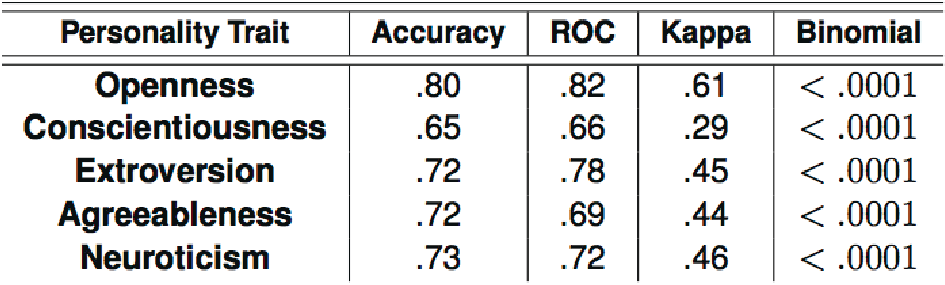 Figure 2: Performance metrics across the Big Five traits. Note the high ROC for Openness and Extroversion.
Why it Works: The Intuition
- Openness: High scorers likely show diverse and frequent screen switches as they explore various information sources.
- Neuroticism: Frequently correlates with "Rhythmicity." Individuals with higher emotional instability may use devices in more sporadic or specific ritualistic patterns to cope with anxiety or stress.
- Extroversion: Linked to higher "Social Media Ratios" and specific evening usage peaks, reflecting their social orientation.
Critical Analysis & Future Outlook
The Takeaway: This work is a milestone for Privacy-Preserving User Modeling. It proves that we don't need to "read the mail" to understand the person; we just need to watch the "envelope's" movement.
Limitations:
- Sample Homogeneity: The study relied on 62 college students. Their digital patterns might differ significantly from a professional in their 50s or a child.
- Short Duration: Seven days provides a snapshot, but personality is long-term. Future studies should aim for longitudinal data (months or years).
Conclusion: As we move toward a more privacy-conscious web, temporal patterns offer a "Golden Mean"—providing high-value personalization for marketers and developers without the ethical baggage of deep-content surveillance. Your digital rhythm is your soul's new fingerprint.