
From Connection to Creation: How ESM Transforms Retail Productivity and Innovation
Digital Innovation and Transformation
This study investigates how a global retailer leveraged Enterprise Social Media (ESM) to enhance employee productivity and innovation. Through qualitative analysis of 30 early adopters, the authors identify key individual mindsets (Social Open Minds, Digital Natives) and cultural pillars (Social Digital Leadership, Open Communication) that transform ESM from a mere tool into a catalyst for SOTA organizational performance.
TL;DR
In 2013, a global retail giant faced a massive connectivity gap: only 15% of its workforce had email. By implementing Enterprise Social Media (ESM), they didn't just give people a place to chat; they unlocked a new paradigm of Social Innovation. This study reveals that successful ESM adoption hinges on nurturing specific employee mindsets (Social Open Minds) and shifting the leadership style from top-down mandates to Social Digital Leadership.
Background: The Connectivity Void
Before the "social" revolution, communication in retail was a mess of paper memos and local team meetings. Information didn't travel across store boundaries. The implementation of a cloud-based ESM platform (like Jive or Yammer) provided a unique opportunity to see if digital social tools could do more than "save time"—could they actually make a company more innovative?
Problem & Motivation: Why Technology is Never Enough
Most companies treat ESM like a "digital notice board." The authors argue that this is why many implementations fail. The real pain points aren't technical; they are cultural and psychological:
- The Surveillance Trap: Employees often feel that open forums are just new ways for "Big Brother" to watch them.
- The Generational Divide: "Social Digital Natives" (under 40) thrive, while older employees may view the platform as an added burden.
- Leadership Absence: If executives don't post, employees don't participate.
The authors' insight is that ESM acts as a "Social Manifold"—it connects disparate knowledge points, but only if the organizational culture provides the "Safe Space" to experiment.
Methodology: Mapping the Social Employee
The researchers identified four key phenotypes of employees who drive success on ESM:
- Social Open Minds: Risk-takers who are willing to change existing work habits.
- Social Digital Natives: Those who naturally translate leisure-time social skills to professional contexts.
- Social Collaborators: Believers in collective thought and document sharing.
- Social Competitors: Employees motivated by "friendly rivalry" to showcase their store's performance.
Key Framework: Factors Influencing ESM Impact
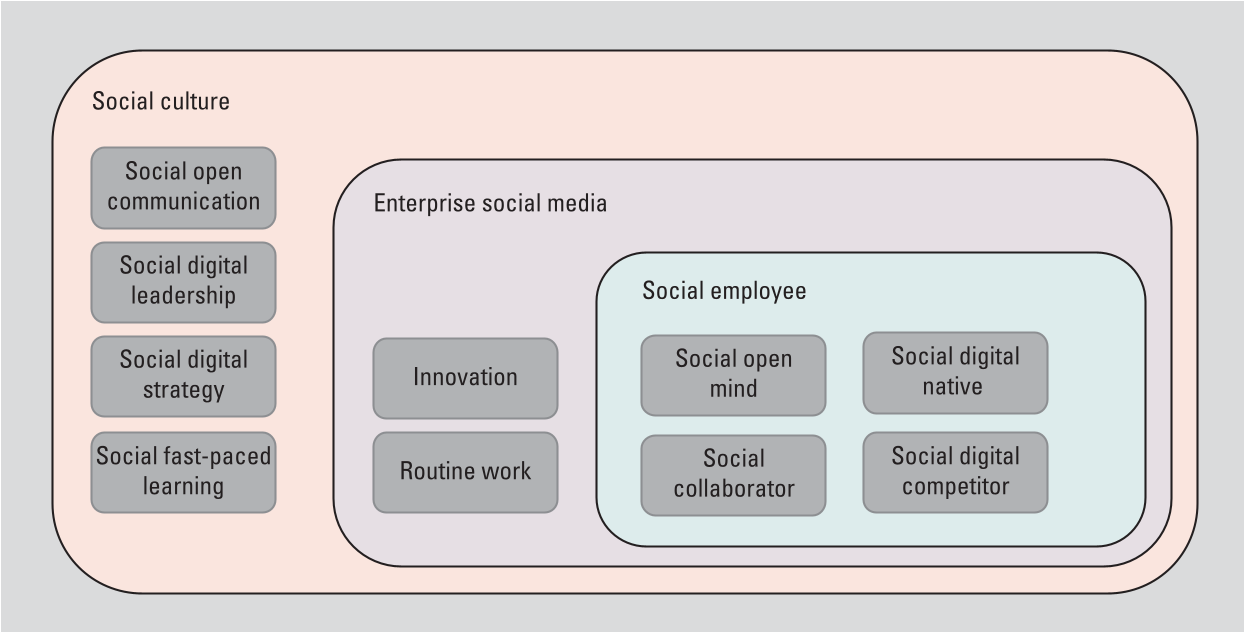 The study illustrates how individual motivations (the "Social Employee") must be paired with cultural enablers (the "Social Culture").
Experimental Insights: Innovation vs. Routine
One of the most profound findings of this study is the Strategic Divergence needed for different work types:
- For Innovation: The platform needs to be "fun" and "entertaining." Gamification, prize-based crowdsourcing, and social mingling are essential to close "knowledge gaps" between teams that don't usually talk.
- For Routine Work: The platform needs to be "structured." It must use the organization's existing professional language and narratives to help employees find best practices for daily operations (e.g., how to stock shelves faster).
Performance Evidence
The qualitative data showed that ESM enabled Social Fast-paced Learning. Instead of waiting for a monthly regional meeting, store managers could take a photo of a successful product display, post it, and have 3,000 other stores adopt the "innovation" within hours.
Critical Analysis & Conclusion
This paper serves as a vital reminder for the AI and Digital Transformation era: Culture eats strategy (and software) for breakfast.
Key Takeaways for Future Research:
- Social Digital Leadership is a non-negotiable. Executives who delegate social media management to HR or Marketing effectively kill the platform's authenticity.
- Fail Fast, Fail Safe: ESM communities must provide psychological safety so that employees feel comfortable sharing "half-baked" ideas that might lead to the next big breakthrough.
Limitations: The study was constrained to a single global retailer. Future research should investigate if these "Social Competitor" dynamics hold true in non-retail sectors like software engineering or healthcare.
Future Outlook: As we move toward AI-integrated ESM (where bots summarize conversations or suggest collaborators), the human "Social Open Mind" will remain the critical catalyst for turning raw data into organizational innovation.