
Digital Juries: Reclaiming Democratic Legitimacy in Content Moderation
Digital Juries: A Civics-Oriented Approach to Platform Governance
This paper introduces "Digital Juries," a civics-oriented framework that adapts the traditional legal jury model to social media content moderation. It establishes a 5-stage design model—Selection, Onboarding, Trial, Consensus, and Enforcement—and validates it through a study comparing deliberative and voting-based jury workflows against current automated/paid moderation.
TL;DR
Social media platforms are the new governors of public speech, yet their moderation processes—anchored by "black-box" algorithms and outsourced labor—face a growing crisis of legitimacy. This paper by Fan and Zhang proposes Digital Juries: a civics-oriented framework where users adjudicate content disputes through structured deliberation. Experimental results show these juries significantly improve user trust and perceived fairness compared to current industry standards.
The "Governor" Crisis: Why Paid Mods and AI Aren't Enough
As toxic content, hate speech, and misinformation scale, platforms have retreated into a "merchant-sovereign" stance. They treat users as consumers, applying rules through "artisanal" (paid human) or "industrial" (algorithmic) means.
The authors argue this creates a procedural justice vacuum. Users feel powerless, regarding moderation as arbitrary or biased. The core insight of the paper is that for a platform to be "legitimately" sovereign, it must offer users a seat at the table—not just as "flaggers" or data-labelers, but as jurors empowered to interpret community norms.
The Digital Jury Model (DJM)
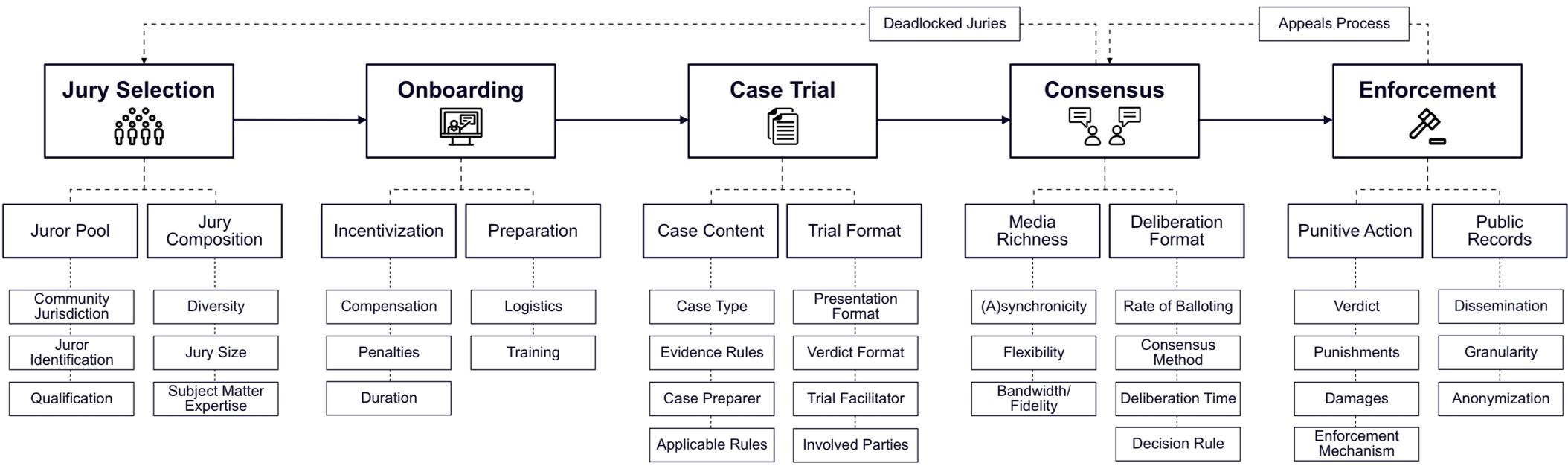
The researchers break down the design space of digital adjudication into five logical stages, translating offline legal safeguards into the digital realm:
- Selection: Determining the "jurisdiction" (e.g., Should only US users judge US political ads?).
- Onboarding: Transitioning the user from a passive browser to an active "citizen-moderator" via training and incentives.
- Case Trial: Presenting evidence (chat logs, screenshots) and the specific community standards in question.
- Consensus: The technical heart of the system. Does the jury use "blind voting" (easier to scale) or "deliberation" (deeper insight)?
- Enforcement: Deciding if the verdict is a binding ban/delete or merely a suggestion to the platform.
Experiment: Deliberation vs. Voting
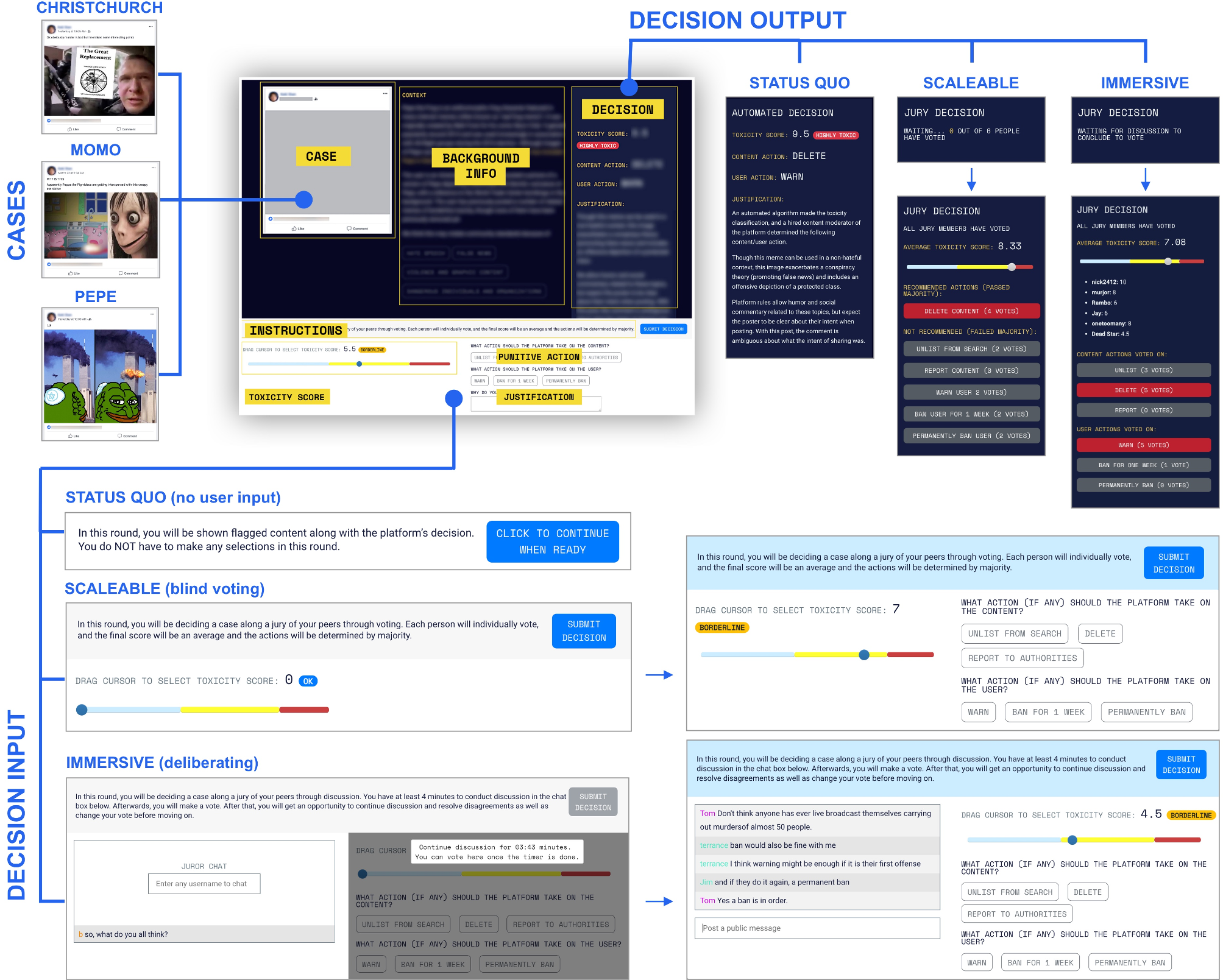
The study compared three conditions:
- Status Quo: Decisions made by the platform's "internal team."
- Scalable Jury: 6-person juries performing one-round blind voting (no interaction).
- Immersive Jury: 6-person juries engaging in a 4-minute synchronous chat deliberation before voting.
Key Findings
The "Immersive" deliberative jury was the clear winner in terms of "Care" and "Trust." Participants noted that hearing other perspectives tempered their own biases. Interestingly, "Scalable" (voting-only) juries tended to be harsher, recommending bans at nearly twice the rate of deliberative juries. This suggests that social deliberation introduces a "nuance buffer" that prevents reactive, punitive decisions.
The Paradox of Choice: Enforcement vs. Recommendation
The most polarizing result was Stage 5: Enforcement.
- The Pro-Enforcement Camp: Argues that recommendations are toothless and will be ignored by platforms whenever convenient.
- The Pro-Recommendation Camp: Distrusts "the mob." They worry about "groupthink," "brigading," or jurors with hidden political agendas.
This tension reveals a fundamental distrust—not just of the platforms (the "King"), but of each other (the "Peers").

Senior Editor’s Perspective: Is it Feasible at Scale?
While the paper offers a brilliant theoretical shift towards "Digital Constitutionalism," the technical hurdles are immense:
- Selection Bias: How do we stop coordinated efforts to "swarm" juries with bad actors?
- Incentive Design: Jurors on AMT were paid; would normal users do the "civic labor" of moderation for free, or would they require platform tokens/status?
- The Time-Scale Gap: AI moderates in milliseconds; juries take minutes or hours.
Conclusion: Digital juries likely aren't the solution for all content (e.g., obvious spam or child safety), but they provide a vital "Appellate" layer for high-stakes, borderline cases where "local context" is the only thing that matters. This work marks a critical transition from "Moderation as a Technical Problem" to "Moderation as a Political Science Problem."