
Digital Silence: Reclaiming Narratives through Storytelling in Times of Suppression
Digital Silence and Liberating Stories: During a Student-Driven Movement
This paper explores the phenomenon of "Digital Silence"—the state of information suppression through internet shutdowns and social media restrictions—during the 2018 student-led road safety protests in Bangladesh. Using Feminist HCI and social justice frameworks, the authors developed a storytelling methodology to preserve "in-the-moment" narratives from protesters, bystanders, and family members.
TL;DR
When the internet goes dark, stories become the light. This paper examines the "Digital Silence" imposed during the 2018 Bangladesh student protests, where the government restricted social media and disconnected mobile data. Through a localized storytelling intervention, the authors demonstrate how oral narratives act as a "liberating" force, preserving human rights accounts when digital platforms are silenced.
Background Positioning
In the intersection of Feminist HCI and Social Justice, this work is less about the "power of the tweet" and more about the "power of the voice" when tweeting is no longer possible. It moves the discourse from technology-as-organizer (like the Arab Spring) to technology-as-archive during active suppression.
The Pain Point: The Void of Digital Silence
During August 2018, Bangladesh witnessed a youth-driven movement for safe roads after a fatal bus accident. As the protests grew, the state responded with:
- Physical suppression: Attacks on students and activists.
- Digital suppression: 3G/4G network shutdowns and the enforcement of the controversial Section 57 of the ICT Act, which criminalized "fake" or "obscene" online content.
This created what the authors term Digital Silence. The core problem is that in these moments, history is often written only by the suppressor, as citizens fear the legal and physical ramifications of posting on social media.
Methodology: Designing for Risk
Traditional research might rely on Twitter APIs or Facebook scraping. However, in a climate of surveillance, the authors took a radically different approach: Offline Voice Collection.
The Story Collection System
The researchers used a custom application designed to work locally, without cloud sync, to protect the participants' identities and data from being intercepted.
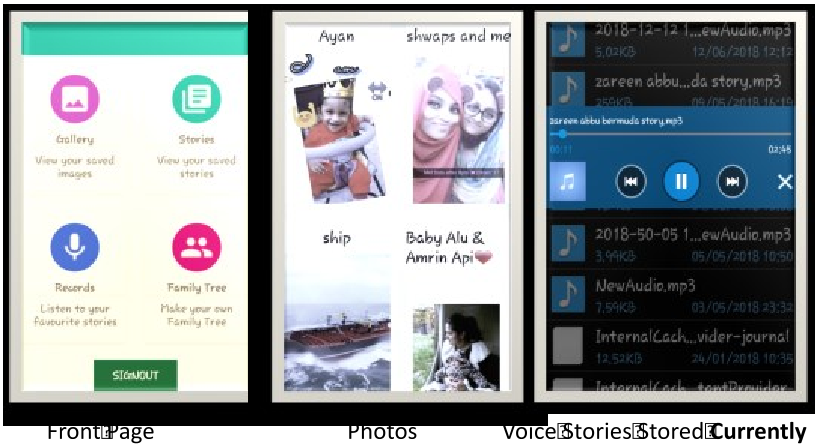 Figure: The specialized interface used to collect audio stories and link family connections without needing an active internet connection.
They gathered 40 stories from 25 storytellers, categorizing them based on their proximity to the events:
- Direct Protestors: Students on the ground.
- Present Observers: Passersby witnessing the attacks.
- Live Stream Viewers: People witnessing the "fragmented truth" before the shutdown.
- Indirect Recipients: Family members hearing stories via word-of-mouth.
Critical Insights: Why Stories Matter
The research highlights that the shutdown didn't stop the flow of information; it simply changed its state.
1. The Paradox of Rumor and Reliability
When official media is perceived as "restrictive" and social media is down, the community relies on assumptions. One of the strongest findings was that logical proximity (knowing someone who was there) was more influential than physical proximity (being in Dhaka vs. Chittagong).
2. Stories as Liberation
The act of telling a story offered a psychological release. Participants often "liberated" themselves by sharing updates, photos, and feelings that they were too terrified to post on their public Facebook profiles for fear of "unknown devices" connecting to their accounts—a common surveillance tactic identified in the study.
 Figure: The digital fingerprints of suppression, including warnings about unauthorized account access and media reports of arrests.
Experimental Analysis: Results of Digital Disconnect
The authors categorized their findings into a matrix of Direct vs. Indirect experiences. Interestingly, even "Indirect" stories carried a high emotional weight, showing that digital silence actually amplifies the community's empathy and perceived shared trauma.
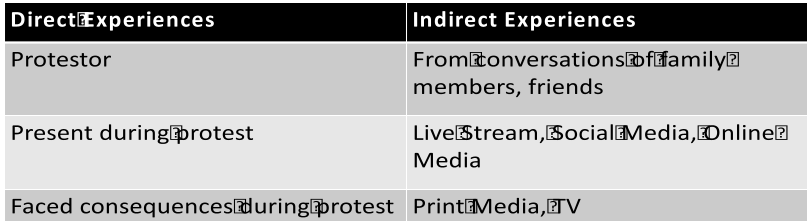 Table: The mapping of how stories flowed from the "Eye of the Protest" to the "Digital Periphery."
Strategic Takeaways & Future Work
Digital Silence and Liberating Stories concludes that storytelling is a form of social justice.
- For HCI Researchers: We must build tools that prioritize Privacy-Preserving Offline Collection during crises.
- For Activists: Oral histories are more resilient than digital posts, which can be wiped or used as evidence for prosecution.
- Limitations: The study was conducted on a small, localized scale. Future research must address how to scale these "pockets of resistance" into a larger, verifiable archive without compromising the safety of the contributors.
Ultimately, while technology can be used to silence a nation, the human instinct to share stories ensures that the pursuit of justice remains "adamant."