
SmartGov: Architecting Data-Driven Governance via Fuzzy Cognitive Modeling
The Role of Digital Technologies in Promoting Smart City Governance: The Case of SmartGov Research in progress
The paper introduces the SmartGov framework aimed at enhancing smart city governance through a combination of Fuzzy Cognitive Maps (FCMs), social media feeds, and open data. It demonstrates how these digital technologies foster citizen engagement and evidence-based decision-making in pilot cities in Cyprus and Spain.
TL;DR
The "SmartGov" project redefines urban management by moving beyond simple e-government portals toward a holistic, data-driven governance framework. By leveraging Fuzzy Cognitive Maps (FCMs), social media sentiment, and Open Government Data (OGD), it provides city officials with a "simulation sandbox" to evaluate the impact of policy changes—such as traffic rerouting or waste management—on citizen quality of life before they are enacted.
Background: Beyond the Digital Facade
The evolution of "Smart Cities" has often focused on infrastructure (IoT sensors and hardware). However, the bottleneck for true urban intelligence is Governance. Current models often fail to capture the "messy" causal relationships of urban life—where a change in waste collection schedules might inadvertently cause traffic jams near schools. SmartGov positions itself as a transdisciplinary bridge, using ICT to transform raw urban data into actionable simulations.
The Problem: The Intuition Gap and Data Silos
Traditional policy-making suffers from the "Intuition Gap," where decisions are made based on experience rather than evidence. Furthermore, while cities generate vast amounts of data (GPS, social media, open portals), this information remains siloed. Most governance models lack a mathematical way to handle the "fuzziness" of human behavior and social feedback in urban planning.
Methodology: The Core of SmartGov
The technical heart of SmartGov is the Fuzzy Cognitive Map (FCM). Unlike rigid algorithmic models, FCMs are fuzzy-graph structures that represent causal reasoning.
- Causal Modeling: Experts and stakeholders define "concepts" (e.g., "Number of cars," "Traffic hazards," "Social media complaints") and the causal links between them.
- Data-Driven Inputs: Instead of static weights, the framework feeds data from social media and open data portals into these maps.
- Scenario Simulation: Policy-makers can adjust one variable (e.g., "Increase pedestrian-only zones") and observe the ripple effect across the entire urban ecosystem.
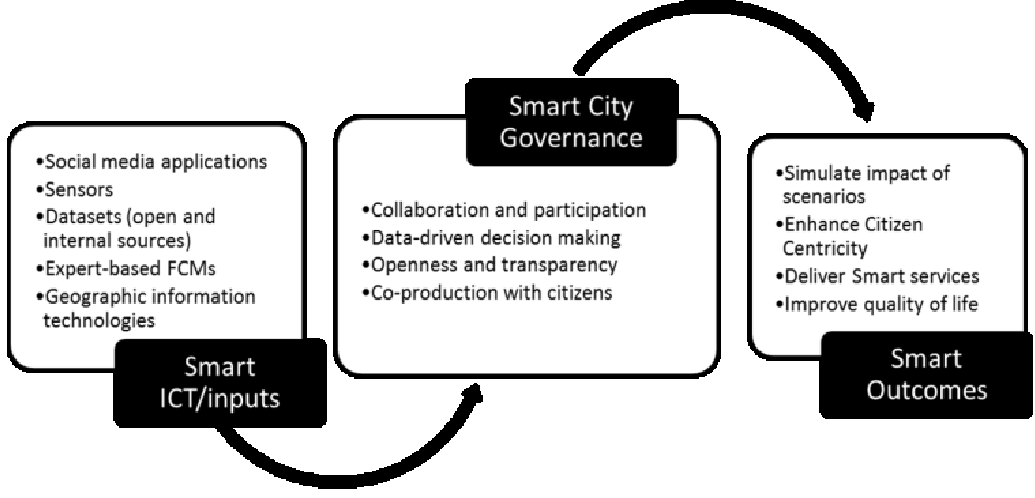 Figure 1: The SmartGov Framework showing the interplay between ICT inputs, governance dimensions, and smart outcomes.
Real-World Pilots & Results
The paper validates this approach through two distinct European pilots:
- Limassol, Cyprus (Waste & Mobility): By integrating GPS data from collection vehicles with social media traffic reports, the city optimized routes to minimize discharge of contaminants and reduce traffic hazards in residential areas.
- Quart de Poblet, Spain (School Safety): The project focused on "citizen centricity" by creating a safer environment for pupils. The FCM modeled the impact of school chaperones and "walking buses" on car density, resulting in a cleaner, safer perimeter during peak hours.
Critical Analysis & Conclusion
SmartGov excels at providing a structured yet flexible framework for evidence-based decision-making. By involving citizens as co-creators via social media feeds, it moves toward "We-Government" (Citizen Co-production).
Limitations: The reliance on "Expert-based" FCMs introduces potential bias; the initial structure of the map is only as good as the experts' understanding of the city. Additionally, the challenge of "Data Noise" in social media remains a significant hurdle for automated text analysis tools.
Future Outlook: As cities become more complex, the integration of AI-driven sentiment analysis into these Fuzzy Maps will be crucial. SmartGov sets the stage for "Digital Twins" of city governance, where every policy is tested in a virtual environment before touching the pavement.