
Digital Traces: How Crisis Responders Self-Organize in the Virtual Wild
Digital Traces of Online Self-Organizing and Problem Solving in Disaster
This paper explores the digital traces of online self-organization and problem-solving during natural disasters by analyzing Twitter (microblogging) and OpenStreetMap (collaborative mapping). It proposes a framework to understand how organizational structures emerge based on the explicitness of the shared site of work and the legibility of the activity record.
TL;DR
When disasters strike, physical infrastructure fails, but digital social structures ignite. This research dives into how people use Twitter and OpenStreetMap (OSM) to solve problems on the fly. By analyzing the "digital traces" of these activities, the paper reveals that the way a platform displays its history—its "visible record"—dictates how effectively strangers can coordinate life-saving information.
Background: Disaster as a Natural Experiment
Sociologists have long known that survivors are the true first responders. In the digital age, this response happens on social media. This paper positions natural disasters not just as tragedies, but as "fruitful settings for natural experiments." It asks a fundamental question of Computer Supported Cooperative Work (CSCW): How do people build a shared understanding when they aren't in the same room, or even on the same continent?
The Core Insight: The "Legibility" of Work
The author argues that self-organization depends on two critical factors:
- Shared Site of Work: Is there a central place (like a map in OSM) or is it decentralized (like a Twitter hashtag)?
- Visible Record: Can you see what others have already done?
In OSM, most mapping happens "behind the scenes" in databases (low legibility). In contrast, Twitter @replies create a visible conversational thread (high legibility). The paper explores how these differences change the resulting social network.
Methodology: Mixing Big Data with Human Context
To bridge the gap between "macro" social structures and "micro" individual actions, the researcher employs:
- Network Science: Mapping who talks to whom to find "structural organizational patterns."
- NLP and Qualitative Analysis: Reading the actual content of tweets and map edits to provide context to the math.
- Edit Sessions: Grouping individual actions into "temporal clusters" to understand the pace of work.
 Figure 1: Conceptual framing of how digital traces manifest in collaborative environments.
Key Findings: From Hurricane Sandy to Haiti
The study highlights two major case studies:
- Hurricane Sandy (Twitter): Retweet networks became denser and more transitively structured during the storm. Users in danger ignored celebrity gossip and focused purely on "actionable information" like evacuation notices and subway closures.
- Haiti Earthquake (OSM): The author identified seven distinct mapping practices, ranging from "parallel mapping" (people working on different things at once) to "tag correction" (fixing each other's work), which acts as a form of social auditing.
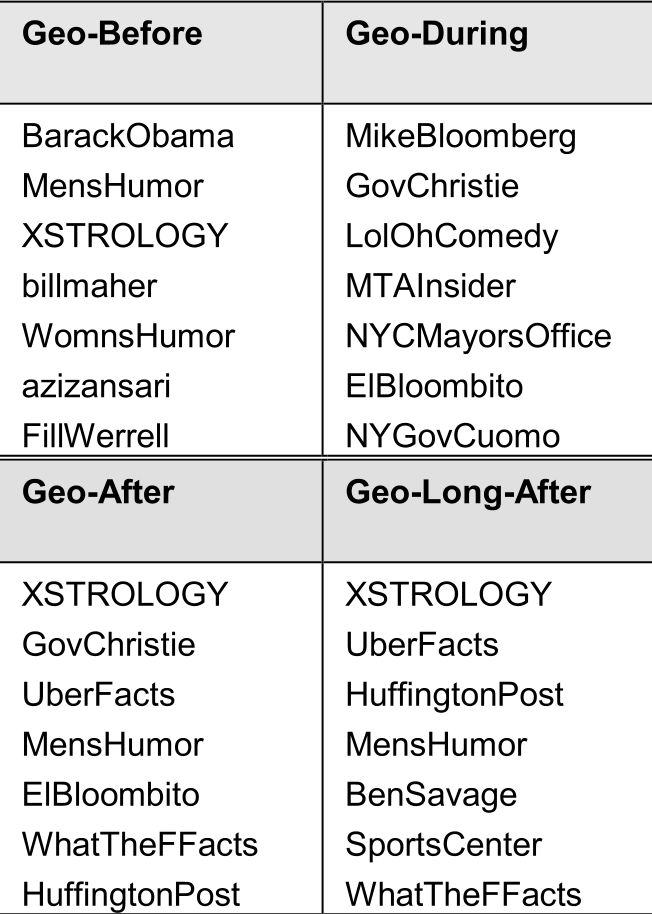 Table 1: Shift in network centrality. Note how during the crisis, authoritative accounts like
 @MikeBloomberg and @GovChristie replace entertainment figures.
Critical Insight & Future Outlook
The "takeaway" for developers of crisis tools is clear: Awareness is everything. If a platform doesn't show a user what has already been "fixed" or "mapped," efforts are duplicated and the community fragments.
The future of this work lies in analyzing "conversational mappings"—where users actively debate map tags. By understanding the "back and forth" of these digital traces, we can build more resilient systems that don't just host data, but foster the emergent communities that keep people safe.
Limitations
The data is inherently noisy. While Network Science finds the "signal," qualitative analysis is still required to understand the intent behind a tweet or an edit, making this research difficult to fully automate at scale.