
Secure Digital Healthcare: Defending IoT Vitals with Reinforcement Learning and AES Encryption
Digitalization of Healthcare with IoT and Cryptographic Encryption against DOS Attacks
This paper introduces a smart remote healthcare monitoring system based on IoT, utilizing Q-Learning for health state classification and AES-128 encryption to defend against DoS and Man-in-the-Middle (MiM) attacks. The framework leverages wearable sensors and LoRaWAN connectivity to provide real-time virtual consultations and emergency alerting.
TL;DR
This research addresses the critical shortage of medical professionals in India by proposing a secure IoT-based remote monitoring system. By combining Q-Learning for intelligent health status classification and AES-128 encryption for data protection, the system successfully detects and mitigates DoS and Man-in-the-Middle (MiM) attacks while maintaining lower latency than traditional MD5-based systems.
Problem & Motivation: The Vulnerability of Virtual Care
With a staggering government doctor-to-patient ratio of 1:11,082 in India, remote healthcare is no longer a luxury—it is a necessity. However, moving medical data to the cloud opens a "Pandora's box" of security risks.
- DoS Attacks: Can paralyze hospital networks, preventing critical alerts from reaching doctors.
- Man-in-the-Middle (MiM): Allows attackers to alter vital signs (like heart rate), potentially leading to incorrect diagnoses or fatal medical interventions.
The authors identify that current systems often focus on monitoring but neglect the computational efficiency of security protocols and the predictive accuracy of emergency triggers.
Methodology: The Three-Phase Framework
The researchers break down their smart healthcare architecture into a modular flow designed for both responsiveness and resilience.
1. Data Collection and Transmission
Using Arduino UNO and various medical sensors, the system captures pulse rates and body temperatures. These analog signals are converted to digital data and transmitted via LoRaWAN to a cloud environment (hosted on GoDaddy/Amazon EC2).
2. Intelligent Monitoring via Q-Learning
Unlike static threshold systems, the proposed method employs a Q-Learning (Reinforcement Learning) algorithm. Transitions between health states are rewarded or penalized based on how far the data deviates from ideal parameters.
- Reward: Calculated if values remain within safe thresholds.
- Penalty: Assessed when values exceed limits.
- Trigger: If the cumulative "Penalty Score" exceeds a specific weight, a critical alert is pushed to the doctor's application.
3. End-to-End Security Layer
To prevent data exposure, the system implements AES-128 bit encryption. This ensures that even if packets are intercepted (Sniffing), the plain text remains hidden. A Role-Based Access Control (RBAC) mechanism further ensures that only authorized medical personal can access sensitive records.
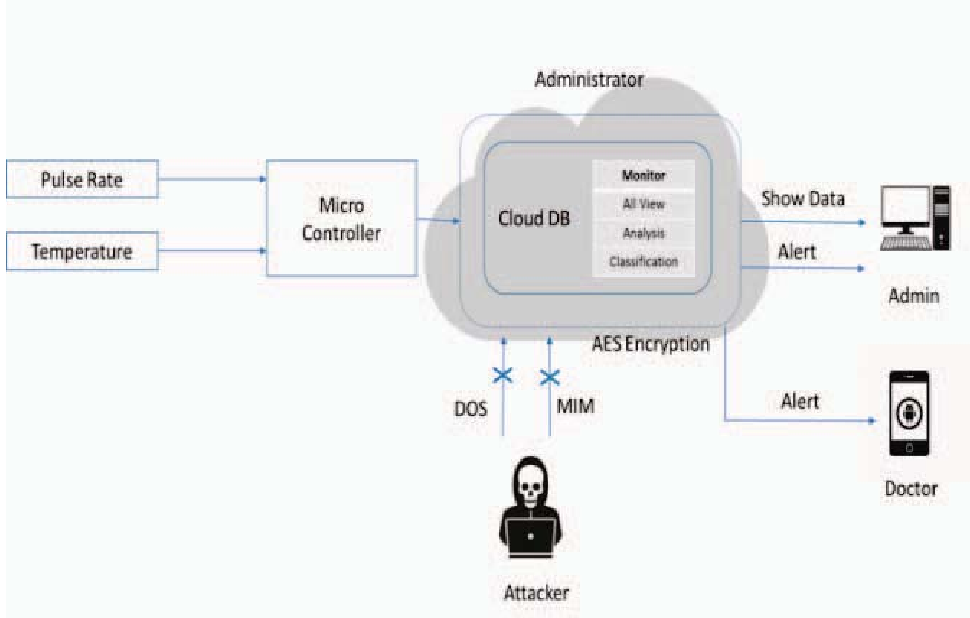 Figure 1: The proposed end-to-end IoT architecture from sensor to cloud GUI.
Experiments & Results: Efficiency and Defense
The system was tested on a dataset of 100,000 records across 100 patients.
Encryption Performance
A key finding was that the proposed AES implementation outperformed traditional MD5 in terms of processing speed. As data size increases, the efficiency gap widens, which is crucial for real-time medical monitoring.
| Data Size (KB) | MD5 Encryption (ms) | AES Encryption (ms) |
|---|---|---|
| 5 KB | 595 | 515 |
| 20 KB | 2260 | 2064 |
Attack Mitigation
The system demonstrated high effectiveness in identifying malicious traffic. DoS attack prevention accuracy remained consistently above 94%, while MiM detection hovered between 90% and 94% across different trials.
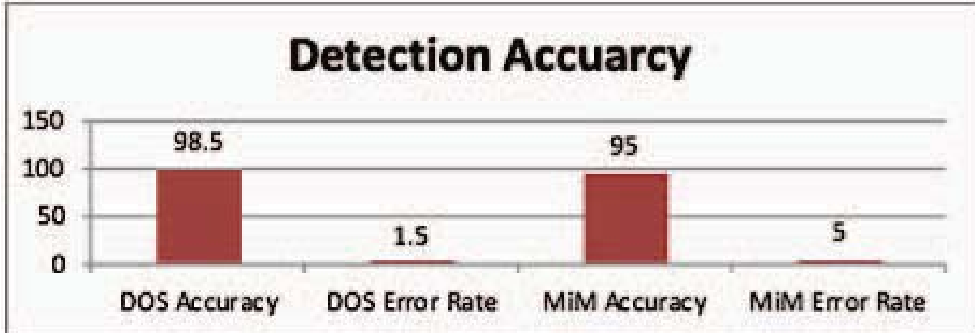 Figure 2: Accuracy of the system in preventing DoS and MiM attacks.
Critical Analysis & Conclusion
Takeaway
The paper successfully demonstrates that heavy-duty security (AES) and intelligent classification (RL) can coexist in an IoT environment. The shift from simple "if-else" triggers to a reinforcement learning "penalty-reward" system allows for more nuanced health alerts.
Limitations & Future Work
- Complexity: While symmetric AES is efficient, the paper notes that asymmetric encryption is still too resource-heavy for simple sensor nodes.
- DDoS Resistance: The authors admit the current system lacks strong resistance to Distributed DoS (DDoS) and suggest exploring Software-Defined Networking (SDN) as a future solution.
- Hardware Constraint: The implementation relies on specific hardware (Ardunio/LoRaWAN); future iterations should focus on cross-platform protocol interoperability.
In conclusion, this work provides a robust blueprint for securing the next generation of digital healthcare, ensuring that the "Internet of Medical Things" is as safe as it is convenient.