
DINOv3-IML: Redefining Image Forensics with a Simple Foundation Model Baseline
DINOv3 Beats Specialized Detectors: A Simple Foundation Model Baseline for Image Forensics
DINOv3-IML is a simple yet high-performance baseline for Image Manipulation Detection and Localization (IMDL) that leverages a frozen DINOv3 backbone with LoRA adaptation and a lightweight convolutional decoder. It achieves a new SOTA by improving average pixel-level F1 by 17.0 points over previous specialized detectors on standard benchmarks.
TL;DR
The field of Image Manipulation Detection and Localization (IMDL) has long been dominated by specialized, complex architectures. DINOv3-IML shatters this status quo by proving that a simple, frozen DINOv3 foundation model with LoRA adaptation can outperform the most sophisticated specialized detectors by a staggering 17.0 F1 points. This work marks a shift from "architectural engineering" to "representation adaptation" in image forensics.
Problem & Motivation: The Complexity Trap
Detecting "fakes" is notoriously difficult because manipulation cues—like splicing boundaries or copy-move artifacts—are often subtle, local, and non-semantic. To capture these, researchers have built increasingly baroque models with multi-view fusion and hybrid CNN-Transformer schemes.
However, these specialized designs often suffer from two issues:
- Fragile Generalization: High performance on one dataset rarely transfers to another.
- Poor Scaling: They don't benefit efficiently from the massive pre-training data used by foundation models.
The authors ask a fundamental question: Can the rich, self-supervised spatial priors in DINOv3 serve as a superior foundation for forensics without the need for complex task-specific heads?
Methodology: The Power of Simplicity
The proposed framework is intentionally minimal to isolate the effectiveness of the backbone features.
1. The Backbone (DINOv3)
The model uses a frozen DINOv3 encoder (ViT-S, B, or L). DINOv3's self-supervised pre-training naturally learns to encode fine-grained spatial structures, making it exceptionally good at spotting the "statistical discontinuities" introduced by image editing.
2. Adaptation (LoRA)
Instead of full fine-tuning, which can "overwrite" the robust pre-trained features (especially when forensic data is scarce), the authors use LoRA (Low-Rank Adaptation) on the Attention layers' QKV projections. This keeps the core knowledge frozen while steering the model toward forensic artifacts.
3. Lightweight Decoder
The "head" is just a three-layer CNN that upsamples patch tokens to a pixel-level mask.
 Figure 1: The DINOv3-IML pipeline. Dense features from a frozen ViT are efficiently adapted via LoRA and translated into masks by a minimal Conv3 head.
Experiments: Breaking the SOTA
The results are a "wake-up call" for the forensics community. Under the CAT-Net protocol (large-scale multi-source training), DINOv3-IML doesn't just win; it dominates.
| Method | Backbone | Avg. F1 (CAT-Net) | | :--- | :--- | :--- | | Mesorch (Prior SOTA) | Hybrid | 0.677 | | DINOv3 + LoRA | ViT-S | 0.704 | | DINOv3 + LoRA | ViT-L | 0.847 |
Even the smallest variant (ViT-S) beats the previous best specialized model.
The "Collapse" of Full Fine-tuning
Perhaps the most insightful finding occurs in the data-scarce regime (MVSS-Net protocol). When training data is limited (only ~5k images), full fine-tuning becomes unstable and fails. LoRA, by contrast, maintains high performance by preserving the DINOv3 priors.
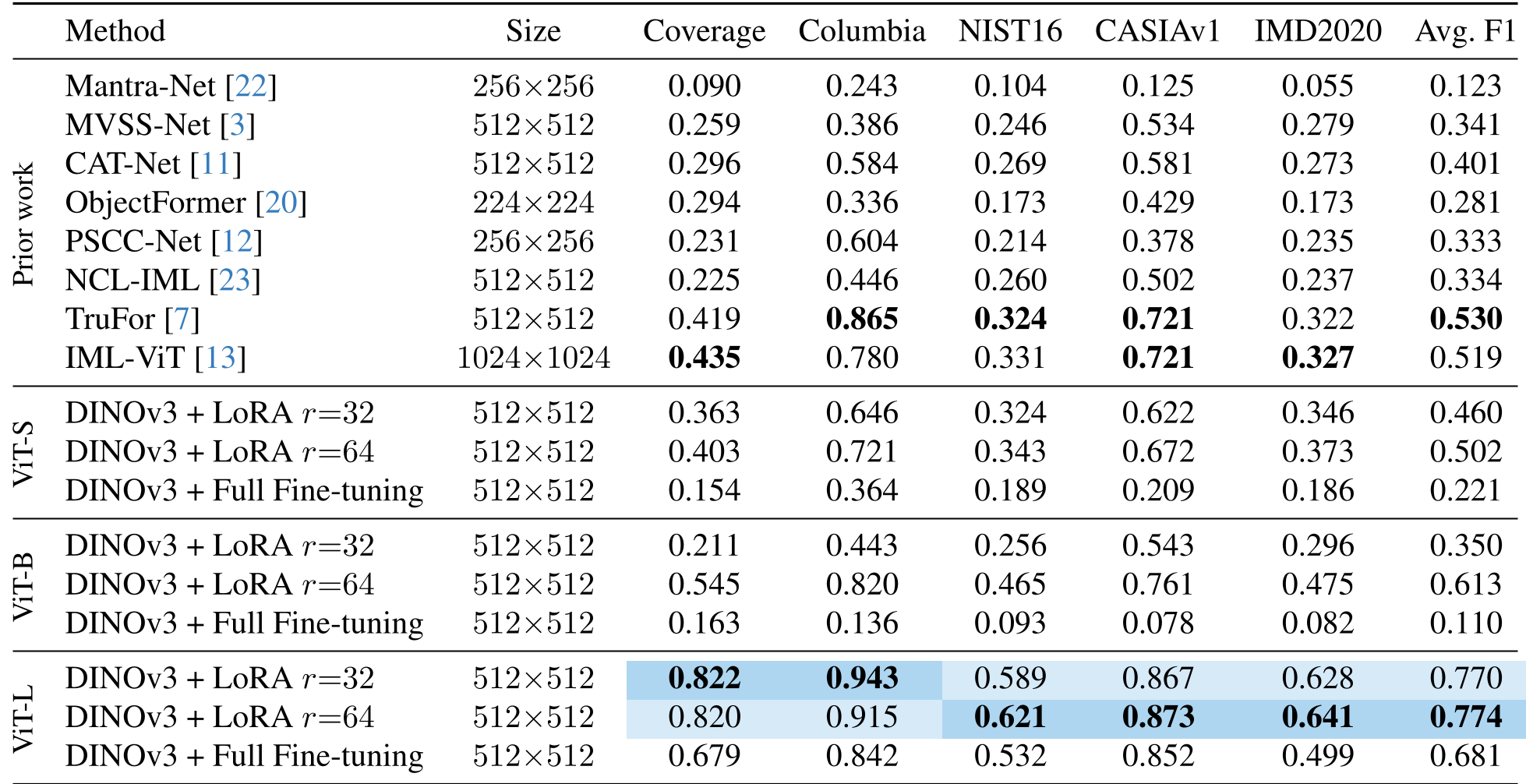 Table 2: Comparison under the restricted MVSS-Net protocol. DINOv3+LoRA maintains a huge lead, while full finetuning (FullFT) for ViT-B collapses to 0.110.
Robustness: Noise vs. Blur
The baseline shows impressive resilience to Gaussian noise and JPEG compression. However, Gaussian blur remains the "Achilles' heel" for all models, including this one. The authors hypothesize that since ViTs operate on 16x16 patches, blur spreads information across patch boundaries, corrupting the spatial discontinuities the model relies on.
Critical Insight: Why Does This Work?
- Representation vs. Task: DINOv3 has seen millions of natural images; it knows what "natural" textures and edges look like. Manipulation creates localized "unnaturalness."
- LoRA is Key: By constraining adaptation to a low-rank subspace, the model retains its "common sense" about images while learning to highlight pixel-level forgeries.
- Scaling Laws for Forensics: This paper proves that IMDL is not immune to the benefits of scaling backbones.
Conclusion
DINOv3-IML proves that in image forensics, less architecture is more. By moving away from complex fusion modules and focusing on adapting powerful foundation models, researchers can achieve vastly superior accuracy and robustness. This work provides a new, high-bar baseline that will likely become the standard reference for all future IMDL research.
Takeaway: If you are still building specialized CNN-Transformer hybrids for forensics from scratch—stop. Grab a DINOv3 backbone, inject LoRA, and focus on the data.