
DIPP: How Privacy Preferences Go Viral in Social Networks
DIPP: Diffusion of Privacy Preferences in Online Social Networks
The paper introduces DIPP (Diffusion of Privacy Preferences), a multi-agent system that models how human privacy behaviors spread through online social networks (OSNs). By adapting the epidemiological SIR model, the authors demonstrate that privacy preferences behave like "infectious" information, where users imitate the sharing habits of their social circle.
TL;DR
Privacy is not just a personal setting; it's a social contagion. The DIPP (Diffusion of Privacy Preferences) model proves that our "sharing habits" spread through social networks like a virus. By applying epidemic modeling (SIR) to multi-agent systems, this research reveals how high-influence "super-spreaders" dictate privacy norms and how building "trust-based immunity" can protect users from privacy violations.
Problem & Motivation: The "Social" in Social Privacy
Most privacy tools treat you as an island. You set a toggle, and your privacy is "fixed." But in the real world, if your friend posts a photo of you at a party without your consent, your privacy is violated regardless of your settings.
The authors argue that privacy behaviors are dynamic. When we see friends sharing certain types of content (e.g., "Work" photos at "Night"), we are more likely to copy that behavior. This creates a ripple effect. The core problem is: How do these preferences spread, and can we model them to predict—and prevent—privacy erosion?
Methodology: The SIR Model for Privacy
The researchers reimagined the classic SIR (Susceptible, Infected, Resistant) model, typically used for viruses like COVID-19 or flu, and applied it to metadata "contexts" (Location + Time).
- Susceptible (S): You see a friend sharing specific content but haven't started doing it yourself yet.
- Infected (I): You have "caught" the habit and are now sharing similar content, potentially "infecting" your neighbors.
- Resistant (R): You've had a bad experience (a privacy violation) or the trend died out. You no longer share that content and are "immune" to the trend.
The Secret Sauce: Trust and Co-ownership
Unlike a biological virus, "Privacy Infection" is mediated by Trust. If a friend violates your privacy, your trust in them drops. In the DIPP model, lower trust acts as a barrier, reducing the "Infection Rate" ().
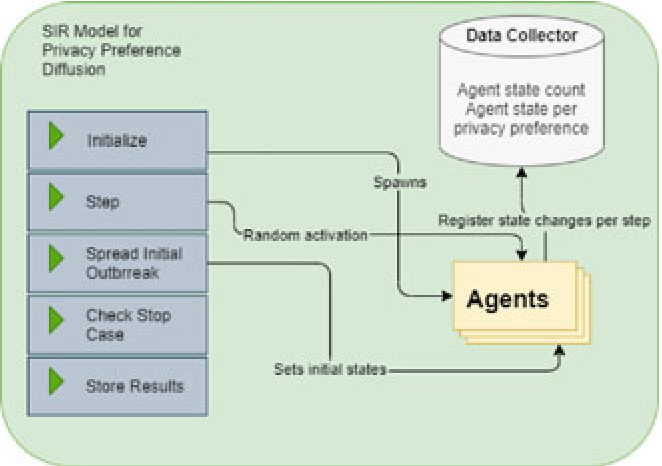 Figure 1: The Multi-agent framework where agents share content, perceive neighbors, and update trust levels.
Experiments: Who Drives the Trend?
The authors tested DIPP using the Copenhagen Networks Study, a real-world dataset of Facebook interactions.
1. The Power of "Super-Spreaders"
The study confirms that Node Degree (how many friends you have) is the ultimate predictor of influence. When the top 1% of well-connected users adopt a "rare" privacy preference, it spreads significantly faster and wider than if a fringe user starts it. This suggests that "privacy influencers" have a massive responsibility in defining what is "normal" to share.
2. Trust as a Vaccine
When trust modeling was introduced, the "Epidemic Peak" (the maximum number of people sharing risky content) dropped. By registering "Level 1" (unwanted context) and "Level 2" (unauthorized co-owned content) violations, agents built a collective defense mechanism.
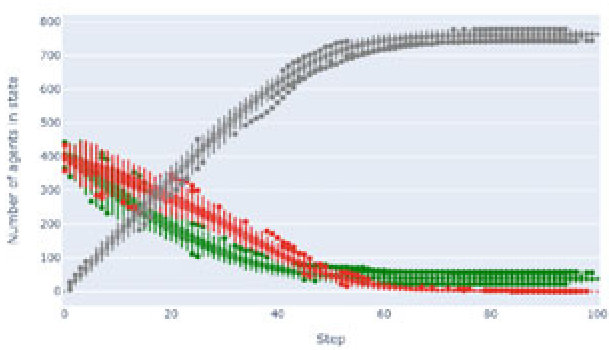 Figure 2: Comparison of state dynamics. Note how the "Infected" curve (red) flattens and declines faster when trust and recovery mechanisms are active.
Critical Insight: Can We Protect Privacy at Scale?
The DIPP model provides a rigorous mathematical foundation for something we've felt intuitively: Online behavior is peer-pressured.
Takeaways for the Industry:
- Platform Design: Social networks should implement "Trust Scores" or "Privacy Feedback Loops" that mimic the DIPP recovery rate. If a user's post is frequently flagged by co-owners, their "Infectivity" (visibility in feeds) should decrease.
- Limitations: The model assumes users are rational and respond to trust consistently. In reality, some users may continue sharing regardless of social friction.
- Future Work: The next step is testing this on varied network topologies (e.g., small-world vs. scale-free) to see if some network shapes are naturally more "privacy-resilient."
Conclusion
By treating privacy as a diffusion process rather than a static choice, DIPP opens a new frontier in Social Cybersecurity. It’s a reminder that in the digital age, your privacy is only as strong as the "immunity" of your social circle.