
Directed Social Queries: Breaking the Black Box of Social Recommendations
Directed social queries with transparent user models
The paper introduces a novel self-organizing tool designed to facilitate directed social queries by matching a user's friends to specific interests or questions using machine learning. By utilizing "Transparent User Models" and interactive visualizations, it enables users to identify, verify, and filter the most relevant friends from large social networks for precise social interactions.
TL;DR
Managing large social circles makes it nearly impossible to find "the right person for the job" manually. This paper presents an experimental system that doesn't just recommend friends for your questions—it explains why it chose them. By combining Wikipedia-enhanced semantic modeling with transparent UI designs, the system achieves a "human-in-the-loop" synergy where users can catch and correct machine learning errors in real-time.
The "Large Friend List" Paradox
In the era of massive social networks, our digital connections often outpace our cognitive ability to manage them. If you want to ask a specific question—say, about a vintage Windows phone or a niche salsa dancing event—the generic "post to wall" approach is noisy and inefficient. Prior works in "group creation" (like ReGroup) helped, but they often acted as black boxes. If the system recommended your boss for a party invite, you wouldn't know why, and you wouldn't know how to fix the underlying model.
The authors identify a critical gap: Transparency. Without knowing the "personality" or the specific "interests" the AI is tracking, users cannot trust directed social queries.
Methodology: From "Likes" to Semantic Meaning
The technical core of the system relies on a three-stage pipeline:
- Semantic Enrichment: Recognizing that a Facebook "Like" (e.g., "The Matrix") is too sparse for deep modeling, the system scrapes Wikipedia to build a high-dimensional bag-of-words for every interest.
- Shared Interest Modeling: The system calculates co-occurrence across the user's entire network to find "Shared Interests"—latent clusters of topics that define different segments of your social circle.
- Personality Mapping: Using Thayer’s Activation-Deactivation Adjective Check List, the system maps these semantic bags-of-words to personality traits (e.g., "Energetic Soul" vs "Sleepy Soul"), adding a layer of social psychology to the recommendation.
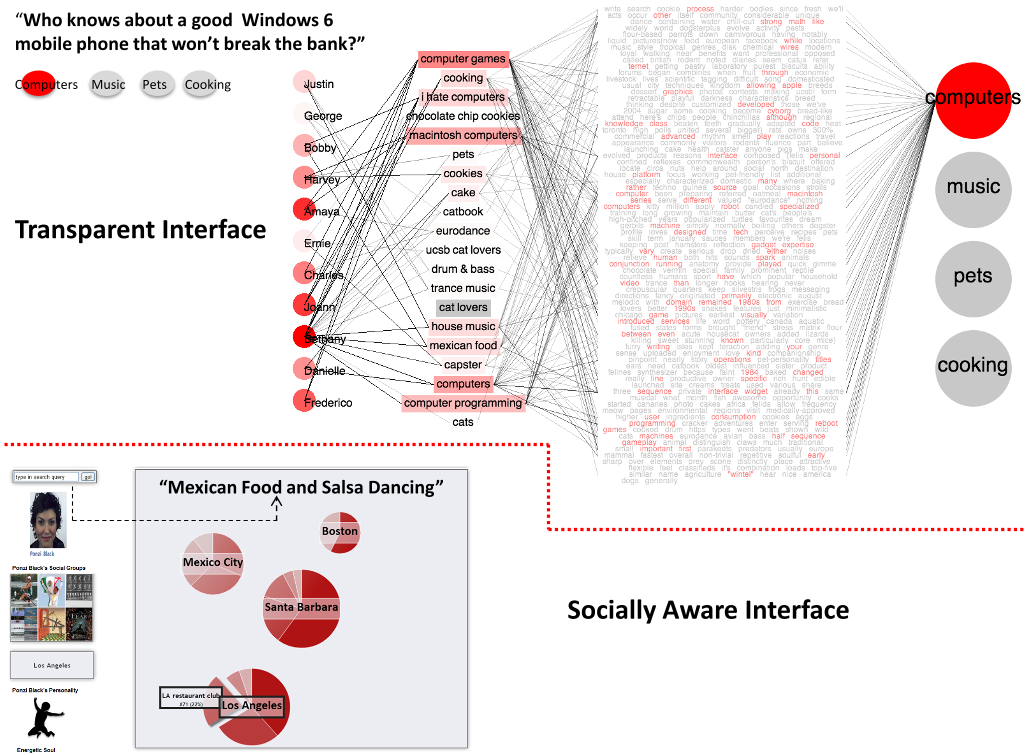 Figure 1: The dual-interface approach. Top: The Transparent Verification Interface showing "Shared Interests" mapped to specific friend recommendations. Bottom: The Socially-Aware Interface incorporating spatial and personality data.
High-Fidelity Interaction: Two Specialized Views
The authors propose that "one size fits all" doesn't work for social visualization. They developed two distinct modes:
- The Transparent Verification Interface: Designed for accuracy. It shows exactly which "Like" triggered a recommendation. If a friend is suggested for a "Windows Phone" query because they liked "Microsoft," the user can see that link and verify if it’s still relevant.
- The Socially-Aware Interface: Designed for context. It utilizes spatial (geographical location) and social (Facebook group memberships) variables. It’s not just about who knows the answer, but who is nearby and who has the right vibe (personality) to engage with.
Experimental Results: The Power of Seeing
The most compelling result from their qualitative analysis was the verification test. The researchers intentionally injected "wrong" data—linking friends to interests they didn't actually have.
The result? Without any prompting, every single participant noticed the errors. Because the UI was transparent, the human-in-the-loop was able to function as a final error-checker for the machine learning model. This proves that transparency isn't just a "nice-to-have" feature; it's a functional requirement for accurate social data modeling.
Critical Analysis & Takeaways
This 2012 work was remarkably prescient regarding the "Explainable AI" (XAI) movement.
- The SOTA Edge: While modern LLMs can now do this semantically with zero-shot learning, the UI/UX philosophy here remains relevant: users should never be forced to trust a recommendation they cannot inspect.
- Limitations: The reliance on Facebook groups and "Likes" is a product of its time. In today's landscape, we would likely replace the Wikipedia-bag-of-words approach with Vector Embeddings from models like BERT or Ada.
- The Future: As we move toward personal AI agents, the "Socially Aware" components (personality and spatial context) will be the key differentiators between a useful assistant and a spam generator.
In summary, this work illustrates that the best social tools are those that treat the user as a partner, providing the "why" behind every "who."