
From Welfare to Work: A System Dynamics Perspective on Disability Employment
Disabled People from Welfare to Jobs: A Decision Support Tool
This paper introduces a Decision Support Tool (DST) built using System Dynamics (SD) to address the stagnant employment rates of disabled people in Norway. Combining extensive literature reviews with original surveys of disabled individuals and employers, the authors developed a simulation model and an Interactive Learning Environment (ILE) to test policy scenarios inspired by successful vocational programs like Telenor’s "Open Mind."
TL;DR
Norway faces a persistent paradox: despite high investment, disability employment rates have been stagnant for 20 years. This paper presents a System Dynamics (SD) simulation tool that models the complex feedback loops between welfare recipients, skeptical employers, and governmental policies. By gamifying policy-making through an Interactive Learning Environment (ILE), the research provides a roadmap for shifting disabled citizens from welfare dependency to tax-paying employment.
Background: The Norwegian Paradox
While Norway’s neighbors like Sweden and Denmark boast disability employment rates of 62% and 53% respectively, Norway has been stuck at 44%. The problem isn't a lack of funding, but rather the inefficiency of the "vocation-first" approach. Traditional programs often keep participants in training for too long, causing them to lose touch with the job market, or they fail to address the "Attitude Gap" of employers who fear the cost of reasonable accommodation.
Methodology: Simulating Social Diffusion
The core of this research is the mapping of social behaviors onto mathematical stocks and flows.
1. The Bass Diffusion Logic
The authors treat "interest in work" and "interest in hiring" as a diffusion process. Just as a new product spreads through a population, the idea of hiring disabled people spreads via social exposure and imitation.
- Disabled People Sector: Captures the transition from being a welfare recipient to someone "interested in work" and finally to becoming an "employed taxpayer."
- Employer Sector: Models how companies move from being "Targeted Employers" to "Employers ready to recruit" once they understand the benefits and available subsidies.
2. The HCP (Handicap-Programme) Blueprint
Inspired by Telenor’s "Open Mind" program, the model introduces a specific structure where the government acts as a facilitator for on-the-job training.
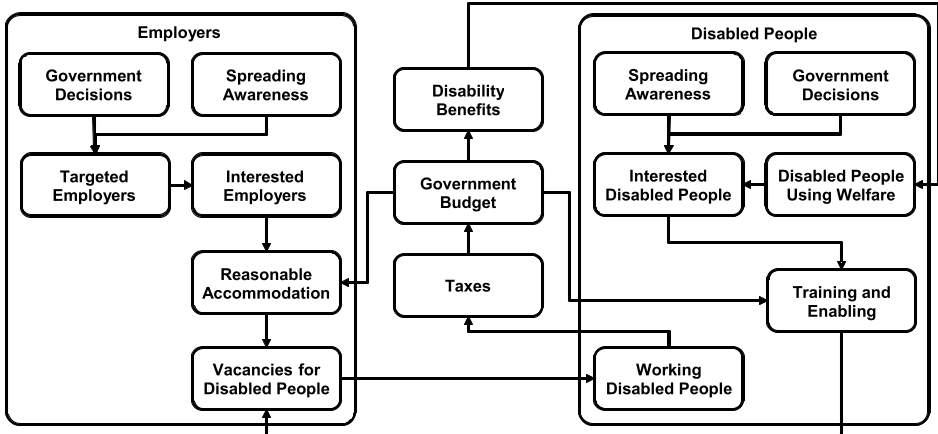 Figure 1: The flow of disabled people through the system, from welfare to work via "imitation" effects and vacancy matching.
Key Insights: Why Attitudes Matter
Unlike many economic models that only look at dollar amounts, this tool incorporates Attitude Sectors. By surveying 302 disabled individuals and 103 employers, the authors quantified:
- The "Enabling Factors" (e.g., technical aids, transport).
- The "Encouraging Factors" (e.g., wage subsidies, mentoring).
The simulation reveals that Advertising (increasing awareness) coupled with Reasonable Accommodation creates more vacancies than pure skill-based training.
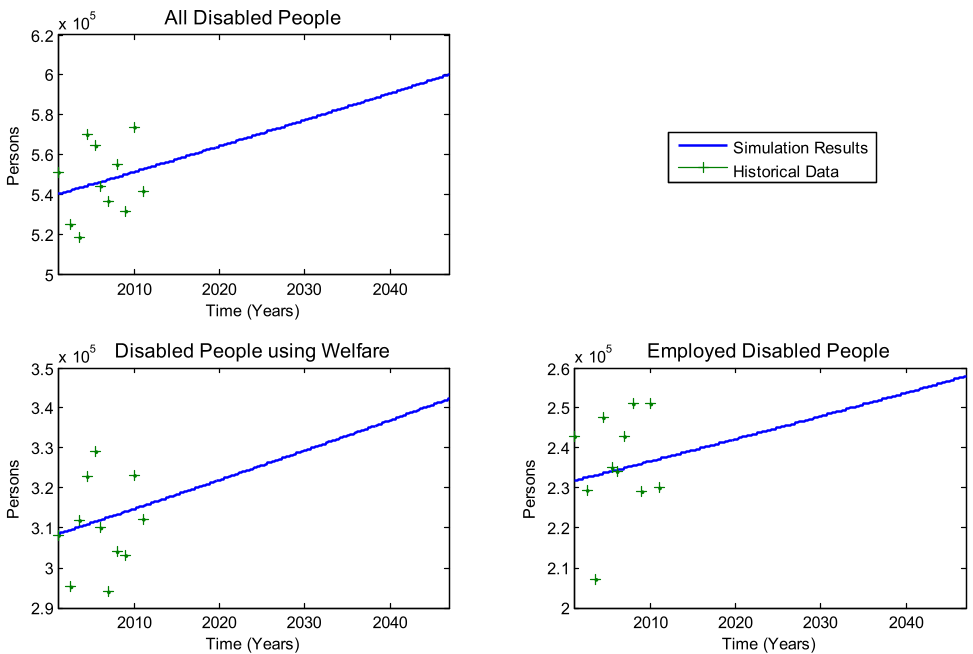 Figure 2: Model behavior reproduction comparing simulated stocks of welfare recipients and employees against historical Norwegian data.
Strategic Value for Policy Makers
The authors transformed their complex differential equations into an Interactive Learning Environment (ILE). This allows a policy maker to drag a slider—for example, increasing advertising spend or wage subsidies—and see the immediate impact on the national budget over 20-30 years.
Deep Insight
The model highlights a "Net Savings" trajectory. While programs like HCP have high upfront costs, the accumulated savings—from stopped disability benefits and newly generated tax revenue—eventually create a positive financial bottom line for the state.
Conclusion & Limitations
This work demonstrates that disability employment is not just a labor issue but a feedback system problem. The primary limitation noted by the authors is "Ecological Validity"—attitudes change over time, and the convenience samples used in the surveys may not represent the entire population. However, as a decision-support tool, it provides a crucial "flight simulator" for governments to test inclusive policies before implementation.
Takeaway for the Future
To break the 20-year stagnation, Norway must pivot from "teaching the disabled to work" to "teaching the market to hire." System Dynamics proves that small interventions in employer awareness provide higher leverage than massive investments in isolated classroom training.