
Disambiguating the Web: Leveraging Social Networks to Solve the "Namesake" Problem
Disambiguating Web appearances of people in a social network
This paper introduces two unsupervised frameworks to solve the problem of Web person name disambiguation by leveraging social network context. It proposes a Link Structure model based on page interconnectedness and the Agglomerative/Conglomerative Double Clustering (A/CDC) method, achieving an 80.3% F-measure on a real-world dataset of 1,000+ hand-labeled pages.
TL;DR
When you Google a colleague like "Andrew McCallum," you don't just find a CS professor; you find a musician, a student, and a dozen others. This paper presents a breakthrough unsupervised approach that uses the social network context (your other contacts) to automatically filter out namesakes. By combining link analysis with a novel dual-clustering algorithm (A/CDC), the researchers achieved an 80% success rate in identifying the "correct" person without any manual training data.
Background: Why Names Are Not Unique
Identity uncertainty is a fundamental challenge in Information Retrieval. While "Adam Cheyer" might be unique, names like "Bill Mark" or "David Israel" are magnets for ambiguity—often fetching pages about legislative "bills" or the country "Israel" rather than the actual individuals.
The core insight of Bekkerman and McCallum is that people don't exist in a vacuum. If you are looking for a specific "Andrew McCallum," he is likely connected to a "Tom Mitchell" or a "Fernando Pereira." This social graph provides the "background knowledge" (K) necessary to distinguish the real person from the digital noise.
Methodology: The Power of Interaction
The authors propose two primary frameworks that work in tandem:
1. The Link Structure Model
This model assumes that acquaintances are likely to be interconnected through their web presence (sharing domains, referring to similar resources, or literal hyperlinks).
- The Central Cluster: The system identifies the largest connected component of pages retrieved by multiple different names in your social group.
- The Distance Metric: It uses a specialized
tfidfvariation weighted by Google’s document frequency to measure cluster similarity.
2. A/CDC (Agglomerative/Conglomerative Double Clustering)
Based on the Information Bottleneck (IB) principle, this method performs "Double Clustering." It clusters documents based on word distributions while simultaneously clustering words based on document distributions.
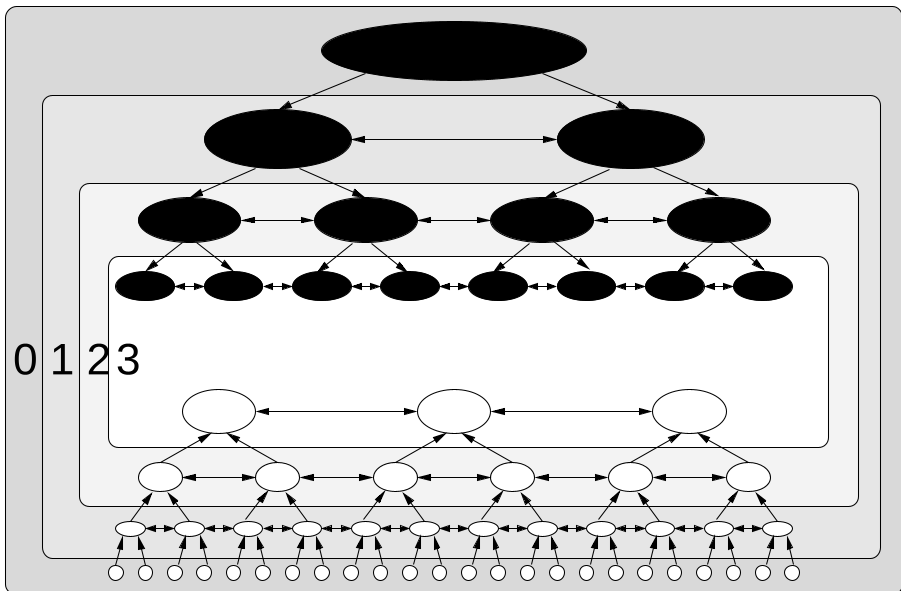
- The Intuition: Similar documents use similar words, and similar words appear in similar documents. By "bootstrapping" these two processes—merging documents (bottom-up) and splitting words (top-down)—the model finds a local maximum of Mutual Information, effectively isolating the specific professional "vocabulary" of the person you are looking for.
Experiments: Beating the Baseline
The researchers tested their models on a hand-labeled dataset of 1,085 pages.
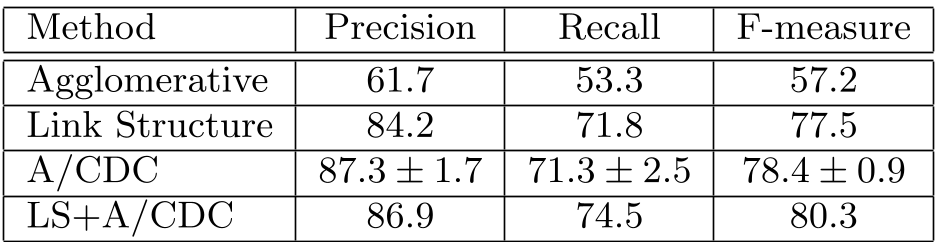
- SOTA Comparison: Compared to traditional Agglomerative Clustering (the prior standard), their Hybrid LS+A/CDC model increased the F-measure from 57.2% to 80.3%.
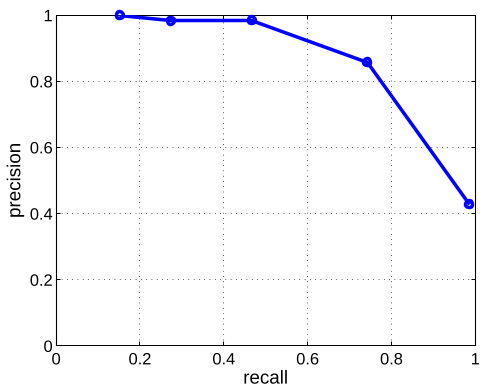
- Handling "Doubles": One of the toughest tests involved separating two different "Fernando Pereiras," both of whom are CS professors. The A/CDC algorithm was able to maintain high precision even at finer granularities, successfully distinguishing between the two individuals by their specific sub-fields of research.
Critical Insight: The "Precision/Recall" Trade-off
As shown in the graph below, the A/CDC algorithm allows for different levels of "granularity." If you need 100% precision (e.g., for an automated contact book), you can stop the algorithm early when clusters are small but extremely pure.
Conclusion & Future Outlook
This work proves that unsupervised learning, when guided by the natural structure of human social networks, can solve highly complex disambiguation tasks. While the 2005 context focused on hyperlinks and keyword distributions, the underlying logic is a direct precursor to how modern Knowledge Graphs and RAG (Retrieval-Augmented Generation) systems handle entity resolution today.
The primary limitation remains "vanishing web presence"—if a person (like the Stanford student David Mulford in the study) has only one page online, the lack of "interconnectedness" makes him nearly invisible to link-based models. Future iterations may need to incorporate cross-platform data (Social Media, LinkedIn) to thicken the graph.