
Discontinued Public Spheres: Why Recurring Social Conflicts Don't Bring Back the Same Crowd on Twitter
Discontinued Public Spheres? Reproducibility of User Structure in Twitter Discussions on Inter-ethnic Conflicts
The study examines the structural stability of the "networked public sphere" by comparing two German Twitter discussions on inter-ethnic conflicts (Cologne 2016 and Chemnitz 2018). Using vocabulary-based web crawling and influencer analysis, it reveals a significant lack of reproducibility in user participation and influencer dynamics.
TL;DR
Do the same people show up to debate the same issues over time? According to a comparative study of two major German inter-ethnic conflicts (Cologne 2016 and Chemnitz 2018), the answer is a resounding "No." With a mere 5% overlap in participants and a massive shift toward formal politicization, the study suggests that Twitter's public sphere is structurally ephemeral, anchored only by a handful of traditional media outlets.
The Problem: The "Dissipative" Nature of Digital Debate
Communication scholars have long worried that the "Public Sphere"—once envisioned by Jürgen Habermas as a stable space for rational discourse—has become fragmented. On Twitter, discussions often flare up as "ad hoc publics" around specific hashtags and then vanish.
The authors identify a critical gap: Structural Discontinuity. If the participants in a discussion change entirely every time a similar event occurs, can society ever reach a stable consensus? To test this, they compared two "ethnicity-related" conflicts in Germany that triggered massive national debates but were separated by nearly three years.
Methodology: Identifying the Influencer "Carcass"
The research team used a custom web crawler to aggregate data from:
- The 2016 Cologne New Year's Eve assaults (12,382 users).
- The 2018 Chemnitz protests (22,973 users).
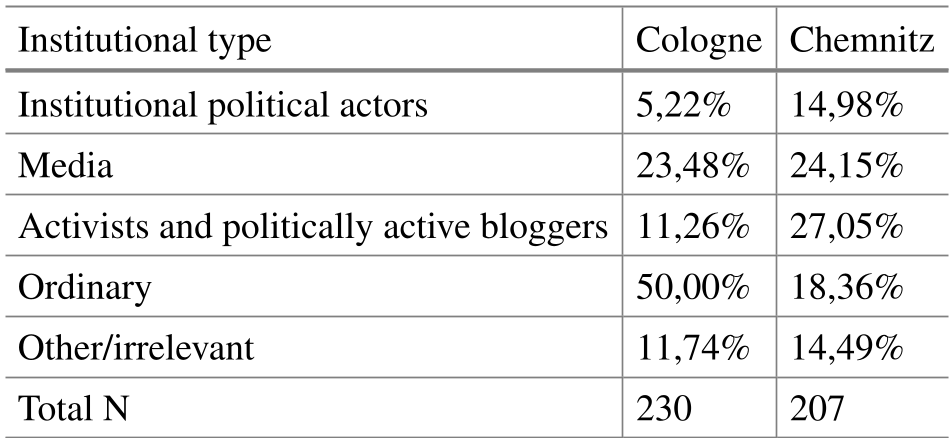
They didn't just look at who tweeted the most; they analyzed Centrality Metrics (Indegree, Betweenness, Pagerank) to find the true influencers. These influencers were then manually categorized into Media, Politicians, Activists, and Ordinary Users.
Key Findings: A Shifting Foundation
1. The 95% Turnover
The most shocking result was the lack of overlap. Only 1,735 users participated in both the Cologne and Chemnitz discussions. When looking specifically at the "Top Users" (influencers), the reproducibility was even lower—only 7% of top users from the first case appeared in the second.
2. Media as the Only Constant
If there is any "carcass" or skeleton to these discussions, it consists of national media outlets (like BILD, SPIEGEL ONLINE, and Tagesschau). Out of the 16 users who managed to remain influential in both years, 13 were media organizations.
3. The Surge of Professional Politicization
Between 2016 and 2018, the nature of the German Twitter sphere changed. The participation of institutionalized politicians tripled (from 5.2% to 14.9%), and grassroots activists doubled. This suggests that while ordinary citizens might treat these events as fleeting moments, political parties (especially the AfD) have professionalized their presence to capture these "ad hoc" moments.
Deep Insight: Efficiency vs. Engagement
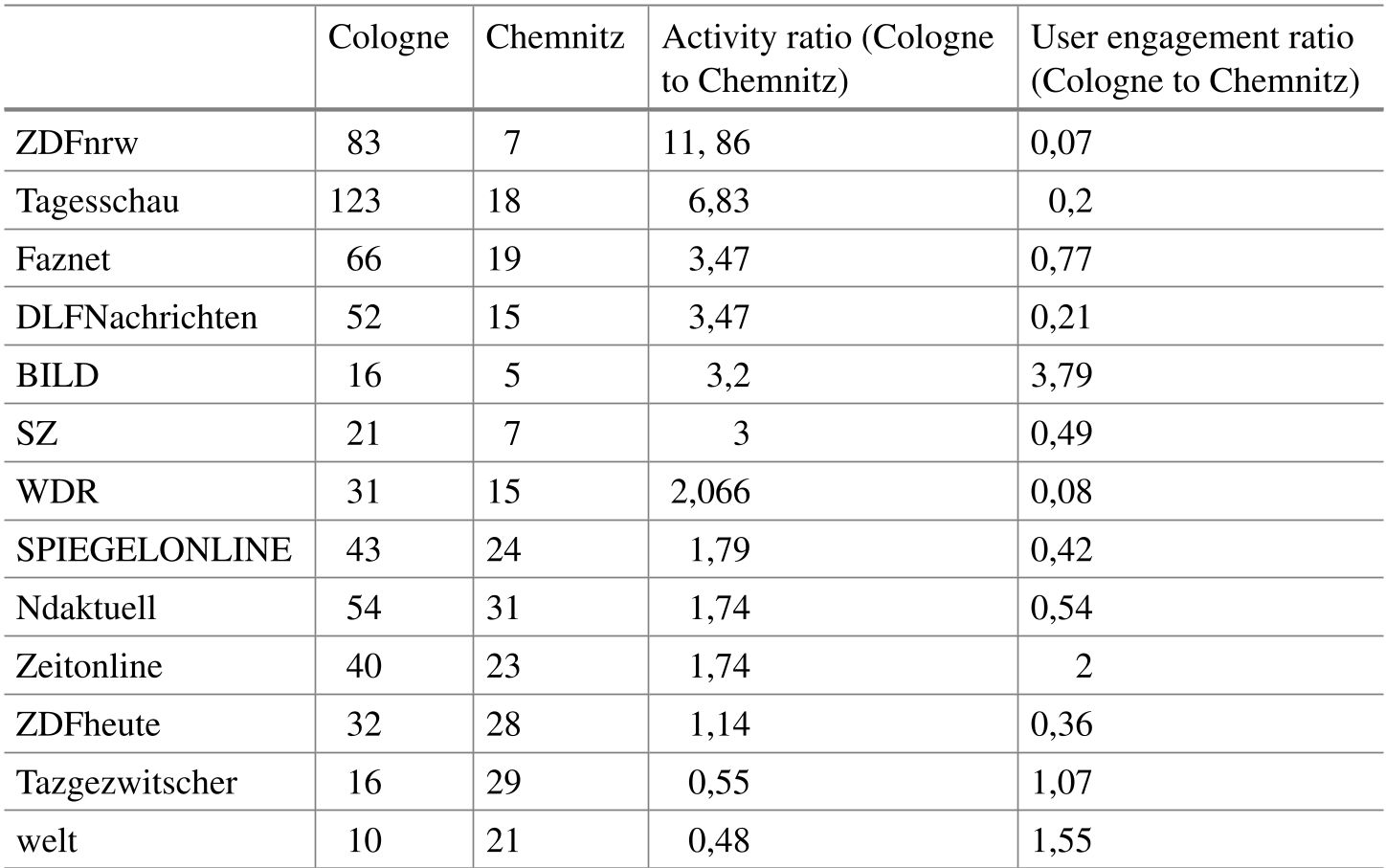
The study reveals a fascinating paradox in media influence (as shown in Table 3). In 2018, media outlets actually tweeted less about the conflict than they did in 2016 (Activity Ratio > 1), yet user engagement skyrocketed (Engagement Ratio often < 1). For example, users were 5 times more involved with @tagesschau's tweets in the second case despite fewer posts. This points to a more polarized and reactive audience that is more "ready" to engage with institutional content than before.
Conclusion & Future Outlook
The study concludes that structural stability in networked public spheres is "not reached." We are looking at a "discontinued" public sphere where the actors change, but the media remains.
Takeaway for Researchers: The "echo chamber" might be less about a permanent group of people and more about a permanent set of institutional triggers (media and politicians) acting on a rotating cast of transient users. Future work should investigate if this instability prevents long-term learning and democratic resolution of social conflicts.