
Social Media Exhaustion: Why Your Users are Quitting Despite New Features
Do you get tired of socializing? An empirical explanation of discontinuous usage behaviour in social network services
This study investigates the phenomenon of discontinuous usage in Social Network Services (SNS) using the Stressor-Strain-Outcome (SSM) framework. It identifies system feature, information, and social overload as key stressors that lead to social network fatigue and dissatisfaction, ultimately driving users' intentions to quit or reduce platform usage.
TL;DR
Why do users abandon social networks even when platforms provide more features and content than ever? This study reveals that Social, Information, and System Feature Overload act as psychological stressors. These stressors create "Social Network Fatigue"—a specific type of mental exhaustion that is a more potent driver of users leaving than simple dissatisfaction.
The "Dark Side" of Pro-Social Design
For years, the industry mantra was "engagement at all costs." Product managers believed that more features, more friends, and more notifications would lead to higher retention. However, this paper identifies a tipping point where these "assets" become "liabilities."
The authors argue that we are witnessing a "technology dilemma": where the marginal utility of a new feature becomes negative because the human brain (referencing Miller’s Law) has a finite capacity to process social demands and information.
Methodology: The Stressor-Strain-Outcome Framework
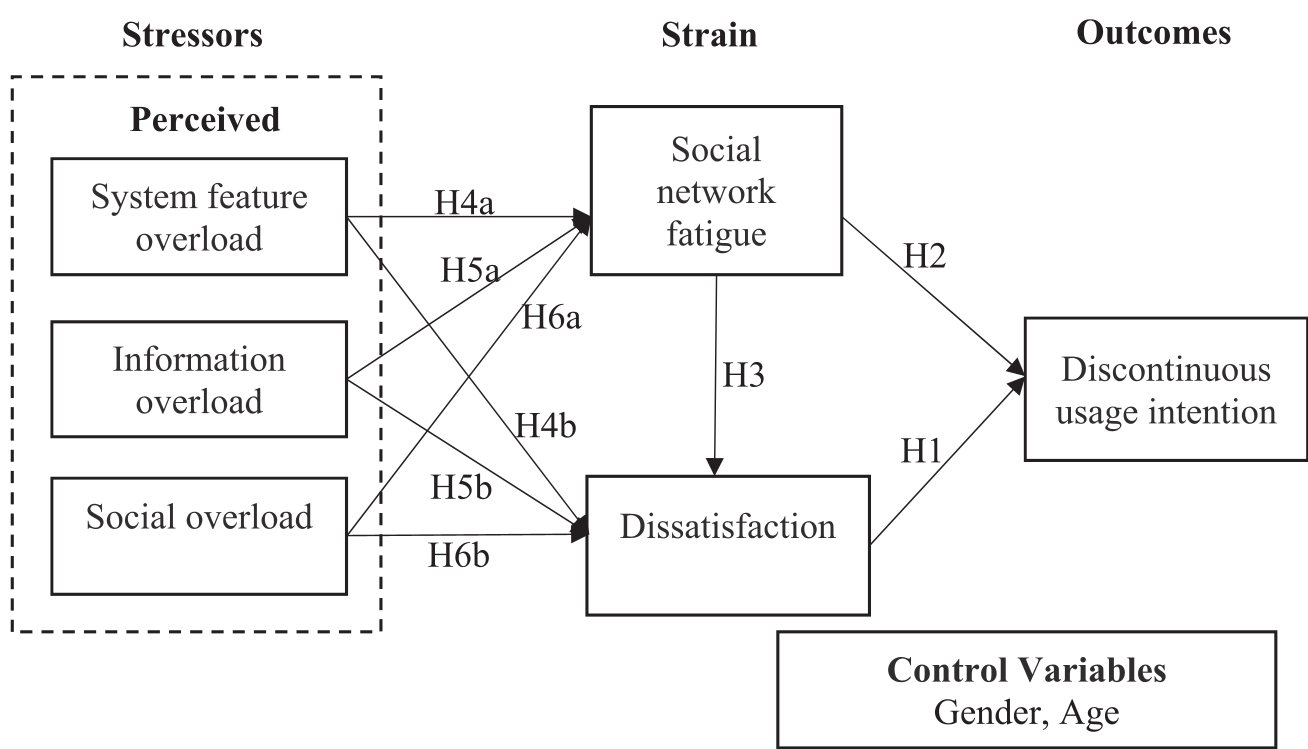
The researchers utilized the Stressor-Strain-Outcome (SSO) framework to map the journey from "too much of a good thing" to total abandonment.
1. The Three Stressors
- System Feature Overload: When the platform becomes too complex to navigate.
- Information Overload: When the sheer volume of posts exceeds processing capacity.
- Social Overload: The feeling of being "crowded" by too many social demands and the pressure to maintain too many relationships (exceeding Dunbar's Number).
2. The Internal Strain
Stressors lead to two distinct psychological states: Dissatisfaction (a cognitive evaluation of poor service) and Social Network Fatigue (an emotional state of tiredness and boredom).
Key Findings: Social Overload is the Main Culprit
The empirical results from 525 users provide several striking insights:
- Social Overload Matters Most: Of the three stressors, Social Overload had the highest impact on fatigue. The pressure to care for "too many friends" is more exhausting than a confusing UI.
- Dissatisfaction isn't the Only Exit: Many users who are technically "satisfied" with a service still intend to leave because they are simply tired. Fatigue is a unique emotional reaction that creates an "intent to disconnect" independent of whether the app "works well."
- Gender and Age Matter: Men were found to be more susceptible to fatigue from feature and social overload than women. Older users also experienced significantly more fatigue as overload increased, suggesting a lower tolerance for digital complexity.

Deep Insight: The Restorative Nature of Fatigue
One critical takeaway for product owners is that fatigue is "restorative." Unlike total dissatisfaction—which usually requires a fundamental service change to fix—fatigue can sometimes be managed with breaks.
However, if a platform's core loop constantly generates social debt (unanswered messages, unviewed stories), the fatigue becomes chronic, leading to permanent "switching behavior" to simpler, more private apps like Snapchat or WhatsApp.
Conclusion & Tactical Recommendations
To fight social network fatigue, the study suggests:
- Filtering over Expansion: Instead of adding features, add better tools for users to reduce their incoming information.
- Sophisticated Grouping: Help users manage "Dunbar limits" by automating the categorization of friends to reduce social pressure.
- Opt-out Functions: Allow users to disable "redundant" features to avoid "feature fatigue."
In the era of the "Attention Economy," the platforms that win might not be those that grab the most attention, but those that respect the user's cognitive limits.
Reference: Zhang, S., Zhao, L., Lu, Y., & Yang, J. (2016). Do you get tired of socializing? An empirical explanation of discontinuous usage behaviour in social network services. Information & Management.