
Smart Spending: Adaptive Discount Allocation for Cost-Efficient Viral Marketing
Discount allocation for cost minimization in online social networks
The paper investigates the "Discount Allocation Problem" in Online Social Networks (OSNs), aiming to achieve a minimum influence spread threshold at the lowest possible cost. It proposes online full-feedback greedy algorithms that adaptively select seed users based on real-time diffusion feedback, significantly outperforming traditional zero-feedback models.
TL;DR
This research shifts the focus from maximizing influence within a budget to minimizing costs required to reach a specific audience size (). By implementing a full-feedback loop, the proposed algorithms "learn" the social network's responsiveness in real-time, offering the smallest possible discounts to activate the most influential nodes.
Background: Why "Zero-Feedback" Strategies Fail
In traditional viral marketing, firms often select a "seed" set of users and give them products for free or at fixed discounts. This is known as the Zero-Feedback approach. However, this has two major flaws:
- Over-prediction: It ignores whether a user actually accepts the discount or if the "influence" successfully bridges the gap between friends.
- Cost Inefficiency: It often results in "over-seeding," spending more budget than necessary to reach the target audience.
The authors argue that in Online Social Networks (OSNs), we only truly understand a node's power after they become active. Therefore, selection should be Online and Adaptive.
Methodology: The Power of Full-Feedback
The paper introduces two greedy policies based on the Independent Cascade (IC) model. The workflow is divided into two alternating stages:
- Seed Selection: Select a user based on high marginal gain and offer a discount.
- Information Diffusion: Observe the actual propagation results before making the next decision.
The Greedy Logic
- Uniform Discount: Picks the user with the highest expected marginal benefit ().
- Non-Uniform Discount: Offers a range of discounts from low to high. It prioritizes the "best bang for your buck"—the user with the highest ratio of expected influence to discount cost.
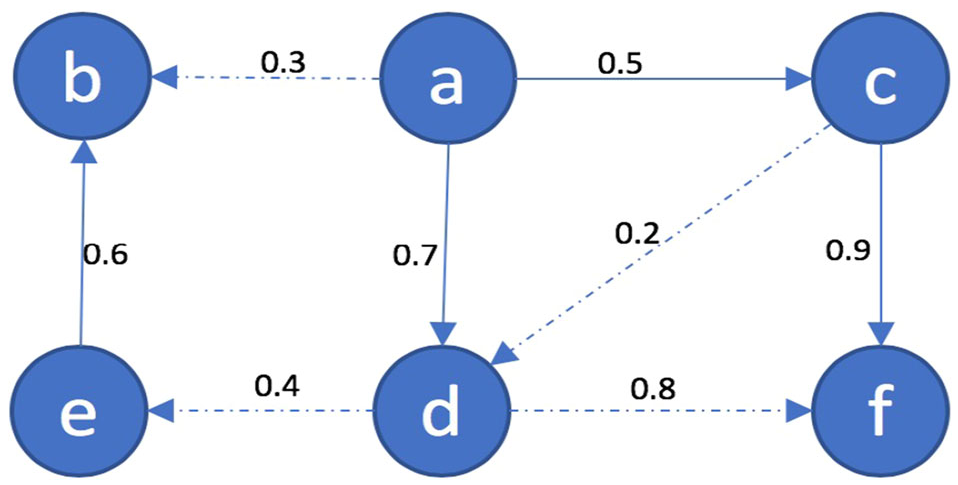 In the toy example above, the online policy adapts. If node 'e' rejects a discount, the policy immediately pivots to node 'b' rather than wasting resources on a pre-planned path.
Mathematical Rigor: Adaptive Submodularity
The authors prove that the influence spread function is online monotone and online submodular. This means that as we observe more of the network, the "surprise" or additional gain from new seeds decreases, but it never becomes negative.
They establish a theoretical bound for their greedy approach: This ensures that the greedy cost won't drift too far from the theoretical "optimal" cost, even in the worst-case scenario.
Experimental Validation
Using datasets from an online forum and scientific collaborations (arXiv), the study compared the Online Greedy approach against Zero-Feedback baselines.
Key Findings:
- Seed Efficiency: For the same target , the online method consistently required fewer seeds because it avoids picking "redundant" nodes that are already likely to be reached by existing diffusion.
- The Discount Paradox: Smaller discounts require more seeds but result in a lower total cost. Larger discounts attract "super-influencers" faster but at a premium price.
- Time vs. Cost: While non-uniform discounts are slightly more complex to calculate, they are more time-saving than uniform discounts because the flexibility of multiple discount tiers makes it easier to find an "accepting" seed quickly.
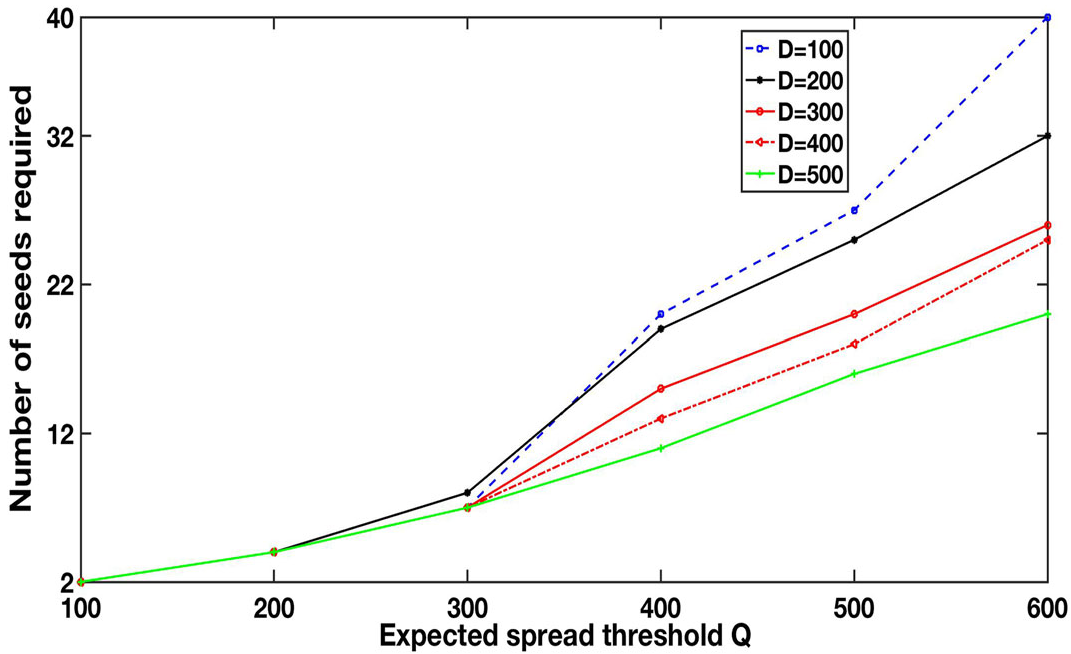 Fig 3 illustrates that higher discounts (D=500) activate the network with fewer seeds, but the slope shows diminishing marginal returns.
Critical Insight & Conclusion
The true value of this work is the realization that information is a resource. By waiting to see the results of the first discount before offering the second, companies can exploit the "lucky" streaks of high diffusion and stop spending once the target is in sight.
Limitations: The model assumes we can wait for a diffusion stage to finish before picking the next seed (Full-Feedback). In high-speed social media campaigns, a "Partial Feedback" model might be more realistic to account for the time-sensitive nature of viral trends.
Future Outlook: Integrating these adaptive costs with multi-product marketing—where different products compete for the same user's attention—is the next frontier for this research.