
Beyond Follower Counts: Identifying True Community Leaders via Optimized PageRank
Discover Community Leader in Social Network with PageRank
This paper introduces an optimized PageRank-based framework to identify community leaders in social networks, specifically targeting the Sina Microblog (Weibo) platform. By integrating the number of followers, mutual relationships, reposts, and comments into an iterative matrix calculation, it ranks user influence and unmasks "zombie fans" to identify genuine leaders.
TL;DR
Researchers from the Beijing University of Posts and Telecommunications have developed a refined PageRank-based methodology to identify "Community Leaders" in social networks. By moving beyond raw follower counts and incorporating iterative influence weighting and engagement quality, the model effectively filters out the noise of "zombie fans" to pinpoint the real drivers of social discourse.
Context & Motivation: The "Zombie Fan" Problem
In the landscape of modern social media (specifically Sina Microblog), influence is often equated with the number of followers. However, this metric is increasingly compromised by "zombie fans" and "water armies"—bot accounts designed to inflate numbers without providing real engagement.
The authors argue that true leadership within a community is recursive: your influence depends not just on how many people follow you, but on who those followers are and how much meaningful interaction (reposts and comments) your content generates.
Methodology: Adapting PageRank for Social Dynamics
The core of the paper lies in a two-stage optimization of the classical PageRank algorithm.
1. The Iterative Eigenvector Approach
Instead of a static count, the researchers treat users as web pages and "follows" as hyperlinks. They build an adjacency matrix where if user follows user .
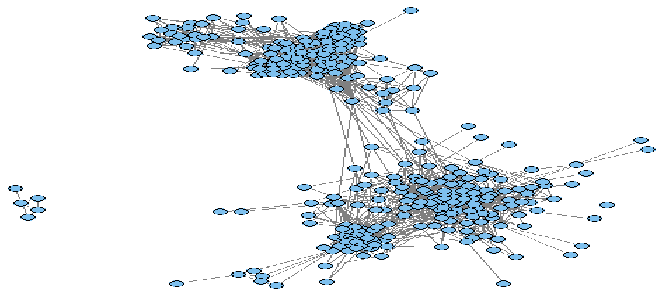
The critical innovation is the secondary calculation:
- Initial Pass: Basic PageRank value calculation.
- Optimization: Users with higher PR values impart more "influence weight" to the people they follow. This loop iterates until the eigenvalues converge, ensuring that a follow from an influential user counts more than a follow from an obscure one.
2. The Comprehensive Value Function
To capture the nuances of content quality and user activity, the authors propose a final ranking formula: Where:
- (Effect Function): PR Value multiplied by average engagement.
- (Quality Function): A weighted linear combination of reposts, comments, and fans.
- : A factor representing user activity frequency.
Experiments and Insights
The study analyzed the top 100 users in the cultural sector of Sina Microblog.
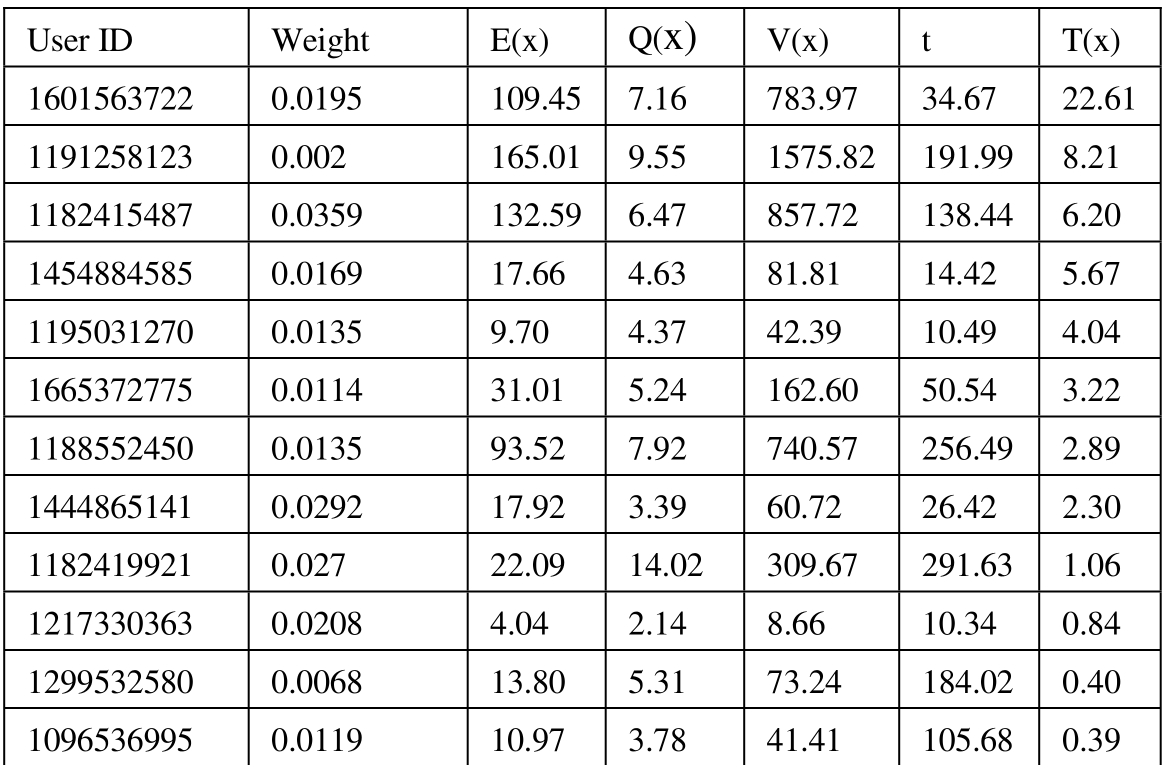
Key Findings:
- Low Correlation with "Follows": PR values were found to be fundamentally tied to the influence of the following group rather than the absolute quantity of followers.
- Resilience to Bots: The PR value of extremely low-influence users (bots) tends toward zero during iteration, effectively neutralizing their impact on the final ranking.
- The Activity Multiplier: Even high-quality content creators can lose leadership status if their frequency of interaction () is too low, suggesting that community leadership requires consistent presence.
Critical Analysis & Conclusion
Takeaway
The paper successfully translates a search engine ranking logic into a social influence context. The most significant contribution is the quantified weighting of interactions (682/1500 surveyed prioritized comments), proving that social "resonance" is a better leader-indicator than social "reach."
Limitations
- Temporal Lag: The data processing relies on a snapshot of recent blogs (200 posts), which may not account for sudden viral shifts.
- Platform Specificity: The weights () are tuned specifically for Sina Microblog and might require recalibration for platforms like X (Twitter) or TikTok where the "Repost/Share" mechanic carries different social capital.
Industry Impact
For digital marketers, this algorithm provides a "BS-detector." By applying these iterative PR calculations, brands can identify influencers who possess genuine structural power within a niche, rather than those with purchased, hollow audiences.