
CSSM: Maximizing Viral Marketing Impact through Community-Scale Sensitivity
Discovering influential users in micro-blog marketing with influence maximization mechanism
This paper introduces the Community Scale-Sensitive Maxdegree (CSSM) algorithm, a novel influence maximization framework designed for micro-blog marketing on platforms like Twitter. By combining community detection with a multi-factor node influence metric (ODC and SND), the method identifies optimal seed nodes to trigger viral marketing cascades more effectively than traditional greedy or degree-based heuristics.
TL;DR
In the era of micro-blogging, identified "influencers" are the engines of viral marketing. This paper proposes the Community Scale-Sensitive Maxdegree (CSSM) algorithm, which identifies these key users by analyzing both their direct followers and their "second-hop" influence potential. By intelligently partitioning social networks into communities, CSSM achieves a wider influence spread than traditional methods while maintaining high computational efficiency.
Background & Motivation
Micro-blog marketing relies on the "Word-of-Mouth" effect. Advertisers aim to select a small set of k seed nodes (influential users) to trigger a cascade of information. The technical challenge is the Influence Maximization (IM) problem: finding the optimal subset of nodes to maximize the final number of influenced users.
The Problem with Prior Art:
- Greedy Algorithms: Computationally expensive and often trap themselves in local optima.
- Single-Metric Heuristics: Methods relying only on node degree ignore the "quality" of followers. A user with many inactive followers might be less valuable than one with fewer, highly-connected followers.
- Community Loss: Existing community-based models often ignore edges between communities, losing the vital "bridge" effect.
Methodology: Beyond Direct Followers
The researchers introduce two critical metrics to define a node's power:
- Outdegree Centrality (ODC): The normalized count of direct followers.
- Sum of Neighbor’s Degree (SND): The total number of "followers of followers." This captures the virus diffusion potential. Even if a node has a moderate ODC, a high SND means their message can reach a massive audience through secondary propagation.
The CSSM Framework
The algorithm follows a structured pipeline to ensure a global influence reach:
- Decomposition: The network is split into communities .
- Scale-Sensitivity: Instead of picking all top nodes from one dense cluster, CSSM assigns a seed budget to each community based on its scale.
- MaxDegree Selection: Inside each community, it selects nodes that maximize the combination of ODC and SND.
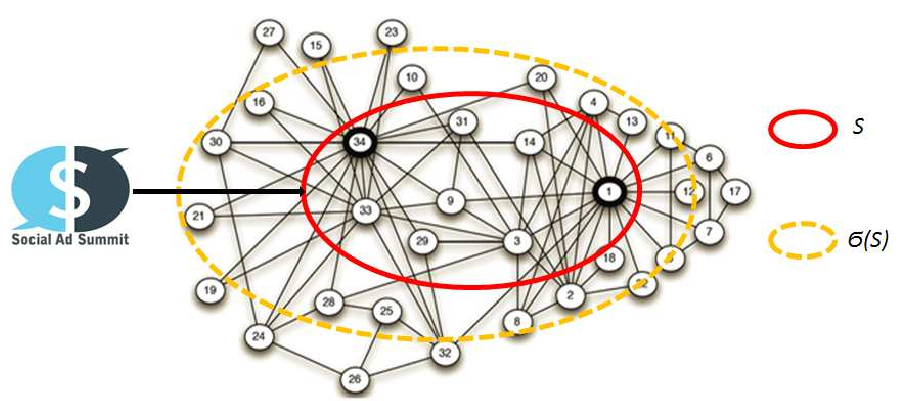 Fig 1: The ripple effect of micro-blog marketing from seed nodes to the wider network.
Experiments and Results
The authors tested CSSM against the Twitter dataset using the Linear Threshold (LT) Model.
1. Superior Influence Spread
As shown in the performance charts, CSSM consistently outperforms the OASNET, Random, and simple Degree-based algorithms. By selecting seeds from different communities, it avoids the "redundancy" problem where multiple influencers target the same audience.
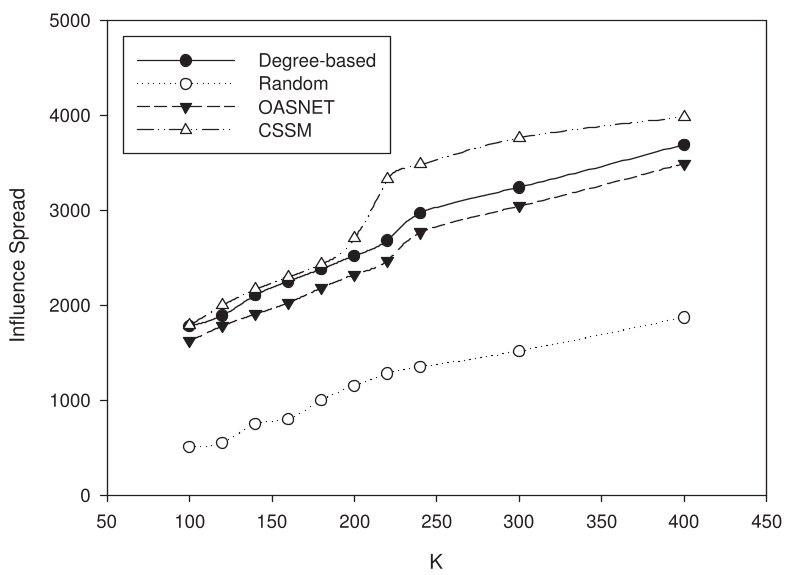 Fig 2: Influence spread comparison across different seed set sizes (K).
2. Efficiency Gains
Complexity is the "silent killer" of IM algorithms. CSSM maintains a time complexity of . In practical terms, it runs nearly as fast as basic degree heuristics but offers significantly better results. Compared to sophisticated models like OASNET, CSSM is nearly 10 times faster.
Critical Insight & Conclusion
The core value of CSSM lies in its structural awareness. It recognizes that a social network isn't a monolithic block but a collection of communities. By forcing the seed selection to respect community boundaries (Scale-Sensitivity) and looking ahead to the neighbor's potential (SND), it captures the true dynamics of how ideas spread.
Takeaway for Practitioners: When identifying influencers, don't just look at the follower count. Look at the reach of those followers and ensure your chosen influencers represent different social clusters to maximize the unique audience reached.
Limitations: Currently, the model assumes a static network topology. Future iterations could benefit from considering temporal dynamics—how influence waxes and wanes over time.