
Beyond Keywords: Discovering Emerging Topics via Social Link Anomalies
Discovering Emerging Topics in Social Streams via Link-Anomaly Detection
The paper introduces a novel approach for detecting emerging topics in social media streams by monitoring "mentioning" behavior (links between users) rather than textual content. It utilizes a probability model for link-anomaly detection combined with Sequentially Discounting Normalized Maximum Likelihood (SDNML) coding to identify topical change-points in real-time.
TL;DR
This research shifts the paradigm of topic detection from "what people are saying" (text) to "who people are talking to" (links). By modeling the statistical anomalies in user mentioning behavior on Twitter, the authors developed a system that detects breaking news and emerging trends—often hours before traditional keyword-based systems can even define what the "right" keywords are.
Contextual Positioning
In the landscape of Topic Detection and Tracking (TDT), most SOTA methods are heavy on NLP and term-frequency analysis. This paper occupies a unique niche by treating social mentions as a "language" where the vocabulary is the user base itself. It positions link-anomaly detection as a high-signal, low-noise alternative to text mining.
The Problem: The Ambiguity of Text
Traditional models suffer from three main friction points:
- Keyword Ambiguity: New events often lack a specific name initially (e.g., people react to a "video" or "that guy" before a hashtag is born).
- Processing Overhead: Text requires segmentation and cleaning, which varies by language.
- Content Diversity: Social streams are increasingly visual (images/URLs), making text-only analysis blind to a large portion of the data.
Methodology: Modeling the "Mention"
The core of the method is a probabilistic model that captures the "normal" behavior of a user. If a user suddenly mentions more people than usual, or mentions people they have never interacted with, the link-anomaly score spikes.
1. The Probability Model
The authors define a joint distribution:
- : The number of mentions () follows a Geometric distribution.
- : The choice of who to mention follows a Multinomial distribution.
- The Innovation: They use a Chinese Restaurant Process (CRP) to estimate the probability of mentioning a "new" user, preventing infinite anomaly scores for first-time interactions.
2. Change-Point Detection (SDNML)
The anomaly scores are fed into a two-layer Sequentially Discounting Normalized Maximum Likelihood (SDNML) framework. This is a sophisticated way of asking: "How much harder is it to compress this new data using my current model?" If the compressibility drops, a change-point—and thus a new topic—is detected.
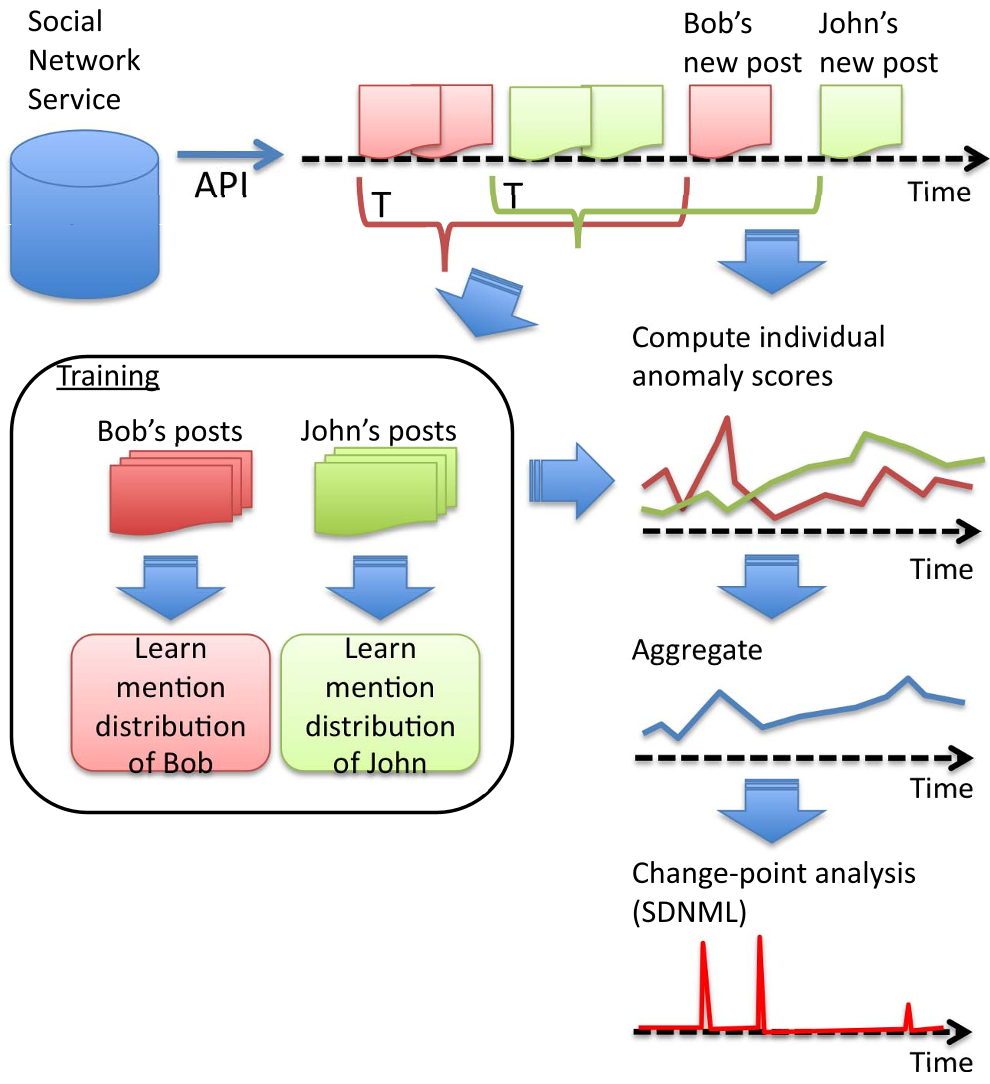 Figure 1: The pipeline from raw post to aggregated anomaly scoring and change-point detection.
Experimental Battleground: Twitter Data
The authors tested the system against human-curated topics from "Togetter."
Case Study: The "BBC" Dataset
In a scenario where users reacted to a BBC comedy segment, the vocabulary was initially fragmented. People used different words to express their anger.
- Link-Anomaly Result: Detected the trend at 19:52.
- Keyword-Frequency Result: Only detected the trend at 22:41.
The link-anomaly method provided a near 3-hour lead time because it captured the burst in social interaction before the community settled on specific keywords like "British" or "BBC".
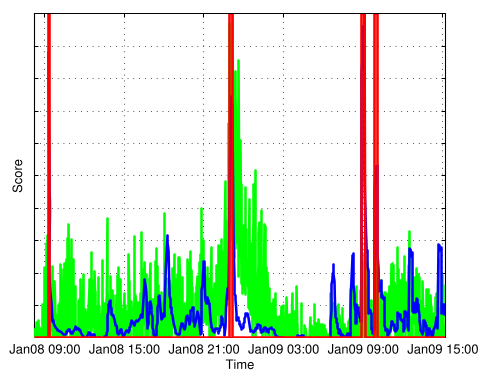 Figure 2: The sharp spike in the blue line (change-point score) indicates the detection of the topic well before keyword counts (bottom charts) reached critical mass.
Critical Insight & Conclusion
Takeaway
The genius of this approach lies in its Inductive Bias: social networks are fundamentally about relationships. When something important happens, the structure of the conversation (who is talking to whom) changes faster than the semantics (what words they use).
Limitations
The model relies on "participants" or a subset of users. If a topic emerges among a brand-new cluster of users not being monitored, the aggregation might fail. Furthermore, it assumes that emerging topics must involve mentions, which might not hold for broadcast-style news that doesn't trigger direct replies.
Future Outlook
This link-centric approach is highly relevant for today’s "post-text" social media environment (TikTok, Instagram). Future research could combine these link-anomaly signals as a "trigger" to activate more expensive, deep-learning-based content classifiers, creating a multi-stage, efficient monitoring system.