
Beyond "Likes": How Your Movie Taste and Friend Circle Reveal Your Private Identity
Discovering Homophily in Online Social Networks
This paper investigates the phenomenon of homophily within Online Social Networks (OSNs), specifically focusing on how movie preferences correlate with social tie strength and user demographic attributes like age. By analyzing 337 Facebook ego networks, the authors demonstrate that users with stronger social bonds (Dunbar's inner circles) exhibit higher similarity in interests, effectively achieving SOTA insights into "user profiling via interest-based homophily."
TL;DR
Is your privacy safe if you only share your favorite movies? This research proves that "Homophily"—the tendency of similar people to bond—allows attackers to predict your age and other profile details by looking at your social circle. By analyzing Facebook ego networks through the lens of Dunbar's Model, the study shows that your closest friends share your tastes much more than acquaintances, creating a "privacy correlation" that can be exploited by viral marketers and data harvesters.
The "Like" Trap: Why Your Interests Aren't Private
The core motivation of this study lies in a paradox: while users are becoming more careful with their "private" data (like birthdays or locations), they freely share "public" interests (like movie pages). The authors argue that these interests are not isolated. Because of Homophily, your preferences are a mirror of your social environment. Current OSNs (Facebook, Twitter) and even Decentralized OSNs (DOSNs) suffer from this vulnerability where your social ties act as a leakage vector for your personal attributes.
Methodology: Bridging Semantics and Sociology
The researchers faced a massive data-cleaning challenge: 69,519 movie titles filled with typos and different languages. To solve this, they developed a hybrid similarity metric:
This allowed them to map messy Facebook "Likes" to clean genres in The Movie Database (TMDb).
The Structural Lens: Dunbar’s Circles
The study doesn't treat all friends as equal. It applies the Dunbar Model, which categorizes social ties into hierarchical circles (5, 15, 50, 150 members) based on intimacy and interaction frequency.
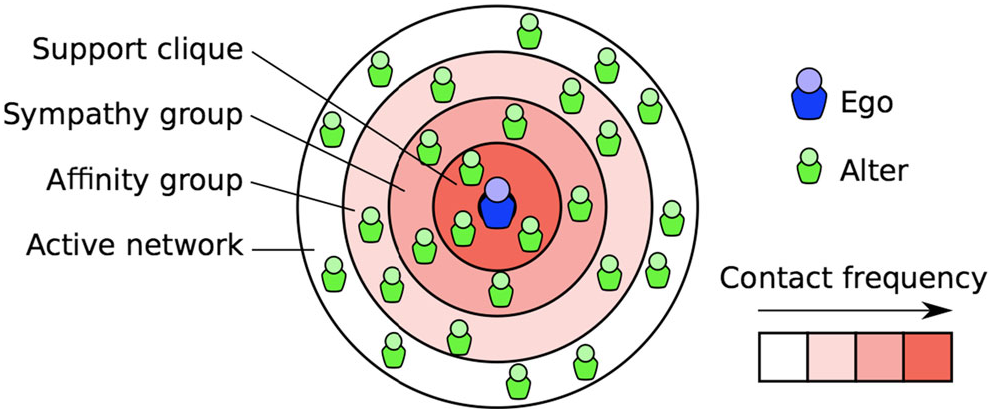 Fig 1: The hierarchical structure of an ego network, from intimate inner circles to weak-tie acquaintances.
Key Insights: Ties and Tastes
The experiment analyzed 337 ego networks and found a direct correlation between Tie Strength and Interest Similarity.
- Intimacy Matters: Users in the inner "Dunbar Circles" have significantly higher movie preference similarity than those in the outer "No-Dunbar" set.
- Age Inference: While knowing a user's age doesn't easily predict their favorite movie (high entropy), the reverse is surprisingly effective. If you group users by specific movie preferences, the age variance drops significantly.
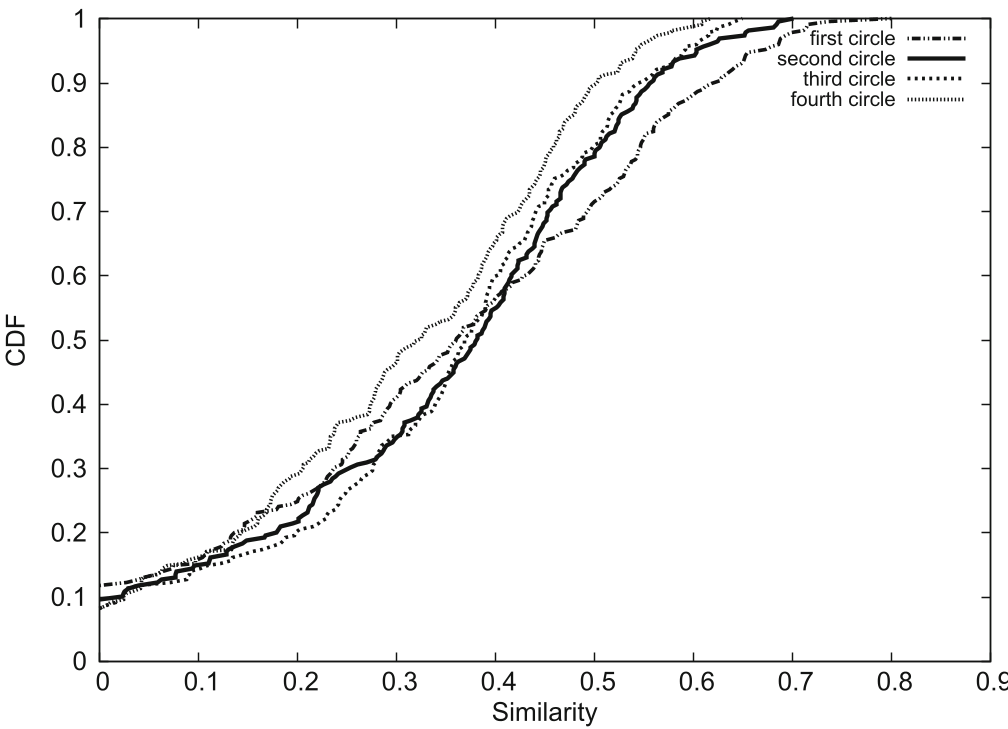 Fig 2: CDF showing that inner social circles (stronger ties) exhibit higher interest similarity (Homophily).
Experimental Results: The Power of Profiling
The authors used K-means clustering to segment users. When clustering by movie interests, they found that 66% of interest-based clusters had an age variation of less than 10 years. This implies that marketers don't need your birthday; they just need your movie list and a few of your friends' movie lists to "triangulate" your demographic profile with high precision.
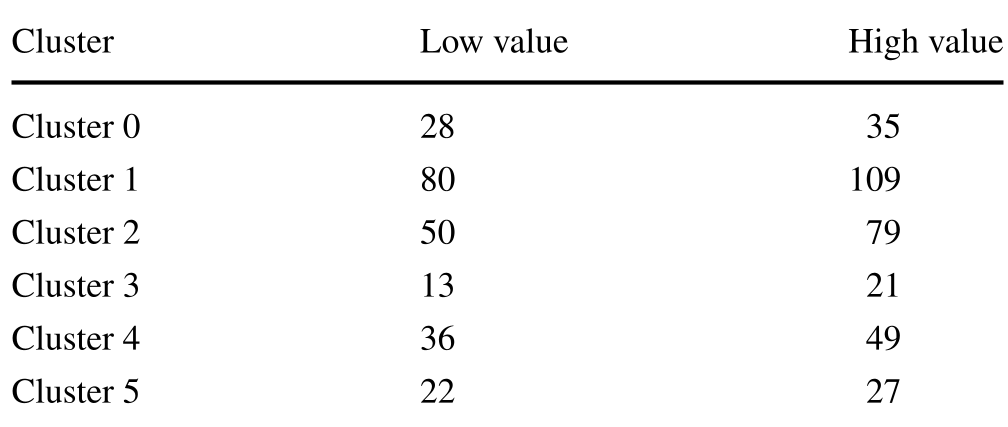 Table 1: Age-based clustering demonstrates how demographics can be segmented, although interest-to-age mapping (profiling) is more potent than age-to-interest mapping.
Critical Analysis & Takeaways
The study provides a sobering look at OSN privacy.
- The "Why" it Works: Homophily isn't just a social quirk; it's a structural feature of human cognition. We use our limited cognitive resources (the 150 Dunbar limit) on people who validate our tastes.
- Limitations: The dataset is restricted to movie genres. Future work needs to integrate music, books, and temporal "check-in" patterns to see if the "Identity Leak" becomes even more severe.
- Future Outlook: For developers of Decentralized Social Networks (DOSNs), these findings suggest that "obfuscating" interests might be as important as encrypting messages to prevent user profiling and viral marketing manipulation.
Final takeaway: In the age of Big Data, you are not just what you "Like"—you are the weighted average of what your 150 closest friends "Like."