
SPEC: Bridging Data Mining and NLP for Interpretable Pattern Discovery
Discovering linguistic patterns using sequence mining
This paper introduces SPEC (Sequential Pattern Extraction with Constraints), a data mining approach to automatically discover linguistic patterns for appositive qualifying phrases. By utilizing sequential pattern mining on itemsets rather than single items, the method combines multiple levels of linguistic abstraction (surface form, lemma, POS tags) into expressive, human-readable rules.
TL;DR
Researchers have developed SPEC, an unsupervised algorithm that "mines" linguistic patterns from text by treating sentences as sequences of itemsets. Unlike traditional methods that look at words in isolation, SPEC looks at words, lemmas, and POS tags simultaneously, discovering complex rules for "appositive qualifying phrases" (e.g., "Militant but opportunist, X..."). The system integrates human expertise through a hierarchical navigation tool, turning thousands of raw data patterns into a refined linguistic grammar.
The Bottleneck of Handcrafted Rules
In Information Extraction (IE), identifying specific linguistic structures like appositives—phrases that describe a noun, often separated by commas—is vital for sentiment analysis and knowledge graph construction. However, we face a classic trade-off:
- Handcrafted Rules: Highly accurate but incredibly time-consuming to write and impossible to scale across domains.
- Black-Box ML: Models like CRFs or early Neural Nets perform well but offer no "rules" that a linguist can inspect, modify, or reuse in other symbolic systems.
The authors identify a third path: Sequential Pattern Mining. But there's a catch—standard sequence mining treats a word as a single unit. In reality, a word is a bundle of features.
Methodology: The Power of the Itemset
The core innovation is shifting from sequences of items to sequences of itemsets.
1. Multi-Level Abstraction
Instead of just mining the word "champion," the algorithm sees:
{(champion), (champion_lemma), (NOUN)}
This allows the discovery of patterns that mix specific words with general categories, such as:
<(champion) (PRP) (NOUN)>
This pattern is more expressive than a simple "noun-preposition-noun" tag and more general than a fixed string.
2. Constraints as Pruning Shears
Mining frequently occurring sequences usually results in "pattern explosion"—thousands of useless results. The authors implement two critical constraints:
- Gap Constraint [0,0]: Ensures the pattern elements are contiguous in the text (essential for qualifying phrases).
- Begin With Constraint: Focuses on phrases appearing at the start of a constituent, where appositives often reside.
3. Human-in-the-Loop via Partial Order
To solve the "large set of patterns" problem, the authors organize patterns in a Hasse Diagram based on a partial order. If a pattern A is more specific than pattern B, they are linked. Using the Camelis tool, a linguist can start at a generic pattern (like NOUN-PRP-NOUN) and "drill down" to specific instances, validating or discarding entire branches of the hierarchy at once.
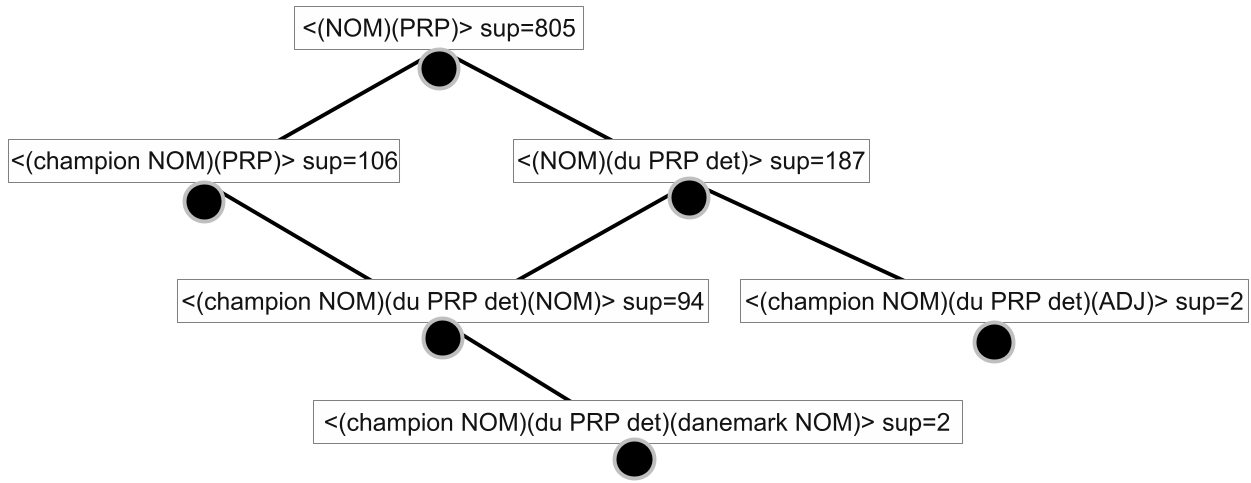 Figure 1: A Hasse diagram showing the hierarchical relationship between general and specific linguistic patterns.
Experimental Results
The authors tested SPEC on two French corpora: AXIOLO (clean) and ARTS (noisy).
- Computational Efficiency: SPEC outperformed the competitive Clospan algorithm significantly at lower support thresholds (where patterns are most interesting), largely because SPEC integrates constraints during the mining process rather than as a post-processing filter.
- Quality: The system automatically rediscovered all 20 handcrafted rules previously identified by linguists.
- Discovery: It found new patterns ignored by humans, such as
< (ADJ) (pour) (DET) (NOUN) >(e.g., "célèbre pour son monastère"), proving that unsupervised mining can find patterns that experts might overlook.
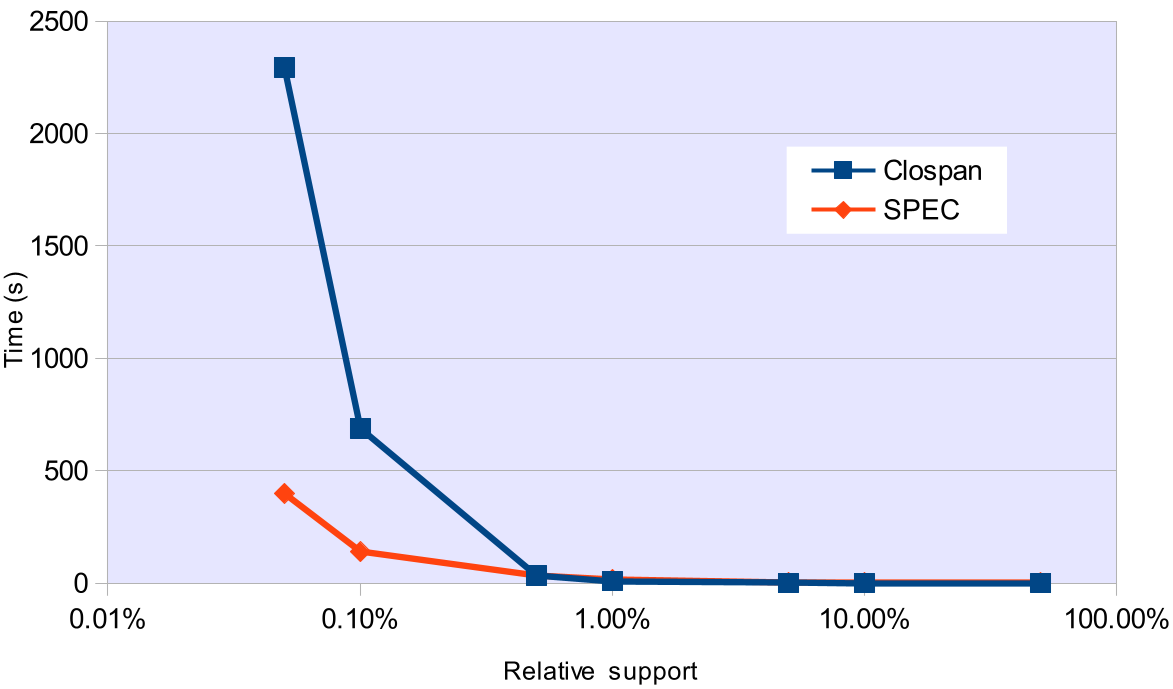 Figure 2: Runtime performance comparison between SPEC and Clospan. SPEC's integration of constraints allows it to handle lower support levels without exponential slowdowns.
Critical Analysis & Conclusion
Takeaway: This work proves that symbolic AI and data mining are not obsolete in the age of ML. For tasks where interpretability and linguistic validation are mandatory, sequence mining of itemsets provides a bridge between raw data and structured knowledge.
Limitations: The method still requires an initial "cleansing" phase (the authors used heuristics to remove circumstantial groups of time/space). While it is more efficient than manual rule-writing, it still requires a human expert to navigate the Hasse diagram for the final "gold standard" validation.
Future Outlook: The transition from itemset mining to relationship extraction (e.g., gene-protein interactions) is a natural next step. By applying these constraints to multi-modal data, we could potentially see similar "pattern discovery" in vision-language tasks where interpretability is currently a major hurdle.