
Instantly Discovering Social Networks: Shifting Process Mining to the Database Layer
Discovering Social Networks Instantly: Moving Process Mining Computations to the Database and Data Entry Time
The paper introduces a scalable framework for discovering social networks (specifically Handover of Work) from large-scale event data by offloading computations to a relational database. By utilizing the DB-XES schema and pre-calculating intermediate structures at data entry time via SQL triggers, the approach enables instant social network analysis, achieving significant performance gains over traditional file-based process mining tools.
TL;DR
The paper addresses the scalability "wall" in social network analysis within process mining. By moving the heavy lifting from the analysis software to a relational database—and performing pre-computations at the exact moment data is entered—the authors achieve "instant" discovery of organizational structures. No more waiting for hours to load massive XES files; the insights are ready before you even click "run."
Background Positioning
In the landscape of Process Mining, this work represents a crucial shift from static, file-based analysis to dynamic, database-integrated intelligence. It builds upon the DB-XES schema and bridges the gap between traditional Social Network Analysis (SNA) and modern Big Data requirements.
The Problem: The Memory Wall and Repetitive Redundancy
Most business analysts today face a frustrating workflow:
- Memory Bottlenecks: Large event logs exceed RAM, causing software crashes or painful disk swapping.
- Repetitive Discovery: When a log grows (e.g., checking monthly progress), traditional tools re-parse the entire historical log instead of just processing the new events.
- The Wait Time: The "End-to-End" computation happens on-demand, leading to productivity-killing wait times.
Methodology: Moving Computation in Space and Time
The core insight of this paper is that the Directly Follows Relation (DFR)—the bread and butter of process mining—can be calculated incrementally.
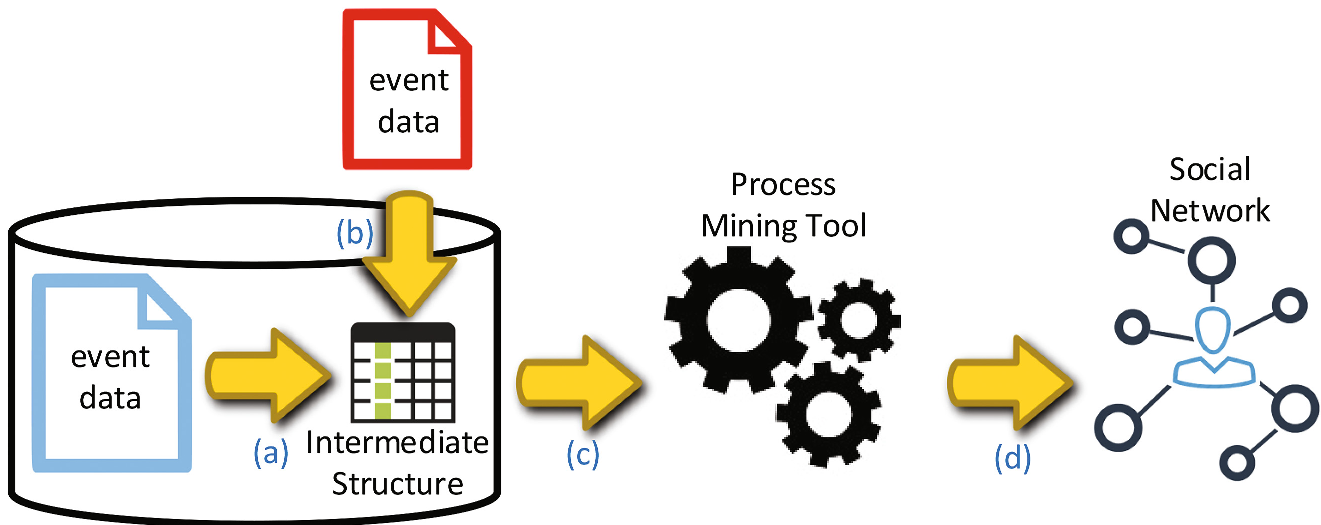
1. The Intermediate Structure
Instead of calculating metrics from raw logs, the authors define Intermediate Structures. In the context of "Handover of Work" (HoW), this means storing the counts of how often Resource A was followed by Resource B.
2. The Architecture Shift
The paper utilizes SQL Triggers. As soon as a new event is INSERTED into the database, a trigger fires to update the relevant HoW tables.
- Space Transition: Computation moves to the RDBMS (Relational Database Management System).
- Time Transition: Computation moves from "Analysis Time" to "Data Entry Time."
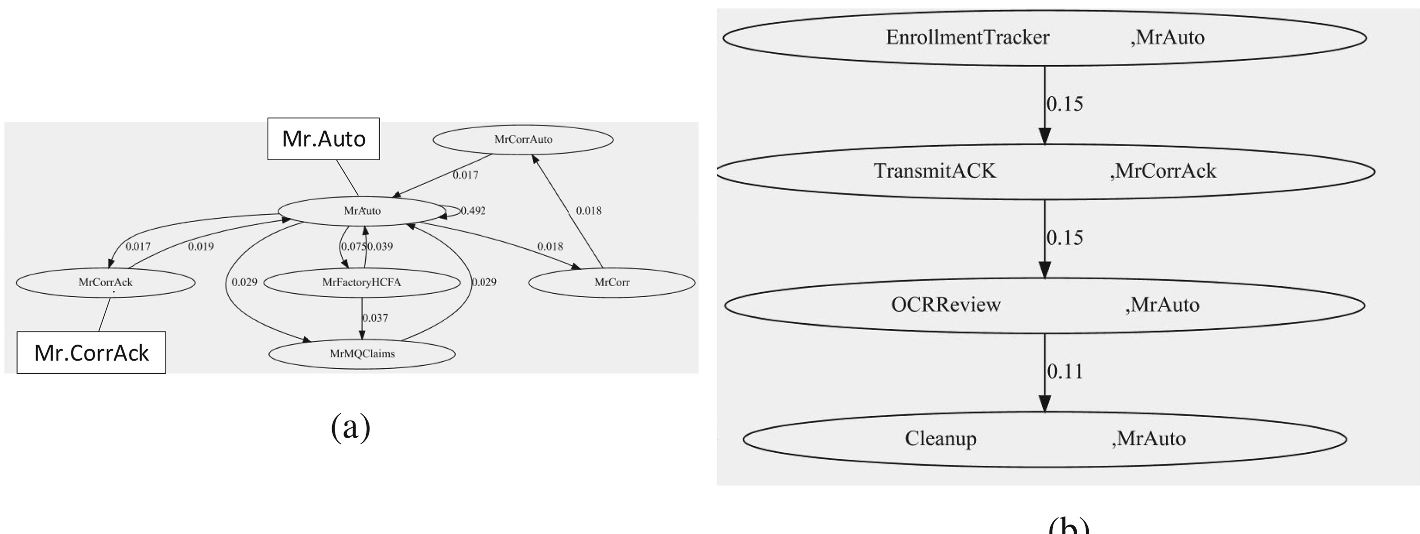
Handover of Work (HoW) Metrics
The authors refine the HoW metric into four categories to balance complexity and insight:
- Absolute HoW: Total count of all handovers.
- Boolean HoW: Counts a handover only once per trace (ignoring internal loops).
- Causal HoW: Only counts handovers where a true causal dependency exists between activities.
Experimental Evidence: Consistency vs. Complexity
The results are stark. In a head-to-head comparison between the traditional file-based ProM approach and the DB-XES approach, the time savings are exponential as the log grows.
As shown above, while the traditional approach (Red) climbs linearly with data size, the DB-XES approach (Blue) remains significantly lower and flatter because the "mining" phase is reduced to a simple SELECT query of pre-summed values.
Key Numerical Insight: The cost of keeping the database "up-to-date" is only 0.8 milliseconds per event, a negligible price to pay for instant insights.
Professional Insight & Conclusion
This paper proves that the "organizational perspective" in process mining doesn't have to be a heavyweight operation. By treating the database as a state-machine that updates its understanding of social relations in real-time, we enable a new class of "Live Process Monitoring."
Limitations & Future Outlook
While the system handles insertions perfectly, the authors note that event removal (deletion/correction) is a future target. Additionally, the approach currently focuses on HoW; extending this to "Subcontracting" or "Working Together" metrics will require more complex intermediate structures that track non-consecutive events within a trace.
Final Takeaway: This work is a blueprint for building enterprise-grade process mining tools that behave like real-time dashboards rather than static reporting engines.