
Discovering Stable Communities: Bridging Multilayer Structure and Temporal Homophily
Discovering Stable Communities in Dynamic Multilayer Social Networks
This paper introduces a novel hybrid approach for discovering stable communities within dynamic multilayer social networks. It leverages a generalized combined metric () that integrates network topology (modularity) and participant homophily (similarity), followed by a temporal stability analysis to identify "community cores."
TL;DR
Social networks are not just snapshots of who knows whom; they are evolving, multi-dimensional webs of interaction. This paper proposes a hybrid framework that detects communities in dynamic multilayer networks by combining structural connectivity with user similarity (homophily). By introducing a temporal stability threshold optimized via Particle Swarm Optimization, the authors successfully identify "stable communities" that persist even as the network grows or changes.
Problem & Motivation
Most current community detection algorithms suffer from "Dimensional Myopia." They either:
- Treat the network as a single static layer, losing the nuance of different relationship types (e.g., separating Facebook friends from DBLP co-authors).
- Ignore the temporal dimension, failing to account for members joining or leaving a group.
- Overlook Homophily—the tendency of individuals to associate with others similar to them (e.g., shared research interests).
The authors argue that a "true" community in a professional or social setting must be both structurally dense across multiple platforms and thematically consistent over time.
Methodology: The TMIG Framework
The heart of the paper is the Temporal Multiplex Information Graph (TMIG) and its associated optimization algorithm.
1. Hybrid Optimization Metric
The authors define a generalized quality metric :
- (Modularity): Measures the density of links within communities relative to a random null model.
- (Inertia): Measures the similarity of node attributes (homophily) within a group.
2. The Hybrid Algorithm
The algorithm follows a Louvain-like iterative process but adapted for multiplexity:
- Phase 1 (Iterative): Nodes move between communities to maximize the gain.
- Phase 2 (Fusion): Communities are collapsed into super-nodes, and the process repeats.
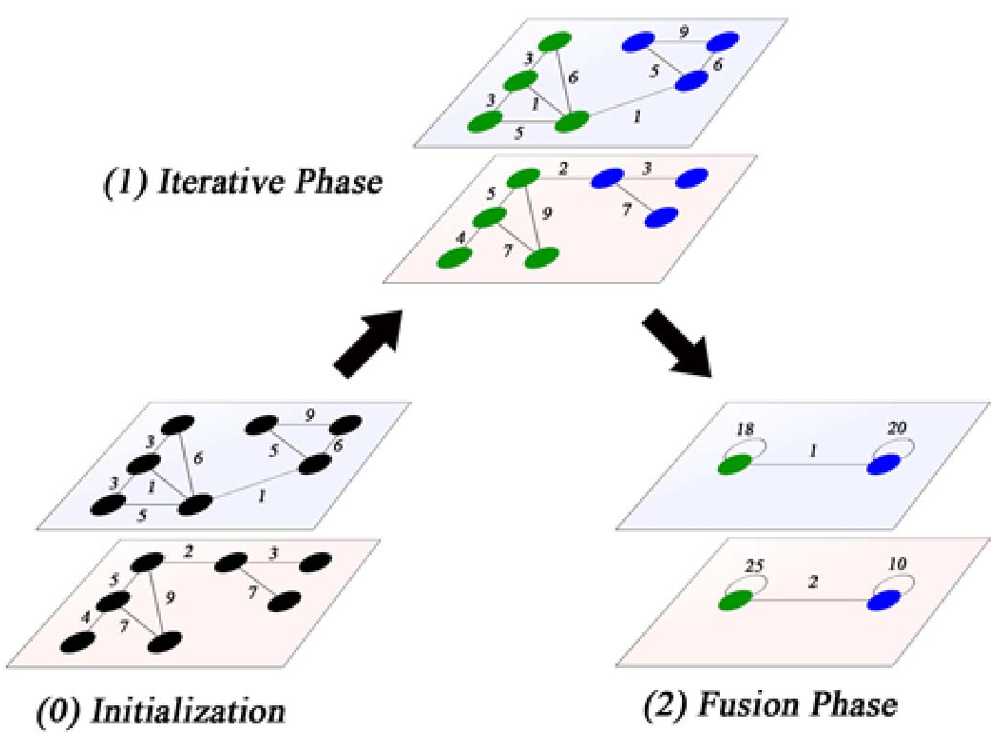 Above: The execution flow of the hybrid community discovery algorithm on a static multiplex slice.
3. Stability via "Community Cores"
To ensure the communities aren't just artifacts of a single timestamp, the authors calculate the probability that two nodes remain together across all time slices. They use Particle Swarm Optimization (PSO) to find the perfect threshold —discarding weak/fleeting connections and retaining the "stable core" of the community.
Experiments & Results
The researchers tested their approach against three baselines (Louvain, Generalized Modularity, and DMultiMOGA) using the RIADI laboratory dataset, which tracks researchers across Facebook, DBLP, and LinkedIn over several academic years.
Quantitative Superiority
The results highlight a massive leap in Inertia (attribute similarity), which baseline structural algorithms almost entirely ignore.
| Metric | Proposed Approach | DMultiMOGA (Dynamic) |
|---|---|---|
| Inertia (D1) | 0.912 | 0.316 |
| Modularity (D1) | 0.87 | 0.901 |
| Redundancy (D3) | 0.891 | 0.802 |
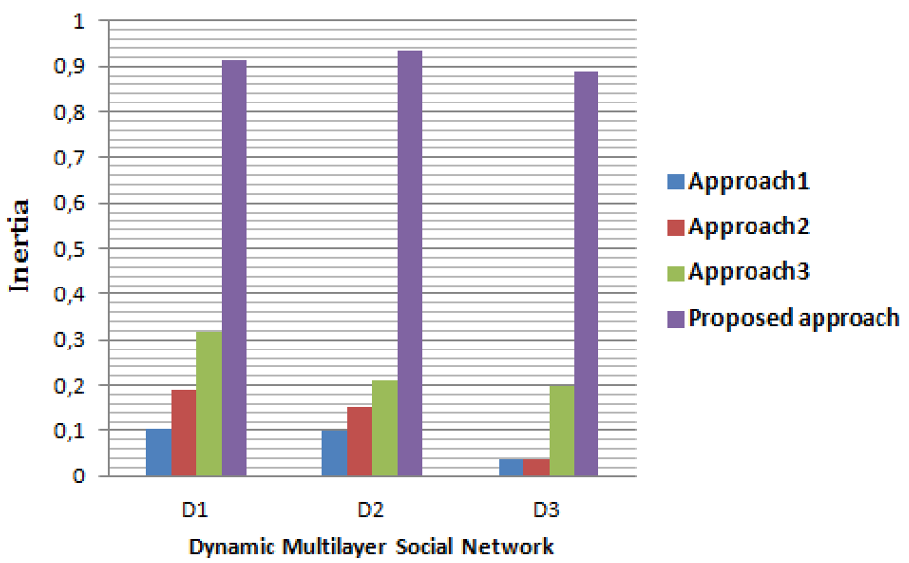 Above: Comparison of Inertia across different datasets. The proposed approach (red) significantly outperforms structural-only methods.
Critical Analysis & Conclusion
The primary takeaway is that structure is not enough. By integrating homophily into the modularity function, the resulting communities are more representative of real-world "Research Focus Groups" (e.g., AI researchers vs. Network researchers) rather than just random clusters of people who happen to be linked.
Limitations:
- Computational Cost: Calculating similarity () across all node pairs in large-scale networks can be O(N²), which may limit scalability for massive web-scale networks.
- Parameter Sensitivity: The weighting factor and threshold are critical; while PSO helps, it requires significant historical data to tune.
Future Outlook: The authors suggest applying this to larger real-world benchmarks. There is also potential to adapt this for recommendation systems—identifying stable communities can help suggest new collaborators who share both structural ties and niche expertise.