
Discovering Temporal Communities: Bridging Content and Context in Social Networks
Discovering Temporal Communities from Social Network Documents
This paper introduces a method for discovering temporal communities in heterogeneous social networks (authors, words, and venues) by formulating the task as a tripartite graph partitioning problem. The core innovation is a constrained partitioning algorithm that threads static communities over time, achieving state-of-the-art results in tracking evolving researcher groups in the CiteSeer dataset.
TL;DR
Social networks are not static; they breathe and evolve. This paper presents a novel framework for discovering "Temporal Communities" by partitioning heterogeneous networks (Authors-Words-Venues). By introducing a constrained partitioning algorithm called Fractional Orthogonal Iteration, the authors successfully "thread" communities across time, maintaining consistency even when researchers change fields or new venues emerge.
Problem & Motivation: The Static Snapshot Trap
Most community detection algorithms treat social networks as a single, frozen snapshot. However, in the real world—especially in academia—memberships are fluid. A researcher might transition from "Traditional AI" to "Deep Learning" over a decade.
The authors identify two fatal flaws in existing work:
- Heterogeneity Oversight: Treating authors and documents as the same type of node leads to normalization disasters.
- Temporal Blindness: Standard spectral clustering ignores the "Prior"—the fact that where you were yesterday highly influences where you are today.
The challenge: How do we mathematically model a network that changes its very structure (nodes appearing and disappearing) while maintaining a logical thread of community identity?
Methodology: Tripartite Partitioning and Temporal Smoothing
1. The Tripartite Model
Instead of a simple graph, the authors define a Bipartite Graph Couple. Imagine two connected mats: one linking Authors (X) to Words (Y), and another linking those same Words (Y) to Venues (Z).
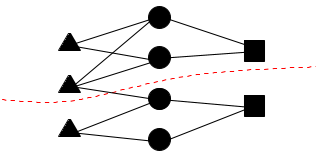 Figure 1: The tripartite structure where Words serve as the bridge between Authors and Venues.
2. Temporal Threading via Constrained Optimization
To solve the temporal aspect, the paper introduces a "Smoothness" constraint. They maximize the cosine distance between the current community subspace () and the previous one ().
When nodes change (the "Evolving Vertices" problem), they employ two clever operations:
- shrink(): Remove nodes that no longer exist.
- expand(): Add rows of zeros for new entities, representing zero prior covariance.
3. Effeciency: Fractional Orthogonal Iteration
Rather than using Semi-Definite Programming (SDP), which is computationally expensive ( or worse), the authors propose Algorithm 1. By using power iteration on a modified matrix (where is the topology and is the historical prior), they find the community-indicative eigenvectors efficiently.
Experiments: More than just Mathematics
The authors validated their approach using a massive scrape of CiteSeer data (1969–2004).
SOTA Comparison
In synthetic tests, the temporal-aware "t-par" method achieved 0.9169 precision, while looking at snapshots individually or even looking at the entire data as one big block yielded significantly lower accuracy. This proves that order and sequence matter in social evolution.
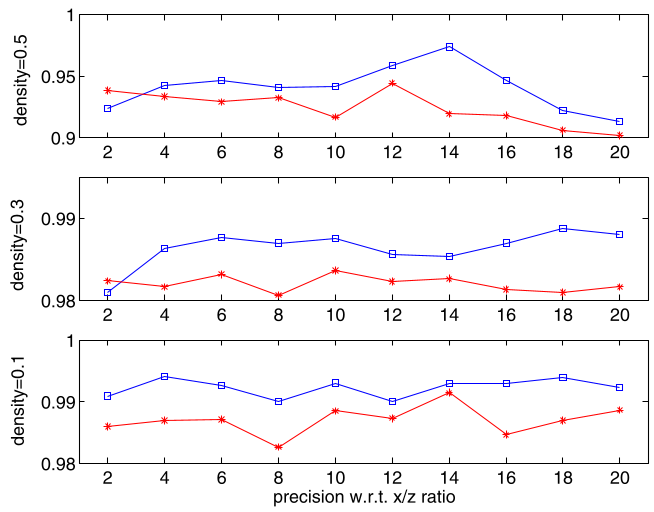 Figure 3: Precision vs. Graph Density. The fractional approach (fsi) shines in sparse, real-world-like conditions.
Real-World Discovery
The algorithm successfully mapped out the "Machine Learning" community. In Table 1 of the paper, we see names like Michael Jordan and Sebastian Thrun moving through venues like JMLR and ICML, capturing the shift from early symbolic AI to modern probabilistic learning.
Critical Analysis & Conclusion
Takeaway
The genius of this work lies in the Fractional Orthogonal Iteration. It provides a bridge between pure graph topology and historical context, allowing the algorithm to "remember" community structures while remaining flexible enough to "learn" new associations.
Limitations
- Number of Communities (): The model still requires a pre-defined . In reality, the number of academic fields grows over time.
- Vagueness: When a community becomes "vague" (low signal-to-noise), the algorithm relies heavily on the prior, which could lead to "ghost" communities that no longer exist in reality.
Future Outlook
This framework is a precursor to modern dynamic embedding methods. Its logic can be applied today in Viral Marketing (tracking how trend-setters influence different product categories over time) or Recommendation Systems that need to account for a user's evolving "contextual community."