
Beyond Static Links: Tracking Active Social Groups via Temporal Fading
Discovering and Tracking Active Online Social Groups
The paper introduces a novel framework for discovering and tracking "Active Online Social Groups" in dynamic networks. It proposes the IGM (Incremental Group Maintenance) and GET (Group Evolution Tracking) algorithms, which combine structural cohesiveness (k-core) with a temporal "activeness score" to achieve SOTA performance in monitoring time-sensitive communities.
TL;DR
Social networks are not static artifacts; they are living, breathing streams of activity. This paper argues that a "community" isn't just about who follows whom, but about who is active right now. By introducing a fading time window and an index-based tracking algorithm (IGM), the authors provide a way to efficiently monitor how social groups form, split, and merge in response to real-world events like elections or global news.
The "Activeness" Gap in Social Analysis
Standard community detection algorithms (like Louvain or basic k-core) treat social networks as a snapshot. However, in platforms like Twitter, user interest is ephemeral. A user might be part of a "Politics" group during an election but completely silent a week later.
The authors identify a critical flaw in prior work: Static group detection cannot capture the "Freshness" of behavior. They propose that a true social group must satisfy three pillars:
- Connectivity: Members must be reachable.
- Structural Cohesiveness: Each member must have at least k active neighbors (k-core).
- Topic Cohesiveness: Members must maintain an "activeness score" above a threshold for a specific topic.
Methodology: The Fading Window and CL-Tree
The core innovation lies in how the authors model time and efficiency.
1. The Fading Recency Score
Instead of a simple binary "active/inactive" status, the paper uses an exponential decay function: This ensures that a tweet from 5 minutes ago carries more weight than a tweet from 5 days ago. This "Recency Score" is then normalized into an Activeness Score, allowing the system to filter out "zombie" nodes that belong to the network structure but aren't participating in the current conversation.
2. Efficiency via IGM and CL-tree
Recomputing the community from scratch every time the window slides (the "Baseline" approach) is computationally prohibitive. The authors utilize a CL-tree (Core Label Tree), which organizes k-cores into a nested hierarchy.
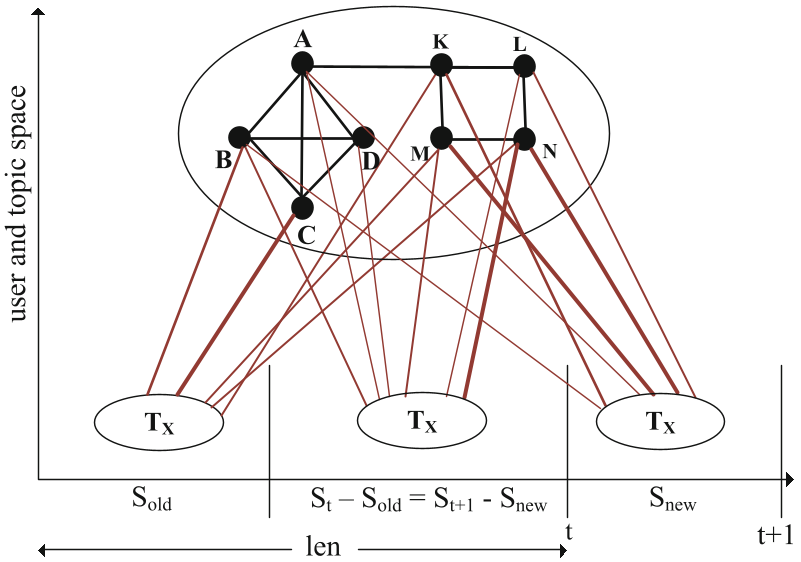
The IGM (Incremental Group Maintenance) algorithm allows the system to update groups by only looking at local changes—new active users joining or old ones falling below the threshold—rather than re-scanning the entire graph of millions of users.
Experimental Insights
The researchers tested their approach on the massive SNAP dataset (467 million tweets).
The Speed Advantage
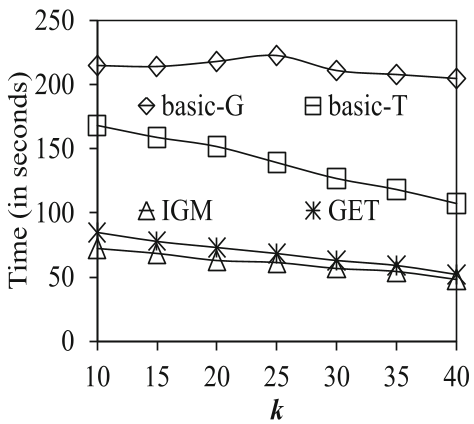
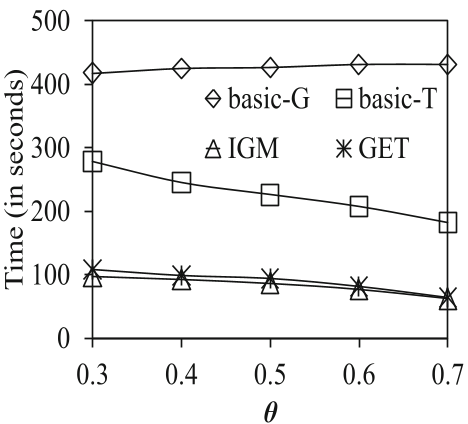
The index-based methods (IGM and GET) showed a massive performance lead over the basic-G baseline. While basic-G struggles with repeated DFS operations on the whole graph, IGM stays efficient by traversing the pre-built CL-tree.
Visualizing Evolution
One of the most compelling parts of the study is the tracking of specific groups. For instance, they tracked a group during the 2009 Iran election. The group size spiked during the election, dipped, and then surged again when pop star Michael Jackson passed away—demonstrating how the same structural backbone of users shifts focus between topics.
Critical Perspective & Summary
Takeaway: This paper successfully bridges the gap between graph theory and temporal NLP. By treating "community" as a dynamic state rather than a static property, it opens doors for more responsive social listening tools.
Limitations: While powerful, the method relies heavily on the choice of the decay factor and the threshold . A "one-size-fits-all" parameter set might not work for both slow-moving academic topics and fast-moving viral memes.
Future Work: The logical next step is exploring automatic parameter tuning, where the fading window adjusts its decay rate based on the "velocity" of the topic stream itself.