
Beyond Sentiment: Automated Emotion Discovery in Tourism UGC
Discovery and Classification of the Underlying Emotions in the User Generated Content (UGC)
This paper presents an automated framework for the discovery and classification of emotions in User Generated Content (UGC), specifically focusing on tourism-related Twitter data. It introduces an ad-hoc software pipeline that integrates Natural Language Processing (NLP) with the WordNet-Affect ontology and assesses results against the structural frameworks of Plutchik and Parrot.
TL;DR
Social media is an emotional goldmine, yet most tools only scratch the surface with "Positive vs. Negative" sentiment analysis. This paper introduces an automated pipeline that moves beyond simple polarity, using the WordNet-Affect ontology and psychological frameworks (Plutchik/Parrot) to identify fine-grained emotions in Twitter data. By analyzing holiday hashtags, the authors prove that "Happy" is just the tip of the iceberg, revealing deeper layers like "Humility," "Calmness," and "Hopefulness."
The Granularity Gap in Affective Computing
In the tourism industry, understanding the tourist's experience is the "Holy Grail" of marketing. However, existing Natural Language Processing (NLP) methods often fall short when dealing with the chaotic nature of User Generated Content (UGC). The researchers identify a significant gap: while we have advanced facial and voice recognition for emotions, textual analysis remains a "fresh and hot" area fraught with ambiguity. Most prior works oversimplify human emotion into six basic categories (Ekman’s model), ignoring the 146+ tertiary nuances that actually define a travel experience.
Methodology: The "Ad-Hoc" Intelligence Pipeline
The authors developed a four-phase methodology to turn raw tweets into actionable emotional intelligence:
- Data Acquisition & Normalization: Using the Google API for language detection and Aspell for spell-checking. This is crucial because tweets are littered with abbreviations and localisms that traditional dictionaries miss.
- Morphosyntactic Labeling: Utilizing FreeLing 3.0 to identify nouns and adjectives.
- Semantic Mapping (The Core): This is the highlight of the methodology. If an adjective like "sad" is found, the system uses WordNet to convert it to the noun "sadness" to match the WordNet-Affect ontology. It also uses synonym logic (Synsets) to map words like "felicity" to "happiness," and subsequently to the primary emotion, "Joy."
- Taxonomic Classification: Results are mapped across three competing frameworks: WordNet-Affect, Parrot’s tree-structured list, and Plutchik’s famous wheel.
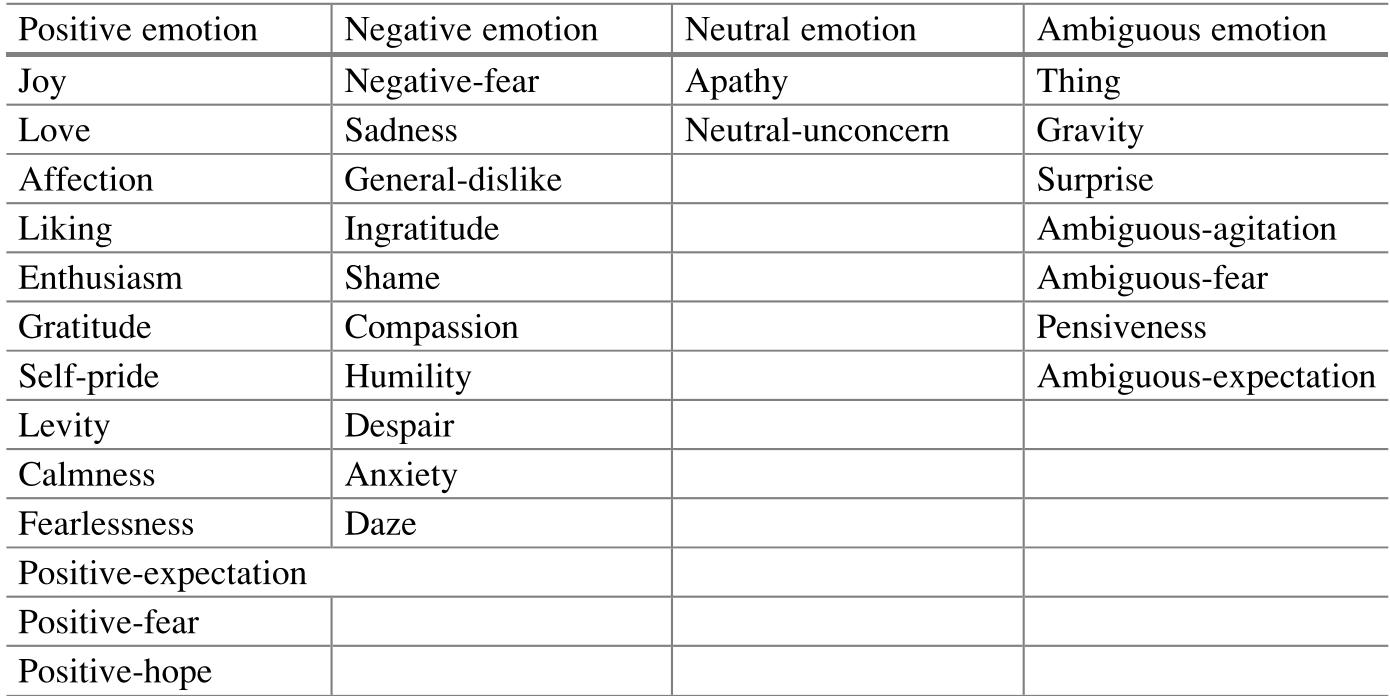 Table: Categorization of emotions across Positive, Negative, Neutral, and Ambiguous valences.
Case Study: Easter vs. Summer
The study analyzed two distinct holiday periods: #SemanaSanta (Easter) and #vacaciones (Summer). The contrast was stark:
- #SemanaSanta: Dominated by spiritual and complex emotions like Hope, Humility, Respect, and Caring.
- #vacaciones: Characterized by Relaxation, Calmness, and Pleasure.
The intervention of the software is clear when looking at the result tables. For instance, the system identified "Passion" as a synonym for "Love" and "Wish" as a bridge to "Affection."
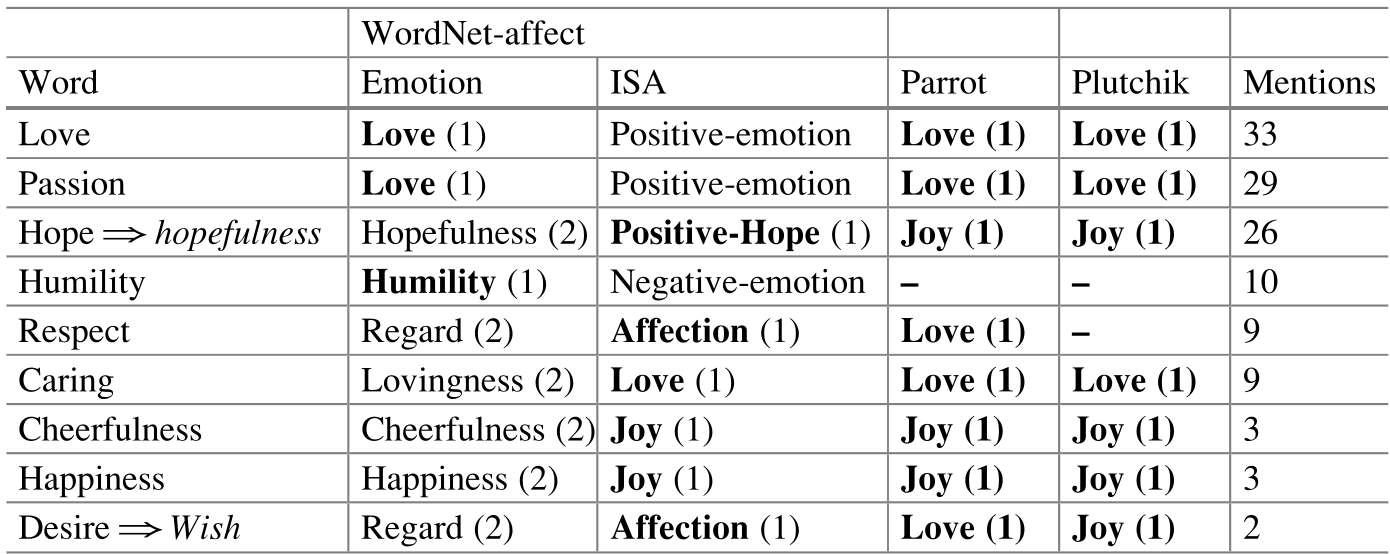 Table: Comparison of terms like 'Passion' and 'Humility' against traditional Plutchik and Parrot models.
Critical Insight: The "Wheel" is Not Enough
One of the paper’s most provocative conclusions is that standard psychological models like Plutchik’s Wheel—while visionary—are actually insufficient for tourism. As shown in the results, Plutchik and Parrot models lacked categories for "Calmness" and "Humility," which were prevalent in the analyzed UGC. This suggests that "Affective Computing" in niche industries like tourism requires a specialized, ad-hoc ontology rather than a "one-size-fits-all" psychological framework.
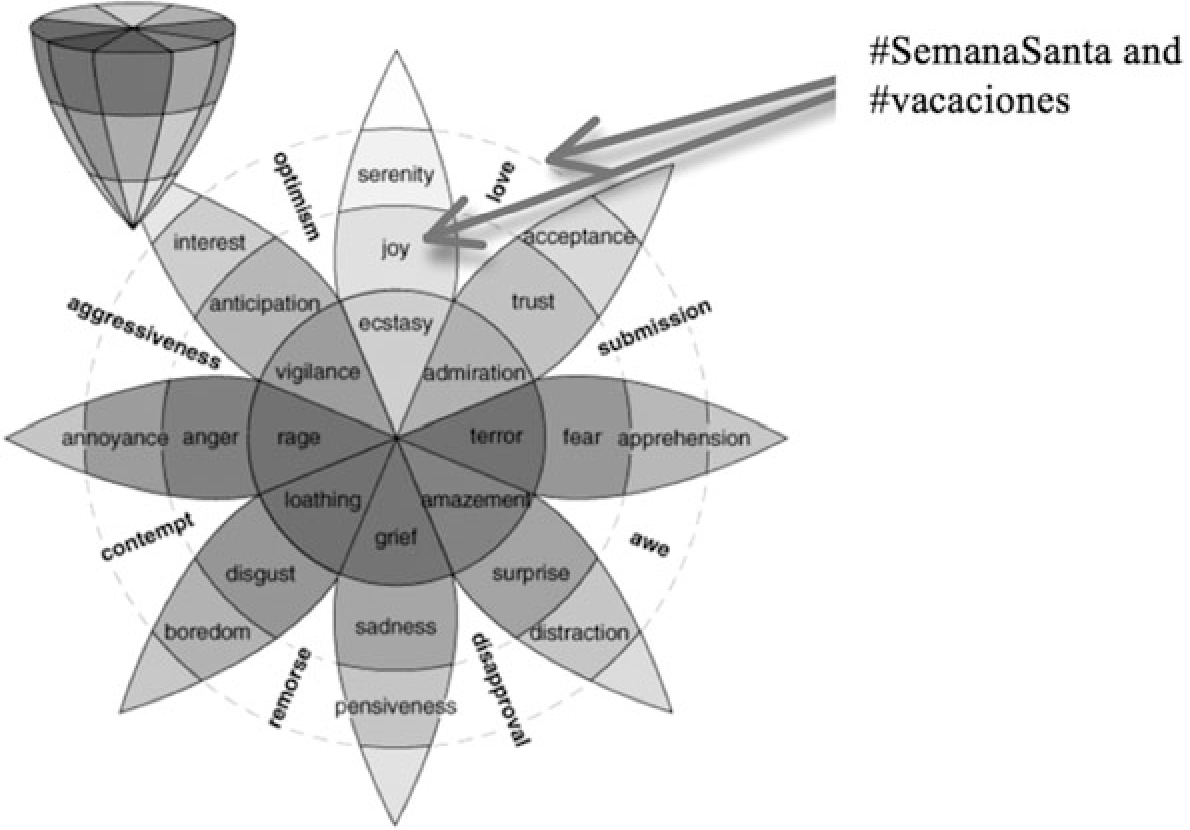 Figure: The classical Plutchik model, which the authors argue needs enrichment for tourism contexts.
Conclusion and Future Outlook
The study successfully validates a scalable way to automate the "Data Curation" of human feelings. While currently effective for English and Spanish, the future lies in multi-language modules and the integration of mood dimensions to predict market movements (like stock indices or destination popularity). For industry practitioners, the message is clear: if you are only looking at "Sentiment," you are missing the most valuable nuances of the customer experience.