
Unilateral Influence: How to Conquer Directed Networks with Only 50% Effort
Discrete Applied Mathematics
This paper explores "dynamic monopolies" in directed graphs, a mathematical framework for modeling the irreversible spread of unilateral influence (e.g., opinions or diseases) in social networks. The authors prove that for any simple directed graph where every vertex has an in-degree of at least one, a strict majority dynamic monopoly exists with a size of at most ⌊n/2⌋, significantly improving previous bounds.
TL;DR
In the study of social networks, we often assume influence is a two-way street. But what happens when influence is one-sided? This paper, "Dynamic Monopolies in Directed Graphs," provides a breakthrough proof: in any directed network where every person listens to at least one other, you only need to "convert" at most 50% of the nodes to eventually influence the entire network under a strict majority rule.
The work moves the needle from previous bounds of 66% or 77% down to a clean 50%, providing both a theoretical guarantee and a practical polynomial-time algorithm to find these critical seed sets.
The Problem: The Asymmetry of Influence
Most classical models for the "Target Set Selection" problem—essentially, finding the smallest group of people to start a trend—rely on undirected graphs. They assume that if Alice influences Bob, Bob influences Alice back.
In reality, influence is often a Directed Acyclic Graph (DAG) or a series of Strongly Connected Components. A celebrity influences a fan, but the fan rarely influences the celebrity. This "unilateral influence" makes the math significantly harder. The problem of finding the smallest such set is NP-hard, meaning we cannot find the absolute minimum in a reasonable time for large networks. Thus, finding tight "upper bounds" (guarantees) is the holy grail for researchers.
Methodology: The Power of Ordering
The researchers' secret weapon is the concept of vertex ordering (). By arranging the vertices in a specific sequence, they define an -value for each node:
In plain English: The -value measures how many "un-activated" neighbors a node has later in the sequence versus "activated" neighbors earlier in the sequence.
 The image shows the typical visualization of directed widget constructions used to prove complexity results.
The Induction Logic
The authors prove that for any Strongly Connected Graph, there exists an order where almost every node has a non-zero -value. By splitting nodes into those with positive and negative -values, they guarantee that one of these sets—by definition no larger than —can act as the "spark" that sets off the entire network.
Key Results: Breaking the 50% Barrier
The core contribution is Theorem 10, which states that for any simple directed graph with vertices:
- Strict Majority Threshold: .
- Result: Smallest dynamic monopoly .
This is a massive improvement over the work of Chang and Lyuu (2009), who previously held the record at roughly 0.77n and later 0.66n.
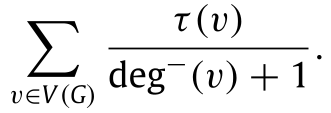 The general bound for arbitrary thresholds provided by the authors as a baseline for comparison.
Algorithmic Efficiency
While finding the absolute minimum seed set is NP-hard, the authors provide a polynomial-time algorithm to find a seed set that satisfies the bound. This makes the research immediately applicable to large-scale network analysis where might be in the millions.
Critical Analysis: Is 50% the Limit?
The authors don't stop at 50%. They pose a provocative question: Could the bound actually be lower?
By analyzing a 2-regular directed complete graph on 5 vertices, they demonstrate a case where the ratio is 2/5 (40%). They hypothesize that 40% (2n/5) might be the true universal upper bound for simple directed graphs.
Limitations:
- Simple Graphs Only: The bound fails for "multiple directed graphs" (where multiple edges can exist between two nodes). In a complete reciprocal directed graph, you might still need .
- Irreversibility: The model assumes once a node is "active," it stays active. In real social dynamics, people often change their minds back (reversible influence), which this model does not cover.
Conclusion
This paper provides a rigorous mathematical foundation for unilateral influence. It settles a long-standing quest for a bound in directed Target Set Selection and offers a robust algorithm for identifying influential "Monopolies" in social structures. For anyone working in epidemiology, social media marketing, or network resilience, it provides the definitive "worst-case" insurance policy: you never need more than half the nodes to win the whole graph.