
Rethinking Structural Balance: Why the "Enemy of my Enemy" is Not Always a Friend
Discrete Applied Mathematics
This paper presents a fundamental rethinking of structural balance in signed social networks, introducing a new axiomatic framework and an index labeled "K" for quantifying the degree of balance. The research challenges the traditional triad-only focus by incorporating cycles of all lengths and backtracking walks, successfully identifying historical shifts in international relations from 1938 to 2008 where traditional measures failed.
Executive Summary
TL;DR: This paper provides a rigorous mathematical overhaul of how we measure stability in social systems. By moving beyond simple triangles and embracing the physics of consensus dynamics, the author proves that international relations are fundamentally "unbalanced" and that historical volatility is better explained by global walk-based metrics than by traditional triad-counting.
Context: This work acts as a significant "theoretical correction" in the field of Network Science, bridging the gap between social psychology (Heider) and spectral graph theory to solve long-standing contradictions in geopolitical data analysis.
The Problem: The Triad Trap
Since the 1940s, social scientists have relied on Heider’s balance theory: "A friend of a friend is a friend; an enemy of an enemy is a friend." Mathematically, this meant looking at cycles of length 3. If a triangle has an even number of negative edges, it's "balanced."
However, the author argues that this is fundamentally incomplete:
- Scale: Why should a cycle of length 3 matter but a cycle of length 4 be ignored?
- Acyclic Tension: Traditional theory says a tree (no cycles) has no balance/imbalance. Intuition says a single negative edge between two people still creates a "dyadic" state that matters.
- The Multi-Faction Reality: In real-world datasets (like Wikipedia or Epinions), "all-negative" triangles are overrepresented. Traditional theory calls this "unstable," but in reality, it may represent a stable 3-way standoff (tripartite structure).
Methodology: From Structure to Dynamics
The author’s key insight is to treat balance as a Consensus Process.
1. The Edge Completion Intuition
The author proposes that any network is "balanced" if it can be evolved into a complete graph where every triangle is balanced. This allows the extension of balance definitions from simple cycles to the entire graph topology.
2. The Consensus Model (Altafini Dynamics)
Imagine nodes exchanging opinions. In a balanced network, the system reaches a "bipartite consensus"—two groups with opposite but stable opinions. In an imbalanced system, opinions eventually decay to zero (neutrality/collapse). Where is the signed Laplacian.
3. The K-Index: Capturing the "Global Walk"
Instead of counting triangles, the author uses the Matrix Exponential of the adjacency matrix. This counts all possible walks between nodes.
- Backtracking Walks: Information going from A to B and back to A () represents a "trivial" cycle.
- Weighting: The index naturally gives more weight to shorter walks (immediate neighbors) than long, distant cycles.
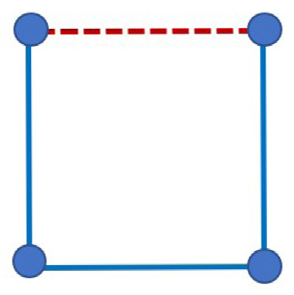 Figure: The author demonstrates how even squares (cycles of length 4) follow the even-negative-edge rule for balance.
Experiments: 70 Years of Global Conflict
The paper applies the index to a dataset of international alliances and wars from 1938 to 2008.
Key Findings:
- The Failure of Triads: A triad-only index () suggested that the world is becoming more balanced over time. This is a false positive caused by ignoring larger structural tensions.
- The Truth of Imbalance: The index shows the world is consistently imbalanced ( to ). There is no "trend" toward peace; rather, the system oscillates.
- Sensitivity to History: The index plummeted during WWII, the Korean War, and the Vietnam War, whereas triad measures were "blind" to the systemic tension of the Iraq-Iran and Gulf Wars.
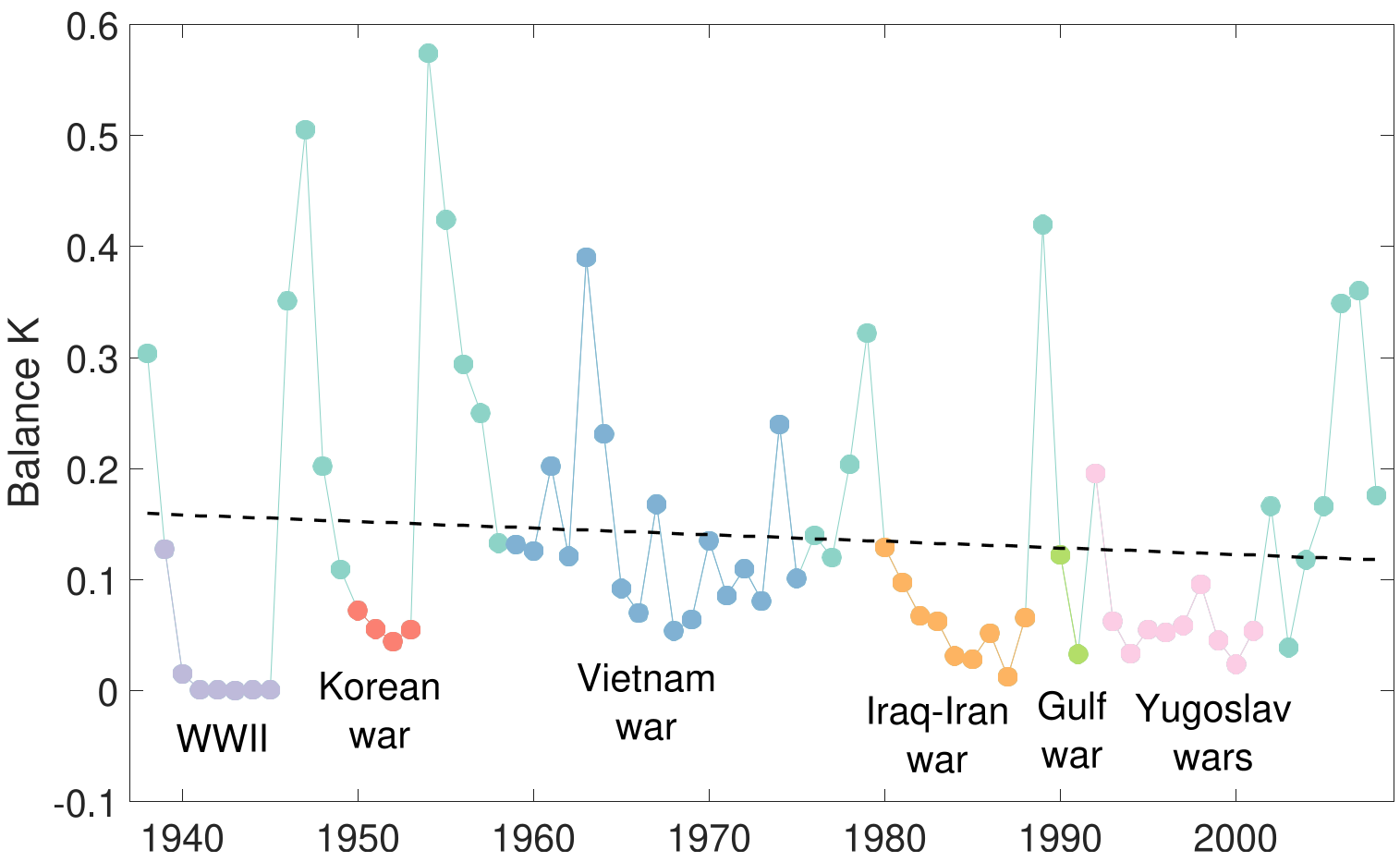 Figure: The K-index accurately maps the "Valleys of Imbalance" to major historical wars.
Critical Insight: Effort vs. Balance
A major contribution is the critique of Null Models. Modern researchers often say a network is "significantly balanced" because it is more balanced than a random shuffle of its edges.
The author argues this is a category error. If a network has a value of 0.1, it is imbalanced, period. Comparing it to a null model doesn't make it "balanced"—it just means the "effort" required to reach that state was lower than random. We must distinguish between the absolute state of a system and its statistical surprise.
Conclusion
This paper serves as a warning against using "rules of thumb" like triad-counting in high-stakes social analysis. Structural balance is a global property driven by the flow of information. For practitioners in AI and Social Analytics, the takeaway is clear: proximity matters. Imbalanced clusters that are "close" in the graph generate exponentially more tension than those far apart.
Future Work: The author suggests applying these multi-partite insights to biological or chemical signed networks, where "balance" might follow entirely different physical principles.