
Hybrid Modeling of Health Career Paths: Integrating Discrete Choice, ABM, and System Dynamics
Discrete choice, agent based and system dynamics simulation of health profession career paths
This paper introduces a hybrid simulation framework that integrates Discrete Choice Experiments (DCE), Agent-Based Modeling (ABM), and System Dynamics (SD) to model health professional career paths. Applied specifically to the optometry workforce in Australia, the method uses Random Utility Theory (RUT) to quantify individual preferences and embed them into a dynamic system model.
TL;DR
This research tackles the complexity of the healthcare workforce—specifically optometry in Australia—by combining three distinct methodologies. By nesting Discrete Choice Experiments (DCE) within a hybrid Agent-Based (ABM) and System Dynamics (SD) framework, the authors move from aggregate "stocks and flows" to a nuanced model of individual decision-making based on Random Utility Theory (RUT).
Context & Motivation: Why Top-Down Models Fail
Workforce planning is often treated as a plumbing problem: how many "units" enter the pipe (students) and how many exit (retirees). However, the human element is notoriously non-linear. Top-down System Dynamics models are excellent at capturing delays and feedback loops in population demand but ignore individual agency.
The authors argue that we need to understand the utility practitioners derive from their choices. Why does a graduate choose a metro job over a rural one? It isn't just about the "average" salary; it's about a heterogeneous mix of preferences regarding work-life balance, location, and professional autonomy.
Methodology: The Triple-Hybrid Architecture
The researchers break down the career path into three critical nodes:
- Node 1: Decision to enter training.
- Node 2: Graduation and entering the profession (The primary focus of this paper).
- Node 3: Permanent exit (retirement or career change).
1. The Decision Engine (DCE & RUT)
Instead of assuming agents act like simple automatons, the model uses Random Utility Theory. The probability of an agent choosing an option is calculated using the Logit formula:
This allows the model to simulate how an agent weighs factors like salary vs. relocation distance.
2. The Simulation Framework (ABM & SD)
- System Dynamics: Used at the state level to provide crude estimates of population-driven demand for eye care.
- Agent-Based Modeling: Represents individual optometrists with unique attributes (age, gender, marital status, proficiency).
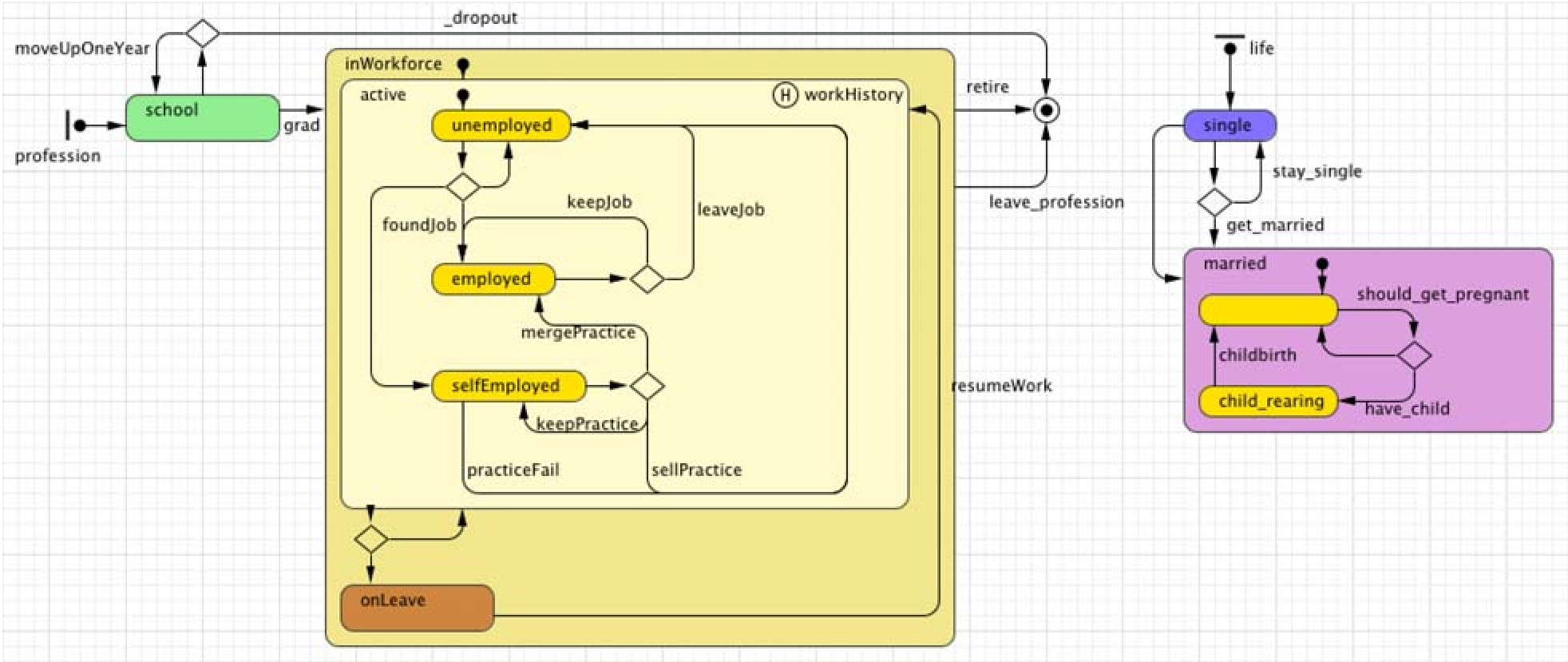 Figure: The state chart representing the career lifecycle within the AnyLogic framework.
Key Insights from the Proof of Concept
The model reveals that "low overall predictive power" in traditional models often stems from concealed heterogeneity. By allowing agents to have different preference weights ( values), the simulation can replicate complex behaviors:
- Job Choice: An unemployed optometrist evaluates three paths: apply for a job, start a practice, or stay idle.
- Probabilistic Outcomes: In one scenario, the model calculated a 67% likelihood of job application vs. a 29% "do nothing" rate, directly tied to the latent utility of available job attributes.
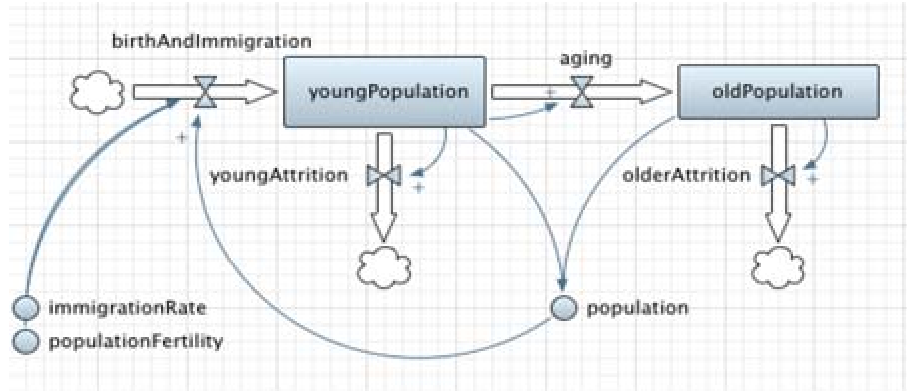 Figure: The SD component managing the macro-level demand within each Australian state.
Critical Analysis & Future Outlook
While the "Triple-Hybrid" approach is conceptually robust, the authors acknowledge several limitations:
- Static Preferences: Currently, agent preferences don't evolve (e.g., a "young" preference for salary doesn't shift to a "family" preference for stability within the current iteration).
- Information Symmetry: Agents are assumed to have "perfect knowledge" of all jobs, which is rarely true in real labor markets.
Takeaway: This work represents a significant step toward Evidence-Based Policy Simulation. By grounding agent behavior in empirical DCE data rather than theoretical assumptions, policymakers can finally test "what-if" scenarios—like rural subsidies or changes in university quotas—with a higher degree of behavioral realism.
Conclusion
The integration of DCE into dynamic models allows us to bridge the gap between "Structure" (the system) and "Agency" (the individual). As the model incorporates more empirical demographics and learning effects, it will serve as a powerful tool for optimizing health professional training and distribution.