
FlowPlace: Leveraging Discretized Network Flow for Optimal Incremental Placement
Discretized Network Flow Techniques for Timing and Wire-Length Driven Incremental Placement With White-Space Satisfaction
FlowPlace is a novel incremental placement methodology for standard-cell circuits that utilizes discretized network flow techniques to reduce critical path delays. The framework integrates a timing-driven analytical global placer (TAN) with a network-flow-based detailed placer (DFP) to optimize timing and wire-length while strictly satisfying white-space constraints.
TL;DR
Incremental placement is the "last mile" of timing closure in VLSI design. FlowPlace introduces a breakthrough methodology using discretized min-cost network flow to optimize timing and wire-length (WL) simultaneously. It achieves up to 33.4% delay reduction with minimal WL overhead, operating at nearly 10x the speed of traditional placers.
Background & Motivation: The Timing Closure Gap
In the Very Deep Sub-Micrometer (VDSM) era, interconnect delay dominates gate delay. Once a circuit is placed, "fixing" timing violations usually involves Engineering Change Orders (ECO). Traditional methods either use Simulated Annealing (too slow) or Linear Programming (too simplistic).
The authors identified a fundamental gap: how to move cells to improve timing without creating new overlaps, violating row-width constraints, or exploding the total wire length? Their "Insight" was to map physical cell movement to fluid flow in a graph, but with a critical twist: physics is continuous, but placement is discrete.
Methodology: The FlowPlace Framework
The system follows a two-stage pipeline: Analytical Global Placement (TAN) followed by Detailed Flow-based Placement (DFP).
1. Accurate Timing Estimation (The -Delay Model)
Before moving cells, you must know how it impacts delay. FlowPlace uses a custom "-delay model" for unrouted nets that estimates Elmore delay by assuming a single trunk routing pattern. This model achieves 5.6% error compared to actual routed delays, far outperforming standard HPBB models.
2. Discretized Network Flow (The Core)
The Detailed Placer (DFP) constructs a graph where:
- Nodes represent cells or white space.
- Arcs represent possible movements (up, down, left, right).
- Costs are derived from timing sensitivity and probabilistic wire-length changes.
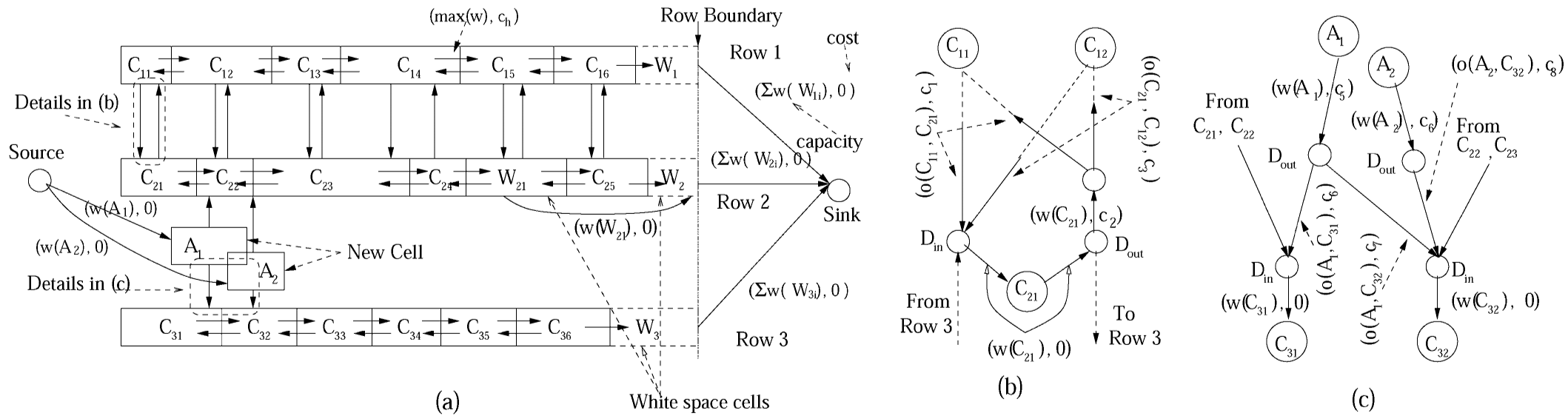 Figure 1: The Basic Network Flow Graph. Source and sink nodes drive movement "pressure" to legal row positions.
3. Solving the "Discrete" Problem
Network flow is naturally continuous—you can send 0.5 units of "flow." But you can't move 0.5 of a cell. The authors introduced Flow Discretization:
- Vertical Arcs: Forcing flow to be binary (0 or cell width) so cells land exactly in rows.
- Max-Flow Heuristic: If a cell's flow "splits" in multiple directions, the algorithm chooses the strongest branch to prevent illegal overlaps.
Experiments: Superior Timing with Small WL Impact
The researchers tested FlowPlace on benchmarks with up to 210,000 cells.
| Benchmark Set | Delay Improvement | WL Deterioration | Runtime |
|---|---|---|---|
| Initial (WL-Optimized) | 17.3% | 9.0% | Fast |
| Combined Cost Mode | 15.7% | 5.8% | Fast |
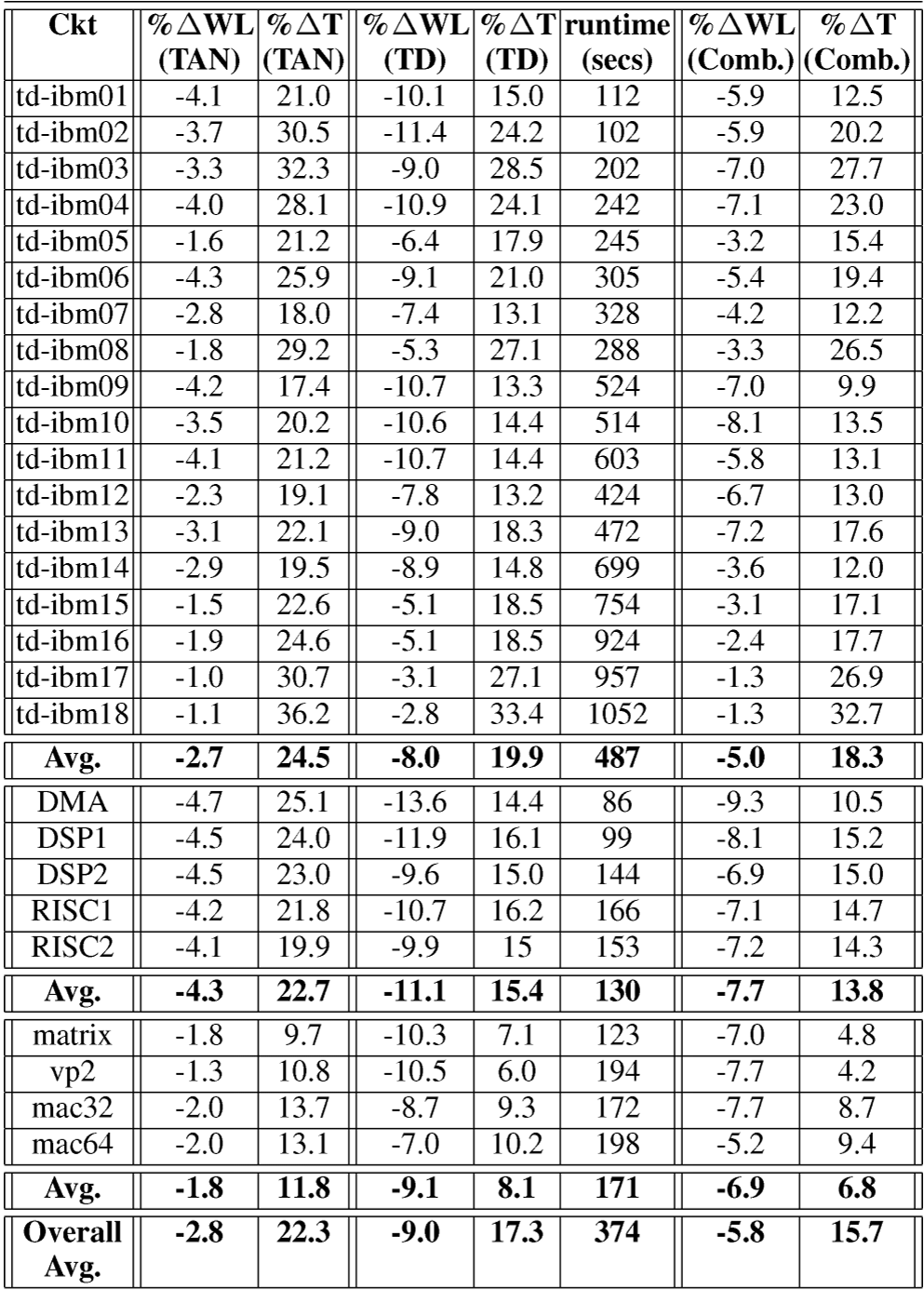 Figure 2: Performance metrics across IBM and Faraday benchmarks showing the efficacy of the Combined Cost approach.
The results show that using a Probabilistic WL Cost (calculating the likelihood of a net's bounding box changing as multiple cells shift) allows the tool to fix timing without ruining the overall routability of the chip.
Critical Insight & Conclusion
FlowPlace's brilliance lies in its White Space Satisfaction policy. By dynamically tracking row capacities during flow augmentation and using "Thrashing Control," it ensures the final placement is 100% legal.
Takeaway: This work proves that network flow is not just for "toy" problems but is a highly scalable engine for VDSM placement. The ability to model timing sensitivity directly into arc costs allows for a level of precision that traditional partition-based placers cannot match.
Limitations: While powerful, the method relies on a high-quality initial placement. It is an "improver," not an "originator." Future work could extend this to thermal-aware or power-aware incremental movements.