
DF2BERT: Bridging Statistical Lexicons and Transformers for Enhanced Social Sentiment Analysis
Discriminative Features Fusion with BERT for Social Sentiment Analysis
The paper introduces DF2BERT (Discriminative Features Fusion with BERT), a hybrid sentiment analysis model that fuses BERT's contextual embeddings with statistical hand-crafted features. It achieves SOTA performance on both English (IMDB) and Chinese (PTT) datasets by combining deep learning with the Log-Likelihood Ratio (LLR) feature selection method.
TL;DR
DF2BERT is a hybrid sentiment analysis framework that combines the semantic power of BERT with the discriminative precision of Log-Likelihood Ratio (LLR) feature selection. By fusing deep contextual embeddings with hand-picked sentiment lexicons, the model achieves superior accuracy on both English and Chinese social media datasets, particularly excelling where standard neural networks struggle with noise.
Problem & Motivation: The "Hidden" Intent in Social Text
Traditional sentiment analysis often focuses on the author's intent. However, social media sentiment is nuanced; a neutral-sounding headline ("Crude oil prices rise 0.5%") can trigger intense emotional responses in readers.
The authors identify two major pain points:
- Noise Features: Standard models can be easily distracted by words that increase classification error but appear frequently.
- Order and Context: While RNNs struggle with long-term dependencies and word order, Transformers like BERT solve this but may still lack the explicit "emotional weight" that specific technical lexicons provide.
The research intuition is simple yet powerful: Deep learning provides the context, but statistical feature selection provides the anchor.
Methodology: The Fusion of Two Worlds
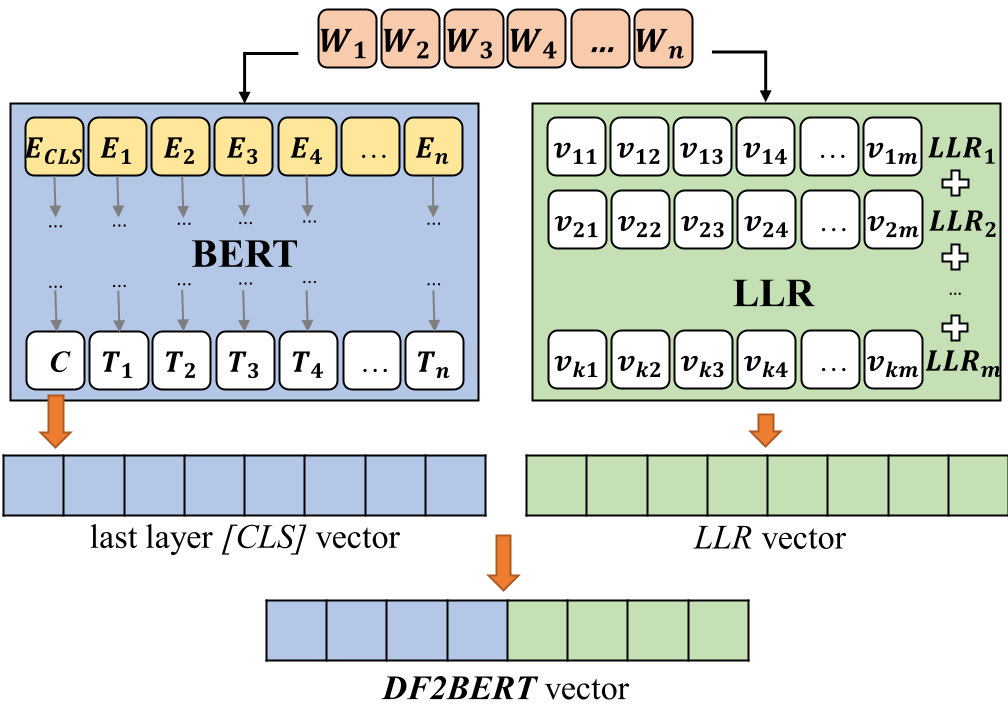
The architecture of DF2BERT revolves around a dual-stream information fusion.
1. Contextual Representation (BERT)
The model utilizes the BERT (RoBERTa pre-training) architecture. It takes the input sequence and extracts the [CLS] token from the final hidden layer—a 768-dimensional vector that serves as a summary of the entire sentence's semantics.
2. Discriminative Feature Selection (LLR)
To filter out noise, the authors use the Log-Likelihood Ratio (LLR). This statistical method calculates the likelihood that a specific word (lexicon) is not randomly appearing but is strongly associated with a specific sentiment (Positive/Negative).
3. Feature Fusion
The "magic" happens at the output layer. The 768-dim BERT vector is concatenated with a vector representing the top 70 LLR-selected features. This combined vector is then fed into the final classification layer.
Experiments & Results
The model was validated against 10 well-known methods, ranging from traditional Baselines (NB, SVM, Random Forest) to Deep Learning (CNN, LSTM, BERT).
Performance Highlights:
- IMDB (English): DF2BERT achieved 93.5%, surpassing pure BERT (93.2%) and leaving LSTM (85.4%) far behind.
- PTT (Chinese): In a smaller, more challenging dataset, DF2BERT reached 88.2%, demonstrating that the LLR features help the model converge better even with limited training data.

Ablation Insight: The authors found that using exactly 70 extracted features provided the optimal balance. Adding more features (e.g., 200) actually introduced noise and degraded performance, validating their theory on "noise feature elimination."
Critical Analysis & Conclusion
Takeaway
DF2BERT proves that Feature Engineering is not dead in the age of Transformers. For specific domains like social media sentiment, "priming" a large model with statistically significant keywords can provide the necessary edge to handle linguistic variability.
Limitations & Future Work
While effective, the current fusion method is a simple concatenation. Future iterations could explore:
- Syntactic Dependency: Incorporating how words relate grammatically, not just their frequency.
- Cross-Domain Application: Testing if LLR features from one domain (movies) can help another (finance).
In conclusion, DF2BERT is a robust, language-independent solution that points towards a "best of both worlds" approach in NLP—combining high-level semantic understanding with low-level statistical reliability.